Pet shop chatbot: grooming bookings, vaccine reminders and delivery
How to use a pet shop chatbot on WhatsApp: grooming requests, opt-in vaccine and reorder reminders, pet food delivery and where AI must stop at the veterinary clinic.
TL;DR
A pet shop chatbot is an agent on WhatsApp that takes grooming requests, answers questions about products and services, records delivery orders and sends vaccine and reorder reminders to owners who opted in. At the veterinary clinic, it handles admin work and never diagnoses: symptoms and emergencies go to the veterinarian, because clinical practice is reserved by law to veterinarians.
Share
A pet owner messages at 22:15: "any grooming slots on Saturday?". Another asks whether the 33 lb bag of food can arrive today, and a third says the dog has been vomiting since the afternoon. At a pet shop, WhatsApp mixes bookings, sales and, sometimes, emergencies, and the staff doing the grooming are the same people answering the phone.
A pet shop chatbot organizes that queue: it takes the grooming request with everything the groomer needs to know, answers product questions, records delivery orders and sends vaccine reminders on the right date. And when a message mentions a symptom, it passes it to a person right away. This guide shows how to set up each part and where AI should stop.
Updated November 2026.
What is a pet shop chatbot?
A pet shop chatbot is a customer service agent, ideally AI-powered, that talks with pet owners on WhatsApp and your website about grooming, products, delivery, vaccines and clinic services, records requests and reminders in each pet's profile and hands anything that needs a human decision to the team. It uses the information the store provides: services, prices, hours, delivery area and rules.
It works for the neighborhood pet shop, the chain with several locations and the veterinary clinic with a store. The difference from a menu bot is that owners write in their own words ("I want to book a bath for Mel, she's a shih tzu") and the agent understands without asking them to press 1, 2 or 3. If you are just starting, the guide to WhatsApp chatbots for small businesses covers the first steps.
What do pet owners ask and what does the chatbot handle?
Most pet shop messages are about grooming slots, prices, products, delivery and vaccines, and the chatbot handles those on its own; symptoms, complaints and exceptions go to a person. The table shows a starting split.
| Topic | What the chatbot does | When it goes to a person |
|---|---|---|
| Grooming | Collects pet, size, coat type, service and preferred time | Pets with difficult behavior or special grooming requests |
| Service prices | Shares the price list by size and coat type | Package quotes or discounts |
| Products and food | Answers from the catalog and suggests listed options | Recommendations for pets with health restrictions |
| Delivery | Takes the order, confirms address and delivery area | Outside the area or urgent orders |
| Vaccines and deworming | Explains services and records the reminder with permission | Questions about the pet's vaccination schedule |
| Symptom or emergency | Sends the safety message and alerts the team right away | Always |
The key is the last row: AI does not assess symptoms. More on that below.
How do grooming requests work through the chatbot?
For grooming, the chatbot collects everything the team needs to fit the pet into the schedule, suggests the open slots the store provided and leaves final confirmation to the team or to an integrated calendar. That way nobody shows up for a grooming that doesn't fit in the day.


Information worth asking for in the conversation:
- The pet's name, species and breed, and whether they are already a customer.
- Size and coat type, which set time and price.
- Service: bath, sanitary trim, full grooming, conditioning, nail trim.
- Behavior and care notes: senior pet, anxious with the dryer, allergic to a product.
- Pickup and drop-off, when the store offers it, with address and time window.
- Preferred day and time of day.
With that data, the agent presents options and records the request. Confirmation can follow two paths: the team checks the calendar it already uses and confirms in the conversation, or, with an integrated calendar (such as Google Calendar through a flow), the agreed time becomes an event. The day before, a reminder reduces no-shows, and the owner replies "confirmed" or "I need to reschedule" in the same thread.
An illustrative example: "Hi, Mel is a small shih tzu with a long coat. Would you like a bath with a sanitary trim on Saturday morning? We have 9:00 and 10:30. Is she usually calm with the dryer?".
How do you send vaccine and reorder reminders on WhatsApp?
Reminders for vaccines, deworming, flea treatment and food reorders work well on WhatsApp when the owner has opted in, the message is an approved template and the date comes from the pet's profile. Without permission, a reminder becomes spam and hurts your number.


Three rules to get it right:
- Clear opt-in. Ask in the conversation or at the counter: "would you like a reminder here for Mel's next vaccine?". Record the answer in the profile. The glossary explains opt-in, and the WhatsApp Business Messaging Policy requires honoring every request to stop (checked November 23, 2026).
- The right template. Outside the 24-hour window, only Meta-approved templates. A notice tied to a service the owner already arranged tends to be a utility message; a product offer is a marketing message. Meta decides the category at approval, and each category has its own price.
- Dates from the profile, not guesses. The vaccine reminder uses the date the clinic recorded. The food reminder uses the bag size and last purchase date, and asks before sending ("Mel's food may be running low, want me to set aside another bag?").
The full rules for templates and categories are in the guide to the 24-hour window, templates and campaigns.
How does the chatbot handle pet food and product delivery?
For delivery, the chatbot confirms the product, quantity, address and delivery area, gives the delivery time and sends the store's payment method, and the team packs the order. For reorders, it uses the history: "the same 33 lb bag as last time?".
What to set up first:
- A catalog with brands, sizes and prices, or an integration with the store's system for real-time price and stock.
- Delivery area by neighborhood or ZIP code, with the fee and the cutoff time for same-day delivery.
- Payment methods and the link the store uses.
Without integration, the agent doesn't know if the product is on the shelf: it records the order and the team confirms. With integration, it checks before promising. The logic is the same as a chatbot for e-commerce, at neighborhood scale.
Veterinary clinic: how far can AI go?
At a veterinary clinic, AI handles admin work (hours, prices, exam preparation, documents and reminders) and does not diagnose, prescribe or assess symptoms. In Brazil, Law No. 5,517/1968, article 5, reserves "the practice of clinical medicine in all its forms" to veterinarians (checked November 23, 2026). Other countries have similar rules; check yours.


In practice, this becomes three configuration rules:
- Safety message. When the owner mentions vomiting, bleeding, seizures, poisoning, being hit by a car or "not eating," the agent does not ask clinical questions: it replies with the text the responsible veterinarian approved (for example, the emergency phone number and the after-hours address) and alerts the team right away.
- No medication advice in chat. Questions about doses, human medicine or "can I give him ibuprofen?" go to the veterinarian. The agent does not take the risk.
- People in the loop. The handoff carries what the owner already wrote, so the team doesn't ask again. The guide to AI-to-human handoff has ready-made rules.
Owner data (name, phone, address) is personal data and falls under Brazil's LGPD: ask only for what you need, explain why and store it with access controls. Human health clinics have similar safeguards, described in conversational AI for healthcare clinics, which serve as a reference.
How do you set up a pet shop chatbot in five steps?
A pet shop chatbot goes live in five steps: list the most common questions, upload services and rules, define what goes to people, test with real conversations and only then promote it. This order avoids the classic mistake of launching before testing.
| Step | What to do | Done when |
|---|---|---|
| 1. Gather questions | Read a month of WhatsApp conversations and group the topics | The 10 most common topics are listed |
| 2. Build the knowledge base | Services, prices by size, hours, delivery area, policies | Every topic has a written answer |
| 3. Define handoffs | Symptoms, complaints, discounts and exceptions go to people | The veterinarian approved the safety message |
| 4. Test | Simulate owner conversations, including the hard ones | The agent rarely errs and hands off correctly |
| 5. Promote | WhatsApp link in your bio, on your website and at the counter | Staff know how to handle what gets handed off |
A WhatsApp link and a QR code at the counter help bring owners to the right channel.
How do you measure a pet shop chatbot?
Measure the chatbot by grooming slots filled, no-shows avoided with reminders, delivery orders and first response time, not by message volume. Compare with the month before the agent.
- Grooming requests that came through the conversation, including after hours.
- No-show rate, before and after the day-before reminder.
- Reorders generated by the food reminder.
- Vaccines up to date among owners who opted into reminders.
- Handed-off conversations and the reason, to improve the knowledge base.
Where does Tolky fit in a pet shop?
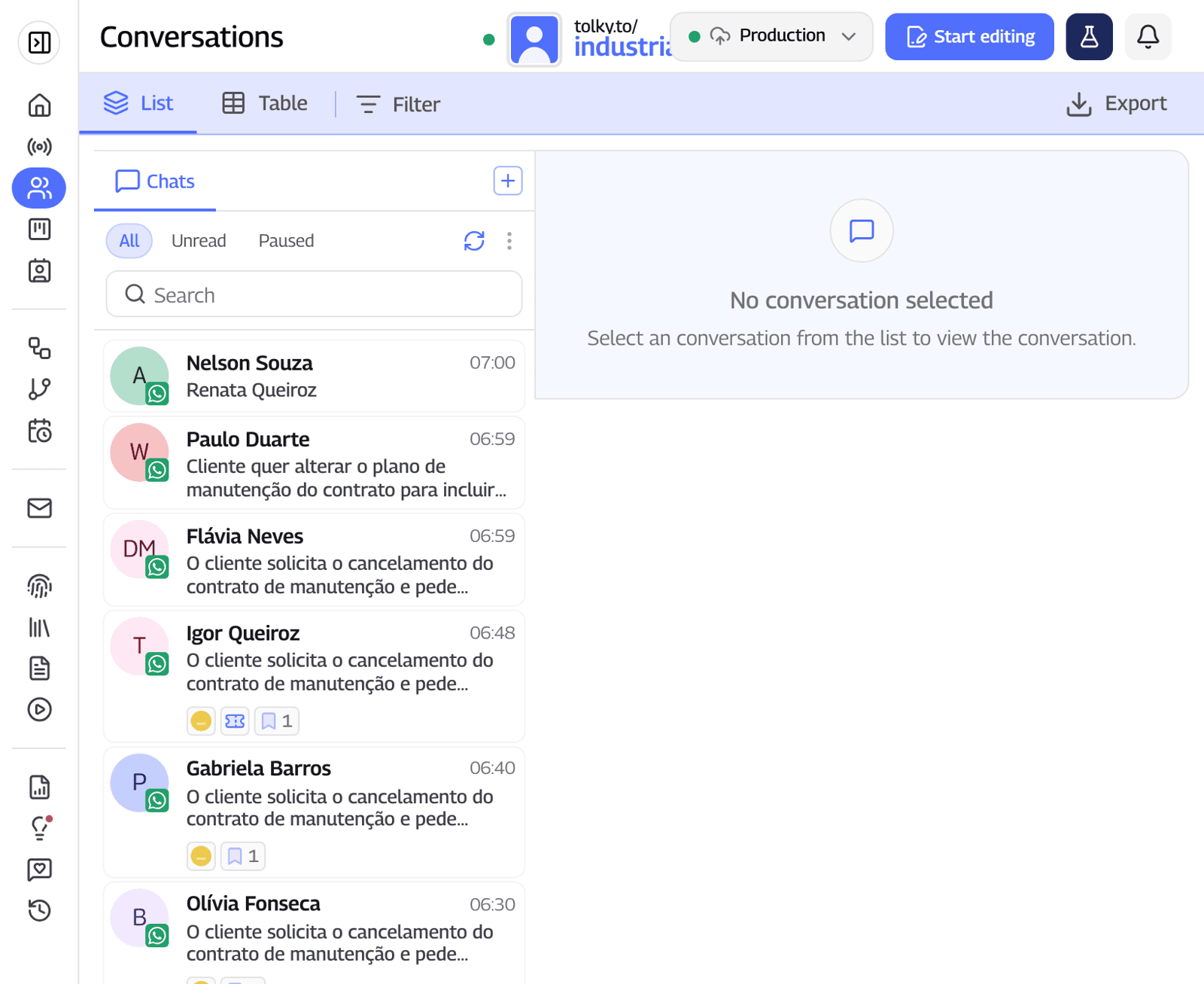
Tolky is an AI-powered conversational CRM: the AI agent works on official WhatsApp and on your website with the pet shop's services and rules, records every pet and request in the owner's history and hands off to the team with context.
- Customer service. An agent on WhatsApp customer service, with queues for the store, grooming and the clinic.
- Forms. The agent fills in pet and request details during the conversation, and forms marked as sensitive are encrypted.
- Scheduling. Tolky does not book slots in your calendar on its own: the AI collects the request and the team confirms. With the Google Calendar connector in Flows, the agreed time can become an event.
- Reminders. Text campaigns with approved templates for owners who opted in, with a conversation when they reply. There are also voice campaigns to confirm appointments by phone.
- History. Every owner in the CRM, with conversations and activities.
To start at no cost, there is the free Individual plan; campaigns are included from the Professional plan. See the plans.
What Tolky does not do: it is not pet shop or veterinary practice management software, it does not store medical records and it does not replace the veterinarian in any clinical decision.
Frequently asked questions
Can a pet shop chatbot book grooming appointments?
It collects the full request (pet, size, coat, service and preferred time) and presents the slots the store provided. Confirmation stays with the team or with an integrated calendar, and a day-before reminder reduces no-shows.
Can I send vaccine reminders on WhatsApp?
Yes, to owners who opted in, using a Meta-approved template when the message goes out after the 24-hour window. The date should come from the pet's profile, and anyone who asks to stop leaves the list.
Can AI answer questions about a pet's symptoms?
No. Assessing symptoms and recommending treatment is clinical practice, reserved to veterinarians. The agent replies with the clinic's safety message and alerts the team right away.
Does the chatbot take pet food delivery orders?
Yes. It confirms product, quantity, address and delivery area and sends the store's payment method. Without stock integration, the team confirms availability before packing.
Are food reorder reminders spam?
Not if the owner opted in and the message is useful and well timed. They become spam when sent to people who didn't ask, every week, or without a way to opt out.
How much does a pet shop chatbot cost?
It depends on the platform, conversation volume and Meta's template fees. With Tolky, you can start on the free Individual plan; the other plans are on plans and pricing.
Conclusion
A pet shop chatbot works when it organizes what repeats (grooming, delivery, reminders) and knows to stop where the clinic begins. Start with grooming requests, write the safety message with your veterinarian, ask permission before any reminder and measure the slots filled.
Explore WhatsApp customer service, see text campaigns, see the plans or talk to the team →. Let's talk?
Share
Tags
- pet shop chatbot
- whatsapp for pet shops
- pet store customer service
- dog grooming booking
- pet vaccine reminder
- veterinary clinic chatbot
- pet food delivery
- #conversational CRM
About the author

Co-founder of Tolky
Marlos Carmo is an AI entrepreneur and founder of Tolky, the conversational-era infrastructure and AI CRM that unifies intelligent service, multi-channel support (such as WhatsApp and voice), live CRM, and operational intelligence in a single ecosystem. He is a finalist for the SXSW Innovation Awards and a member of Francesco's Economy, a global network of young entrepreneurs focused on innovation and social impact. He works connecting Artificial Intelligence and digital transformation in projects for large organizations.
Next step
Want to bring this to your operation?
Tati, Tolky's AI assistant, understands your scenario in a few questions, suggests the best path and connects you with someone from the team, with full context.
Share