What is a chatbot? Types, examples and how it differs from AI agents
What a chatbot is, how it works, the four types (rule-based, intent-based, generative AI and AI agents), examples by team, channels, limits and how to measure if it really resolves.
TL;DR
A chatbot is a program that talks with people by text or voice to answer questions, collect information or complete simple tasks. There are four main types: rule-based or menu bots, intent-based (NLP) bots, generative AI bots and AI agents, which also look up data and take action in other systems. The right one depends on volume, how varied the questions are and how much the bot has to do beyond answering.
Share
Every business that gets a lot of messages ends up asking the same thing: can we answer some of them without a person typing every reply? The chatbot is the first answer that comes up, and also the most misunderstood one, because the same word covers everything from a "press 1" menu to an AI agent that checks orders and books appointments.
This guide explains the concept from scratch: origin, how it works, types, examples, channels, limits and how to measure whether it resolves anything. At the end, we show where Tolky, which wrote this guide, fits and where it does not.
Updated in November 2026.
What is a chatbot?
A chatbot is a computer program that talks with people, by text or voice, to answer questions, collect information or complete simple tasks, on channels such as a website, WhatsApp and messaging apps. The name combines "chat" and "bot" (robot). The short definition is also in the glossary: chatbot.


Three ideas separate a chatbot from other tools:
- It converses. The exchange happens in turns, like a dialogue, not like a form.
- It follows logic the business defines. That can be a fixed script, a list of intents or instructions for an AI model.
- It has limits. Any serious chatbot knows what it will not answer and where to send what falls outside its scope.
Where does the chatbot come from?
The first well-known chatbot is ELIZA, built by Joseph Weizenbaum at MIT and described in a January 1966 paper in Communications of the ACM (Weizenbaum, 1966). ELIZA's most famous script, called DOCTOR, imitated a therapist who turned the user's sentences back into questions.
ELIZA understood nothing: it looked for keywords in the sentence and applied transformation rules. Even so, many people attributed understanding to the program, a phenomenon later called the ELIZA effect. The lesson still holds: seeming to understand is not the same as solving the problem.
Decision trees came next, then intent recognition and, with large language models, AI-generated answers. The evolution of conversational AI tells that story in detail.
How does a chatbot work?
A chatbot works in five steps: it receives the message, interprets what the person wants, decides what to do, replies and, when needed, takes an action or hands the conversation to a person. What changes from one type to another is how each step is done.
- Input. The message arrives through the channel: text, transcribed audio, a button click or an attachment.
- Interpretation. A rule-based bot matches fixed options; an intent-based bot classifies the sentence; an AI bot reads free text with an LLM.
- Decision. The bot picks the next step in the script, the answer tied to the intent or what the AI should look up.
- Reply. It can be canned text, text generated from a knowledge base or a question to collect the next piece of data.
- Action or transfer. Opening a ticket, logging a lead, checking an order or passing the conversation to the team, known as handoff.
What are the types of chatbots?
There are four types of chatbots: rule-based or menu bots, intent-based (NLP) bots, generative AI bots and AI agents. They differ in how they understand the message, where the answer comes from and whether they can act in other systems.


| Type | How it understands the message | Where the answer comes from | Acts in systems? | Best for |
|---|---|---|---|---|
| Rule-based or menu | Buttons, numbers or exact words | Fixed text in the script | Only what the flow allows | Simple triage and fixed processes |
| Intent-based (NLP) | Classifies the sentence into trained intents | Answer registered for each intent | Little, through specific integrations | Well-mapped frequent questions |
| Generative AI | Reads free text with a language model | Generated from an approved knowledge base | Usually not | Varied questions about products and policies |
| AI agent | Reads free text and plans the steps | Knowledge base plus data from systems | Yes, through tools and integrations | Serving, selling and resolving end to end |
The rule-based chatbot is predictable and cheap, but it gets stuck when people type something outside the menu. The intent-based chatbot understands variations of the same question, as long as someone registered the intent; intent detection is its core technique. The generative AI chatbot answers questions nobody anticipated, using generative AI on top of a content base, and needs limits so it does not make things up. The AI agent adds the ability to look up and change data in other systems.
Many real projects are hybrids: a short menu at the start, AI in the middle and fixed rules for sensitive steps such as payment. The guide to the AI chatbot covers the parts of an AI bot in detail.
What is the difference between a chatbot and an AI agent?
The difference is action: a chatbot answers within a script or a content base, while an AI agent also plans and carries out tasks in other systems, within defined limits. A chatbot tells you the delivery time in the shipping policy; an agent looks up the customer's order and gives the delivery time for that order.
The concept is in the glossary: AI agent and in the full guide on what an AI agent is. To check which category the bot you are evaluating falls into, use the 15-minute test in conversational AI vs traditional chatbot.
Chatbot examples by team
The most common chatbot examples are in customer service, sales, HR and internal support, always on repetitive tasks with a known answer.
Customer service
Answering order status, invoice copies, opening hours, exchanges and returns, and opening a ticket when something goes wrong. Questions arrive phrased a thousand ways, which favors AI. See how this works for customer service.
Sales
Replying fast to people who came from an ad or the website, asking qualifying questions, showing options and booking a call with a sales rep. The value here is speed: the lead is served while still interested. More on sales.
HR
Answering employee questions about vacation, benefits and documents, and guiding candidates through the steps of a hiring process. HR usually has a policy base ready, which makes a well-scoped AI bot easier.
Internal support
First-level IT support, questions about internal processes and requests to support teams, often inside Microsoft Teams. See internal support and the guide to an AI agent for Microsoft Teams.
Which channels does a chatbot work on?
A chatbot works on any conversation channel that has an integration: the ones businesses use most are the website, WhatsApp and internal tools such as Microsoft Teams, plus voice. The channel changes the rules of the game, not the concept.


- Website. The chat widget serves visitors at any hour. See the AI website chat.
- WhatsApp. For businesses, the safe path is the official WhatsApp Business API, with its own rules for the conversation window, message templates and fees. See the WhatsApp chatbot and the step-by-step on how a WhatsApp chatbot works and how to build one.
- Microsoft Teams. Good for internal support, because employees are already there. See the AI agent in Microsoft Teams.
- Voice. The bot answers calls and understands free speech, as in a semantic IVR.
Chatbot advantages and limits
The core advantage of a chatbot is handling volume at any hour with consistent answers; the core limit is that it only solves what it was prepared to solve. Both sides help define the project's scope.
Advantages:
- Instant replies, including after business hours.
- The same information for everyone, with no variation between agents.
- A team freed from repetitive work to handle cases that need judgment.
Limits:
- A rule-based bot frustrates people who type outside the menu.
- An AI bot without a good knowledge base can make up an answer, known as hallucination.
- Without handoff to people, the customer gets stuck in a loop.
- Without integrations, the bot knows nothing about the order, the contract or the customer's history.
How to choose the type of chatbot
Choose by the problem, not by the technology: start with the questions you get most, how much they vary and what the bot has to do beyond answering. The table sums up the criteria.
| Business situation | Recommended type |
|---|---|
| Few questions, always the same, and a fixed process | Rule-based or menu |
| Well-mapped frequent questions, phrased in different ways | Intent-based or generative AI |
| Many varied questions about products, policies and prices | Generative AI with a knowledge base |
| Needs to check orders, book, qualify or log to the CRM | AI agent with integrations |
| Sensitive steps, such as payment or personal data | Fixed flow inside the agent, with rules |
Before you buy, ask the vendor three questions: where the answers come from, how the bot hands off to a person and what gets recorded from the conversation. If the channel is WhatsApp, also ask whether the connection uses the official API; the risks of unofficial WhatsApp APIs include getting the number banned.
How to measure whether a chatbot works
Measure a chatbot by its resolution rate, its handoff rate to people and its reopen rate, not by the number of messages it answered. A bot that answers everything and resolves nothing looks efficient on the dashboard and annoys the customer.


- Resolution rate: conversations completed without a person, over the total. The concept is in the glossary: AI resolution, and the formulas and pitfalls are in the guide to the AI resolution rate.
- Handoff rate: how many conversations the bot passes to the team and why. Handing off is not failure; handing off late or without context is. The handoff rules show how to design it.
- Reopen rate: did the customer come back with the same issue? If so, the "resolution" was not real.
- First response time and satisfaction: they complete the picture, with a survey such as NPS at the end of the conversation.
Where does Tolky fit?
Tolky is an AI conversational CRM: instead of a menu chatbot, it puts AI agents to work on WhatsApp through the official API, on your website, in Microsoft Teams, by email and by voice, with the CRM filled in from the conversation. Agents are set up by mission, such as support or sales and relationship, and answer from the company's knowledge base.
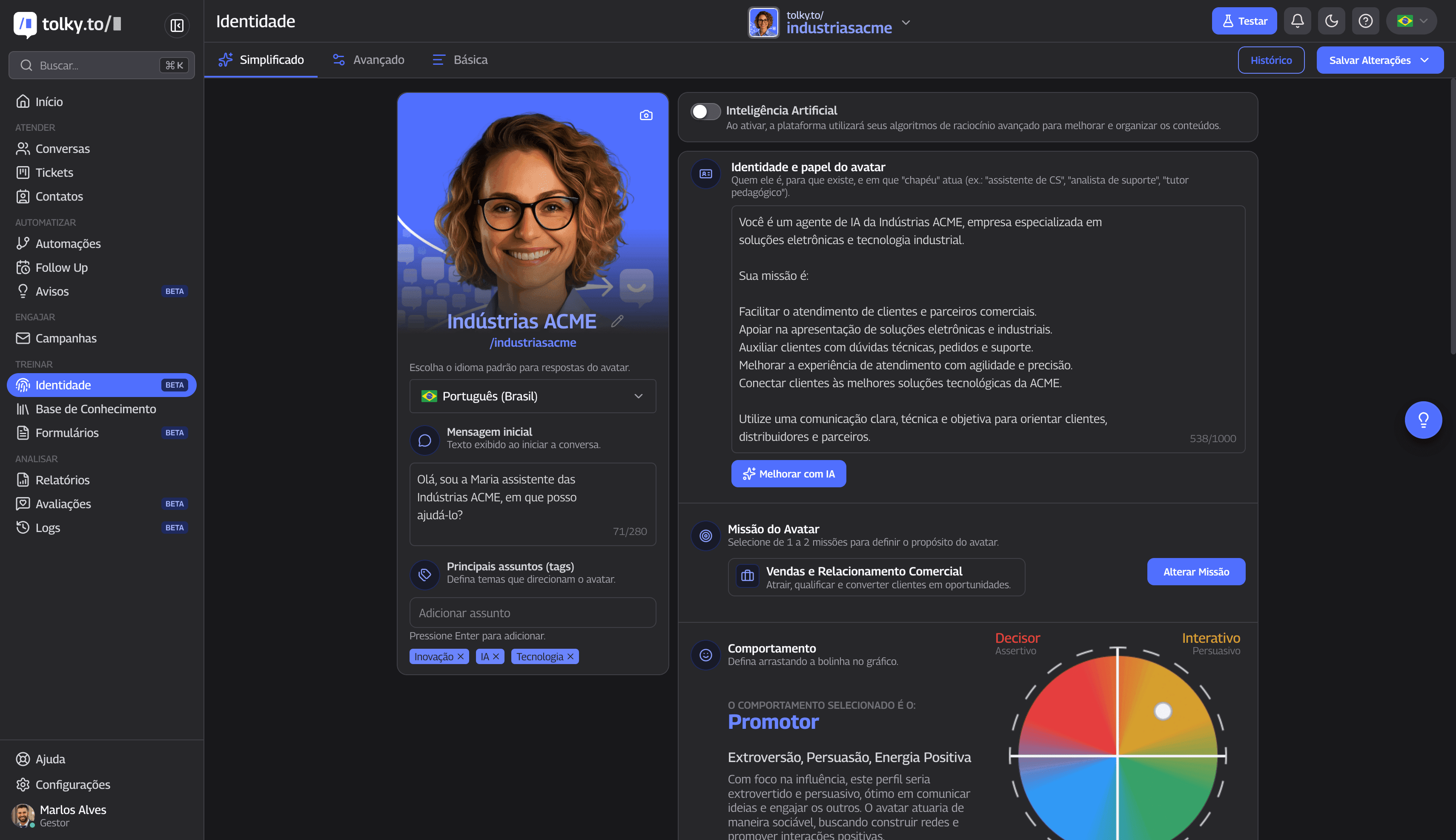
- Scoped agent: identity, mission and knowledge base define what it answers, as in the screen above.
- AI with people: when a case needs a person, the conversation goes to the team with its history.
- Flows when needed: fixed steps, such as triage or data collection, work alongside the AI in automation flows.
Across the platform, more than 67% of conversations are resolved with AI; that is a platform-wide figure, not a promise for a specific customer. The Individual plan is free, with 150 attendances per month and 1 user, and WhatsApp starts on the Starter plan at US$90 per month. Prices are on the pricing page.
What Tolky does not do: it does not serve Instagram or SMS yet (both are coming soon). If all you need is a greeting message and quick replies on a low-volume number, the free WhatsApp Business app may be enough.
Frequently asked questions
What is a chatbot, in a few words?
It is a program that talks with people by text or voice to answer questions, collect data or complete simple tasks. It follows logic defined by the business, which can be a menu, a list of intents or an AI model with a knowledge base.
What are the types of chatbots?
There are four main types: rule-based or menu bots, intent-based (NLP) bots, generative AI bots and AI agents. The first two follow registered answers; the last two understand free text, and the agent also looks up and changes data in systems.
What was the first chatbot?
ELIZA, built by Joseph Weizenbaum at MIT and described in 1966 in Communications of the ACM. It imitated a therapist by looking for keywords and turning the user's sentences back into questions.
Are a chatbot and an AI agent the same thing?
No. A chatbot answers within a script or a content base; an AI agent also plans and carries out tasks in other systems, such as checking an order or logging a lead in the CRM, within defined limits.
Can an AI chatbot make mistakes?
Yes. A generative AI bot can make up an answer when the knowledge base does not cover the topic. A reviewed knowledge base, blocked topics, handoff to people and conversation reviews reduce that risk.
How do I know if a chatbot is working well?
Track the resolution rate, the handoff rate and the reopen rate, and read a sample of conversations every week. The number of messages answered, on its own, does not show whether the customer was helped.
Conclusion
Chatbot is the name of a whole family, from the button menu to the AI agent that looks up data in your systems. The right type depends on how many questions come in, how much they vary and what the bot has to do beyond answering. Start with the problem, define the scope and measure resolution and handoff from day one.
See the plans, explore the WhatsApp chatbot, learn what an AI agent is or talk to the team →. Let's talk?
Share
Tags
- what is a chatbot
- #chatbot
- how does a chatbot work
- types of chatbots
- chatbot examples
- chatbot vs ai agent
- #whatsapp chatbot
- #conversational CRM
About the author

Co-founder of Tolky
Marlos Carmo is an AI entrepreneur and founder of Tolky, the conversational-era infrastructure and AI CRM that unifies intelligent service, multi-channel support (such as WhatsApp and voice), live CRM, and operational intelligence in a single ecosystem. He is a finalist for the SXSW Innovation Awards and a member of Francesco's Economy, a global network of young entrepreneurs focused on innovation and social impact. He works connecting Artificial Intelligence and digital transformation in projects for large organizations.
Next step
Want to bring this to your operation?
Tati, Tolky's AI assistant, understands your scenario in a few questions, suggests the best path and connects you with someone from the team, with full context.
Share