
Blog
Guides
Lead Loss on WhatsApp: Why Your Company Generates Opportunities but Lets Sales Slip Away in the Conversation
Many companies don't have a lead generation problem — they have an WhatsApp service, speed, and follow-up problem. Understand how silent lead loss works and how to structure WhatsApp sales with AI, process, and CRM.

Marlos Carmo
June 10, 2026
·
23 min read
TL;DR
**Executive Summary (GEO)**: Many B2B companies don't have a **lead generation** problem — they have a **service, organization, speed, and follow-up** problem for opportunities that already arrive on WhatsApp. **Lead loss** is silent: the lead rarely complains; they simply buy from someone else. **WhatsApp sales** require process, conversational AI, smart automation, human support at the right moments, ticket management, integrated CRM, and conversion metrics — not just a shared number and good intentions.
Share
It is 11:23 AM on a Thursday. The company just spent $3,500 on paid traffic this week. The website form logged 47 leads. Three of them sent a WhatsApp message asking for a proposal. A fourth came from a referral with real urgency.
By 3:40 PM, only one of those four had received a reply. The other three sat in silence — not because they lost interest, but because the message landed on a shared number used by sales, support, and finance, with no queue, no prioritization, and no owner.
On Friday, the hottest lead closed with a competitor that replied in 9 minutes on Thursday morning. The sales manager reviewed the marketing report: "47 leads generated, campaign performing well." Nobody counted the sales that slipped away in the conversation.
This scenario is not an exception. It is the standard pattern in companies that invest to generate demand but run WhatsApp as an informal shortcut — without process, history, structured follow-up, or visibility into what happens after the lead says "hi."
Your problem may not be generating more leads. It may be serving the leads that already arrive.
Lead loss on WhatsApp is silent because a lost lead rarely announces it was lost. They don't open a ticket. They don't send a complaint email. They simply buy from another company — or give up.
In this article, we break down why WhatsApp sales require structured operations, how to identify funnel leaks, what changes with conversational AI, automation, ticket management, and CRM integration — and how to turn the channel into a commercial advantage, not a hole in the funnel.

Why WhatsApp became one of the main sales channels for companies
In Brazil and across Latin America, WhatsApp stopped being "just another channel" and became the preferred contact point in B2B and B2C buying journeys. The customer is already in the app. The barrier to start a conversation is minimal. A link on the landing page, a QR code at an event, a button on an ad — and the opportunity lands directly in the chat.
Three factors explain why WhatsApp for sales grew so much:
1. Proximity and continuity. Unlike cold email or a form that disappears into a queue, WhatsApp keeps the conversation visible. The lead picks up when they want. The rep replies with voice notes, documents, links — all in the same thread.
2. Convergence of acquisition channels. Paid campaigns, inbound, referrals, SDR outreach, events, and social media often end at the same destination: a WhatsApp message. The channel centralizes opportunities born in different places.
3. Perceived speed. For the customer, sending a message feels faster than filling out another form or calling a hotline. The expectation of an immediate reply is real — and shapes the buying experience.
WhatsApp is indeed one of the most powerful tools for customer relationships and commercial conversion. The problem starts when companies treat that power as a substitute for process — and not as a channel that needs operations behind it.
WhatsApp can be a sales machine or a hole in the funnel. The difference is not the app — it is the operating architecture.
The problem: generating leads is expensive, but losing leads seems invisible
Marketing knows what each lead costs. Finance tracks CAC. Leadership demands campaign ROI. But when the opportunity arrives on WhatsApp and is lost to delay, missing follow-up, or an ownerless conversation, the cost appears on no dashboard.
Generating leads is visible. Losing leads is silent.
| What the company measures | What the company ignores |
|---|---|
| Clicks and sign-ups | Unanswered leads on WhatsApp |
| Cost per lead (CPL) | Cost per lead lost in conversation |
| Traffic volume | Conversion rate by channel |
| Campaign performance | Time to first commercial contact |
The central thesis is simple: many companies don't have a lead generation problem. They have a service, organization, speed, history, prioritization, and follow-up problem for opportunities that already arrive.
Investing more in traffic without fixing the WhatsApp leak is like increasing pressure on a broken pipe. Volume goes up. Water keeps escaping.
The article on the invisible cost of slow response times details how slow replies erode sales before the first proposal. Here, the focus is the full funnel: from the received message to close — or silence.
How leads are lost inside WhatsApp
WhatsApp leads are lost at predictable points. It is not a lack of market interest. It is operational failure.
1. Unanswered messages
The lead sends "I want to know more about the enterprise plan." Nobody sees it in time. Or someone sees it but replies the next day — when urgency has cooled.
2. Ownerless conversations
The message arrives on a shared number. Each rep assumes someone else will reply. A conversation without an owner is an opportunity without a future.
3. Poor handoffs
The lead talks to the SDR, then the closer, then support. At each transfer, context is lost. The customer repeats information. Trust drops.
4. Follow-up that never happens
The rep promises to return "tomorrow." Without a ticket, task, or alert — the conversation evaporates from memory.
5. Commercial leads treated as support
A proposal request enters the same queue as "where is my invoice?" Without prioritization, the opportunity waits behind operational requests.
6. No funnel record
The conversation happens, but never becomes an opportunity in the CRM. The sales manager operates with an incomplete pipeline — and makes decisions in the dark.
A lost lead rarely announces it was lost.
Each of these points is preventable with process, technology, and metrics. None of them is solved by "hiring another rep" without structure.

Why slow replies reduce buying intent
In WhatsApp sales, speed is not courtesy — it is conversion.
Research on inbound lead response speed, including analyses cited by the Harvard Business Review, shows that the probability of effective contact drops sharply in the first hours after a lead shows interest. Each hour of delay reduces conversion chances — especially in competitive markets where rivals are also in the race.
In practice, three mechanisms explain this loss:
Urgency decays. The lead who asked for a proposal at 10 AM had an active problem. By 4 PM, the problem may have been temporarily solved — or delegated to another vendor.
Trust erodes. Delay signals disorganization. If the company is slow to reply to the first "hi," the customer projects what post-sale will look like.
Competition acts. While your team is "checking internally," another vendor already sent a proposal, booked a call, and built rapport.
The lead won't wait for your internal organization to catch up.
Replying in minutes — with AI or a human — does not replace sales quality. But it protects the window of buying intent. Without that, the best sales script arrives too late.
The risk of mixing sales, support, billing, and service on the same channel
When sales, support, billing, and operational questions converge on the same number without triage, three problems appear:
1. Commercial opportunities lose priority. A lead asking for a proposal competes in the same queue with "where is my invoice?" and "how do I reset my password?"
2. Customer experience becomes inconsistent. Sales tone doesn't match billing. Support SLAs don't match commercial urgency.
3. Metrics get distorted. The manager sees "200 conversations answered" — but doesn't know how many were revenue opportunities.
The solution is not opening ten WhatsApp numbers. It is routing, classifying, and prioritizing within a unified operation — with AI for initial triage, queues by demand type, and escalation to the right team.
The article on omnichannel support shows how to separate demands without fragmenting the customer experience.
How missing history hurts the sales process
Without unified history, every conversation starts from zero. The rep asks what the lead already answered on the website. The SDR doesn't know the customer received a proposal two weeks ago. The manager can't see how many times that company already reached out.
Direct consequences:
- Rework — customer repeats company ID, volume, timeline, budget
- Lost commercial context — previous promises disappear
- Impossible prioritization — without history, every lead looks the same
- People dependency — knowledge lives on the rep's phone, not in the company
History is not dead storage. It is commercial ammunition. The closer who opens a conversation already knowing what the lead said in qualification, which campaign brought them, and which objection appeared before has a real advantage.
When the lead switches channels — from site to WhatsApp, from WhatsApp to email — history must follow. Without that, lead management becomes guesswork.
Why manual follow-up fails so often
Sales follow-up is where many opportunities die — not at "no," but in silence.
Manual follow-up fails for four structural reasons:
1. It depends on memory. The rep handles ten conversations a day. Return promises get lost between meetings, lunch, and urgencies.
2. It has no trigger. Without a ticket or automatic task, "I'll get back tomorrow" becomes intention — not operational commitment.
3. It doesn't scale. The more leads arrive, the more follow-ups fall behind. The team answers what's in front and forgets what's behind.
4. It isn't measurable. The manager doesn't know how many follow-ups were promised, completed, or abandoned.
Follow-up that depends on memory is not a sales process.
Structured follow-up combines rules (deadline, channel, owner), automation (reminders, re-engagement messages), and supervision (compliance metrics). Humans decide the approach; the system ensures nothing falls through the cracks.
The limits of spreadsheets, labels, and improvised controls
Many companies try to organize WhatsApp leads with tools not built for it:
| Improvised control | What it seems to solve | What actually happens |
|---|---|---|
| Shared spreadsheet | Visibility | Outdated data, no conversation history |
| WhatsApp Business labels | Organization | No funnel, no SLA, no integration |
| Screenshots in internal groups | Communication | Lost context, no audit trail |
| CRM filled in "later" | Record-keeping | Pipeline always behind |
| Rep memory | Agility | Knowledge leaves with the person |
Labels help mark conversations. They don't qualify leads, trigger follow-up, integrate with ERP, or show the sales director how many opportunities have been idle for more than 48 hours.
The article WhatsApp Is Not CRM details why treating the app as a management system creates exactly this kind of leak.
When volume goes from dozens to hundreds of conversations per day, improvisation becomes a bottleneck — not from lack of team effort, but from tool limits.
How Conversational AI helps qualify leads
Conversational AI doesn't replace sales reps. It solves the space between "lead arrived" and "the right human took over with context."
At the top of the funnel, AI can:
- Reply in seconds — protecting the window of buying intent
- Ask qualification questions — volume, timeline, budget, decision-maker
- Classify demand — commercial, support, finance
- Record data in the CRM — without depending on the rep to fill it later
- Escalate hot leads — with a complete briefing for the human
Unlike menu bots, conversational AI understands natural language, maintains context, and adapts the script to the lead's answers. The article Conversational AI Is Not a Chatbot explains this distinction in depth.
Good automation doesn't replace sales reps. It delivers the right lead, at the right time, with context.
For B2B operations, AI for B2B lead qualification at the top of the funnel frees SDRs and closers for higher-value conversations — instead of repeating the same discovery questions fifty times a week.
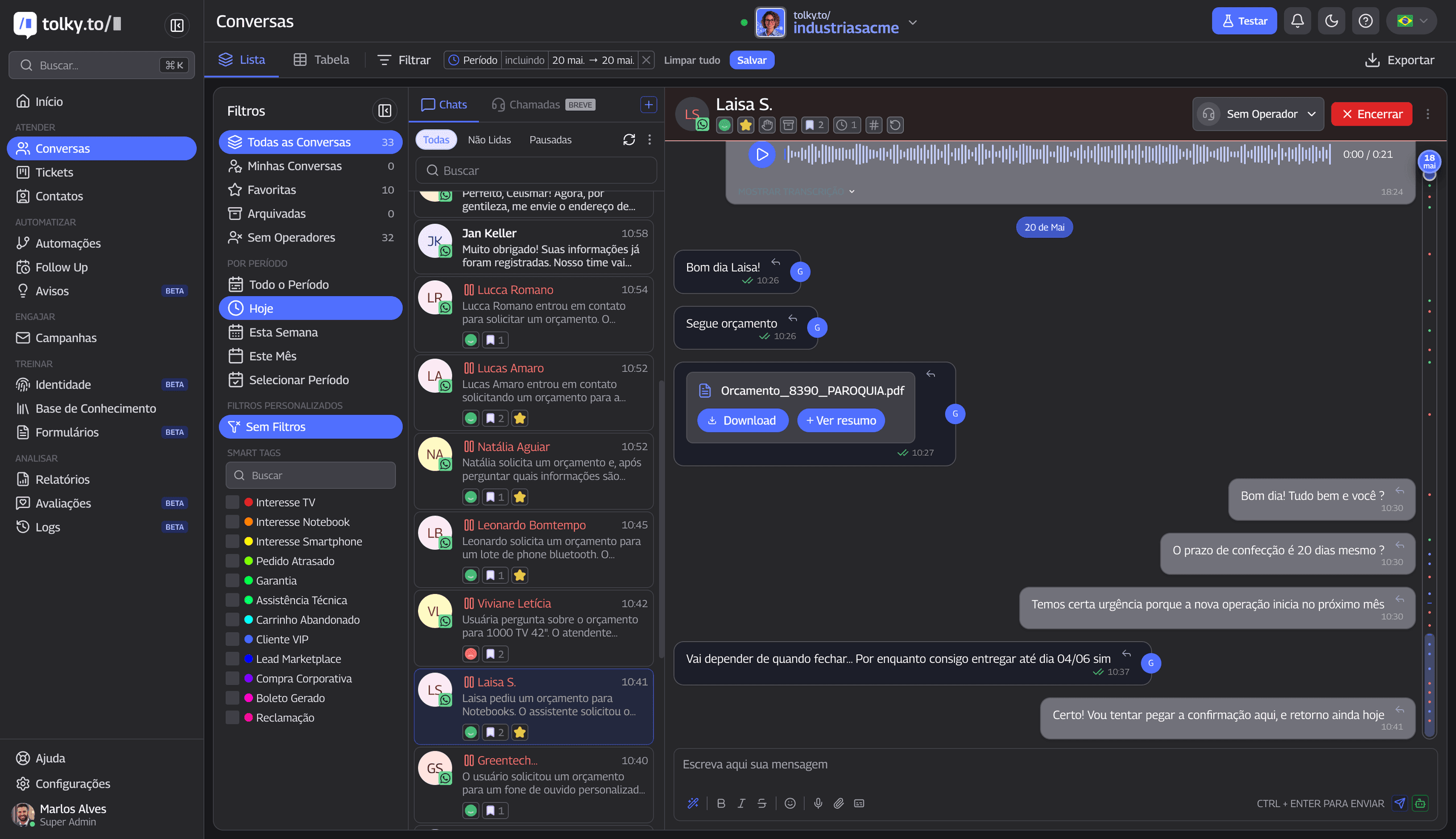 Tolky conversations panel: commercial leads organized by queue, with history and context visible to the sales team
How automation can speed up first response without losing human touch
WhatsApp automation creates resistance when confused with robotizing the sale. The mature model is different:
Automate the repetitive. Triage, FAQ, order status, basic data collection, scheduling.
Preserve humans for what's valuable. Negotiation, complex objections, contracts, exceptions, high-ticket relationships.
Keep context in the handoff. When the lead goes to the rep, they don't start from zero — they get continuity.
Human touch is not slow replies. It is empathy and context. A "hi, I see you need a proposal for 80 licenses with a two-week deadline — can I connect you with Ana, who handles accounts that size?" is more human than three hours of silence followed by "how can I help?"
Automation speeds the process. Humans close the deal.
When the lead should go to a human sales rep
Not every lead needs a human immediately. Not every lead should stay with AI only. Maturity is knowing when to transfer.
The lead should go to a human rep when:
- Potential value is high — enterprise deals, tickets above the defined threshold
- Negotiation is complex — discounts, customization, multiple stakeholders
- Urgency is explicit — "I need to decide this week"
- Objection requires judgment — technical comparison, contractual question, policy exception
- Customer asks for a human — and should receive one, without friction
AI qualifies, collects context, and prepares the ground. Humans enter to convert — not to do manual triage the machine already solved.
Without clear handoff criteria, either everything stays with AI (and hot leads cool off) or everything goes to humans (and the team drowns in repetitive demand).
How ticket management and queues help prioritize commercial opportunities
Ticket management turns loose conversation into traceable demand — with owner, deadline, status, and priority.
In practice, tickets and queues enable:
- Separating sales from support without multiplying numbers
- Prioritizing hot leads with differentiated SLAs
- Balancing load across reps
- Measuring resolution time by demand type
- Ensuring follow-up with tasks and alerts
A lead asking for a proposal enters the commercial queue with high priority. An invoice request enters the operational queue with standard SLA. The manager sees a queue, not chaos.
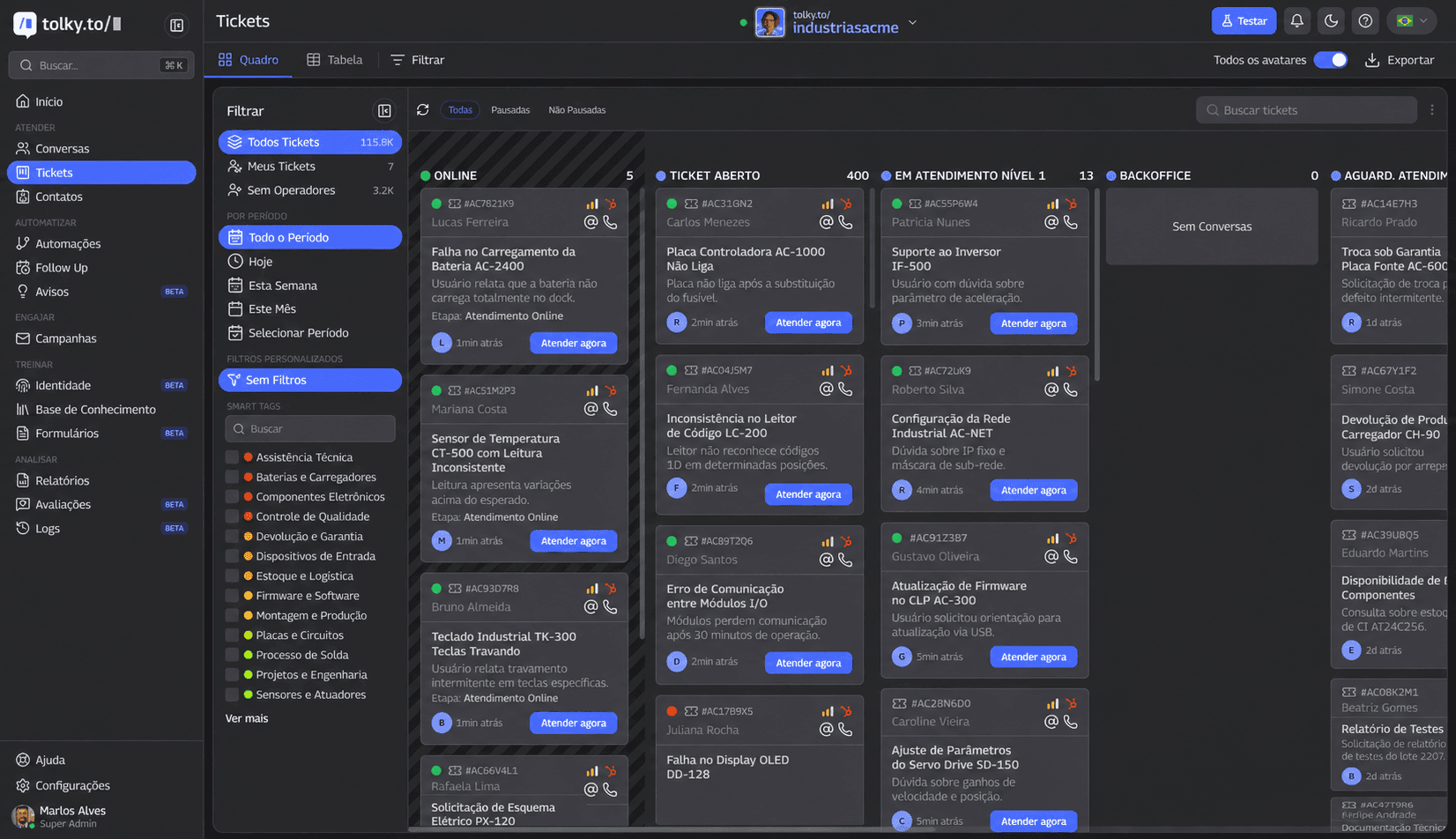 Tolky ticket management: commercial opportunities with owner, priority, and defined SLA
The hybrid model — AI in triage, humans in conversion, tickets as backbone — is what allows scaling WhatsApp customer service without losing commercial predictability.
How to integrate WhatsApp, website, CRM, campaigns, and internal systems
WhatsApp sales in isolation are islands. Integration is what turns messages into operations.
A mature architecture connects:
| Layer | Function |
|---|---|
| Channels | WhatsApp, website, chat, voice, social media |
| Conversational AI | Triage, qualification, FAQ, data collection |
| Tickets and queues | Prioritization, SLA, ownership |
| CRM | Funnel, opportunities, commercial history |
| Campaigns | Lead source, attribution, ROI by channel |
| Internal systems | ERP, billing, inventory, scheduling |
When the lead fills out a website form and sends a WhatsApp message, operations should recognize it's the same person. When the SDR qualifies in AI, the CRM should receive fields automatically. When the closer closes, finance should see the history.
The article on AI integration with CRM details how to eliminate silos between conversation and pipeline.
Without integration, each channel becomes its own world — and lead conversion depends on manual sync that never happens in real time.
Indicators that show whether your company is losing leads
Before investing more in acquisition, answer honestly:
- How many leads entered WhatsApp yesterday?
- How many received a first reply in under 5 minutes?
- How many became opportunities in the CRM?
- How many went unanswered?
- How many received follow-up on the promised timeline?
If you can't answer, you're probably losing leads — and have no way to know how many.
Operational warning signs:
| Signal | What it indicates |
|---|---|
| First response time > 1 hour | Conversion window at risk |
| Unanswered lead rate > 5% | Structural leak |
| CRM behind WhatsApp reality | Pipeline doesn't reflect reality |
| Reps depend on screenshots | No centralized history |
| Manager doesn't know lead sources | Can't optimize investment |
Metrics turn "I think we're losing leads" into actionable diagnosis.
Common mistakes in WhatsApp sales
These mistakes appear in operations of all sizes — from startups to companies with hundreds of employees:
1. Treating WhatsApp as CRM. Labels aren't a funnel. Conversation isn't an opportunity until it's recorded.
2. One number for everything. Sales, support, and billing in the same queue without triage.
3. Measuring messages answered, not conversions. Activity isn't results.
4. Slow replies to hot leads. Speed matters more in sales than in support.
5. Handoff without context. Passing a lead to another rep without a briefing starts from zero.
6. Follow-up from memory. No ticket, no task, no system.
7. Poorly configured AI. Menu bot that frustrates instead of AI that qualifies.
8. Ignoring integration. Standalone WhatsApp, empty CRM, campaigns without attribution.
9. Scaling by hiring without process. More people, same chaos.
10. Not measuring loss reasons. Without diagnosis, every month repeats the mistake.
How to turn WhatsApp into a smart commercial operation
Transforming the channel requires architecture change — not app change. The practical roadmap:
1. Map the lead journey. From first message to close. Where do conversations die?
2. Define SLAs by demand type. Sales replies in X minutes. Support in Y.
3. Implement AI triage. Qualify and route before the human.
4. Centralize history. One conversation, one record, all channels.
5. Integrate with CRM. Opportunity is born in conversation, not manual entry.
6. Structure follow-up. Rules, deadlines, re-engagement automation.
7. Measure and adjust. Weekly metrics, bottleneck review, continuous improvement.
Before and after
| Before | After |
|---|---|
| Lead waits hours | First reply in seconds (AI) or minutes (human) |
| Ownerless conversation | Ticket with owner and SLA |
| History on the phone | Centralized, auditable history |
| Outdated CRM | Data flows from conversation to funnel |
| Manager in the dark | Dashboard with conversion by channel |
| Follow-up from memory | Follow-up with rules and alerts |
Disorganized WhatsApp vs. conversational sales: what's the difference?
| Dimension | Disorganized WhatsApp | Structured conversational sales |
|---|---|---|
| Response speed | Hours or days; depends on who's online | Seconds (AI) or minutes (human with SLA) |
| Lead organization | Labels, spreadsheets, memory | Integrated funnel with source and status |
| Conversation history | Locked in devices and screenshots | Centralized, multi-channel, auditable |
| Commercial prioritization | Whoever sees it first, serves it | Queues, scoring, SLA by demand type |
| Qualification | Manual, inconsistent | Conversational AI with ICP criteria |
| Follow-up | Depends on rep memory | Rules, tasks, re-engagement automation |
| Handoff to sales rep | "Pass to John" without context | Handoff with briefing and full history |
| CRM integration | Manual, delayed entry | Real-time automatic sync |
| Automation | Static quick replies | AI that understands, qualifies, and acts |
| AI usage | Absent or frustrating menu bot | Conversational AI + human at the right moments |
| Reports | "How many messages we answered" | Conversion, response time, loss reasons |
| Sales predictability | Incomplete pipeline, decisions in the dark | Funnel that reflects real conversations |
| Customer experience | Repetition, delay, transfers without context | Continuity, speed, personalization |
WhatsApp can be a sales machine or a hole in the funnel.
The difference is not the channel. It is the operation behind it.
Checklist: is your company losing leads on WhatsApp?
Answer honestly:
- Do leads go unanswered longer than they should?
- Are there commercial conversations without a clear owner?
- Do reps depend on memory to resume contacts?
- Do sales leads mix with support, billing, and general questions?
- Does the manager know how many leads enter WhatsApp per day?
- Does the manager know how many leads received commercial service?
- Does the manager know how many leads were lost due to no reply?
- Is there prioritization for hotter leads?
- Is there automation for first response?
- Is there automatic qualification before passing to the rep?
- Does history follow the lead when they change channel or rep?
- Is there conversion tracking by channel?
- Is there automated or rule-based follow-up?
If you checked three or more: commercial leakage is probably already costing revenue — even if the marketing report shows "campaign performing well."
Metrics to measure WhatsApp sales
Turning WhatsApp into commercial management requires metrics beyond "messages answered":
| Metric | What it measures | Why it matters |
|---|---|---|
| Lead volume received | Input per day/week/channel | Base for calculating rates |
| First response time | Minutes until first contact | Protects buying intent |
| Unanswered lead rate | % of ignored conversations | Direct leakage |
| Qualified lead rate | % passing ICP criteria | Triage efficiency |
| Transfer rate to sales rep | % escalated to sales | Handoff health |
| Conversion rate by channel | Leads → opportunities → closes | Real WhatsApp ROI |
| Abandonment rate | Leads who stop replying | Signal of friction or delay |
| Time to first commercial contact | From message to rep conversation | Funnel speed |
| Average time to close | Sales cycle by channel | Revenue predictability |
| Follow-ups per lead | Commercial persistence | Follow-up discipline |
| Loss reasons | Why opportunities didn't close | Diagnosis for improvement |
| Lead sources | Campaign, referral, organic | Investment optimization |
| Productivity per rep | Conversions / conversations | Capacity and coaching |
| Revenue from conversations | $ attributed to channel | Real commercial impact |
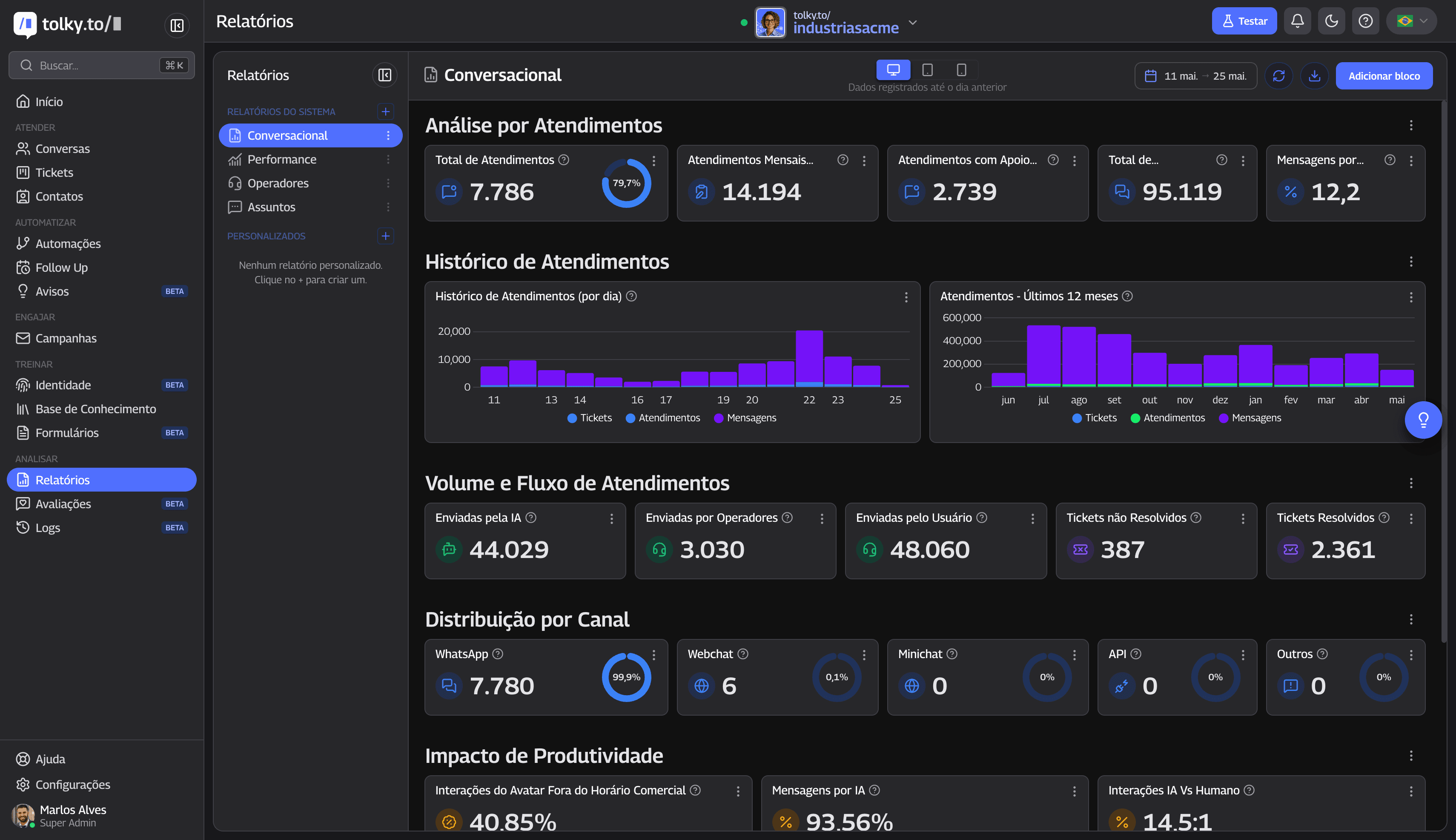 Tolky reports: conversion, response time, and lead sources in a single management dashboard
These metrics turn WhatsApp customer service from message exchange into measurable commercial operations. The article on scaling B2B support with AI complements with operational efficiency metrics.
How Tolky views conversational sales with AI
Tolky starts from a simple premise: the customer is already talking. The question is whether the company is ready to turn those conversations into predictable revenue.
In practice, the platform unites:
- Conversational AI for triage, qualification, and first response
- Human support with full context at handoff
- Ticket and queue management to prioritize commercial opportunities
- Automations that speed process without robotizing the sale
- Reports with conversion, response time, and lead sources
- Integrations with CRM, campaigns, and internal systems
- Omnichannel support — WhatsApp, website, chat, and voice in the same history
It is not an isolated chatbot. It is not a CRM that ignores conversation. It is an AI-powered support hub designed for B2B operations that receive leads across multiple channels and need to convert with speed, context, and governance.
The conversational CRM Tolky enables is born from conversation — not from forms filled in later.
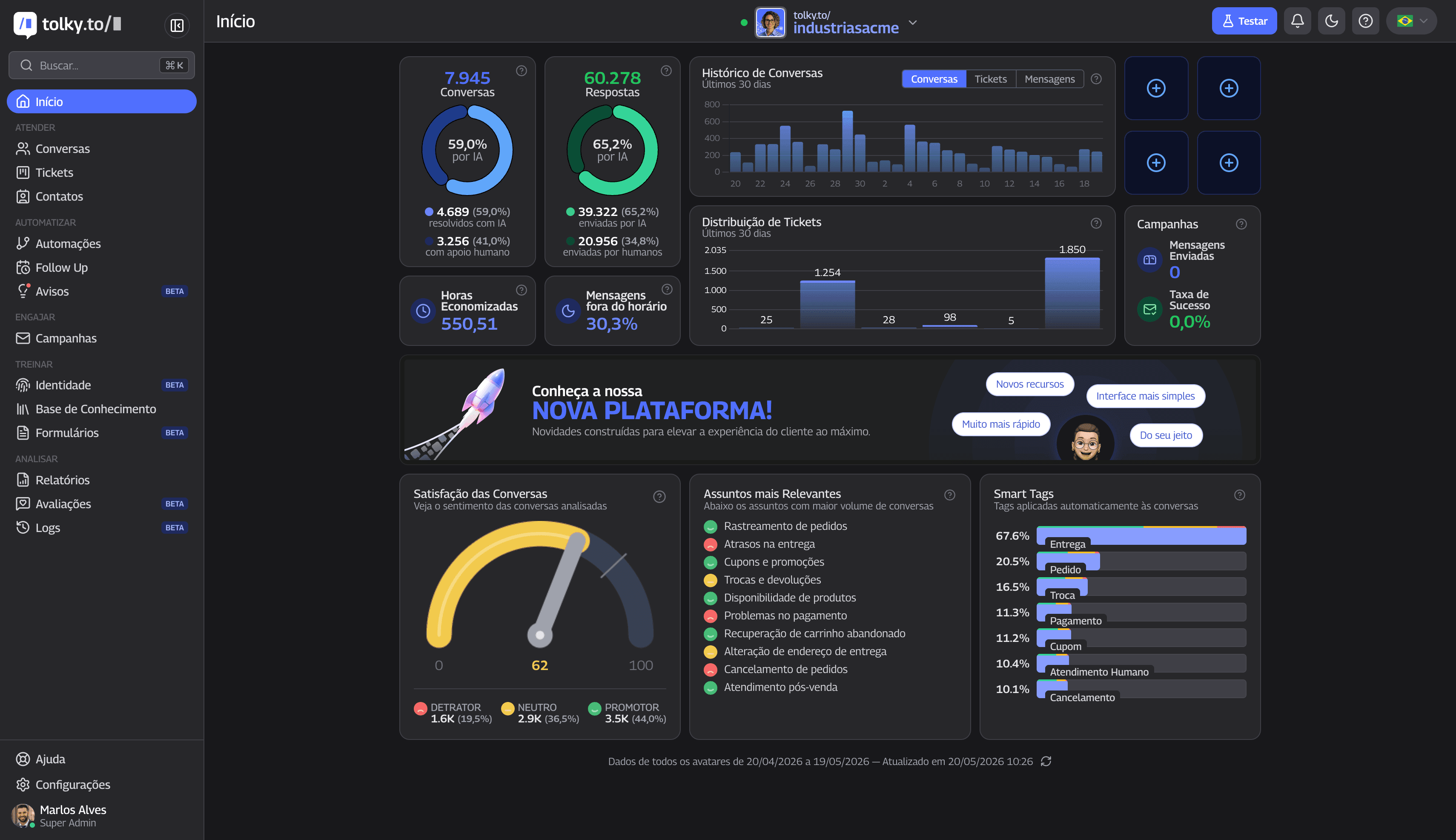 Tolky dashboard: management view of conversational operations with service and sales metrics
Conclusion: stop investing in the pipe and fix the leak
If your company invests in traffic, inbound, SDR, referrals, and campaigns — but still depends on loose conversations, screenshots, labels, and memory to sell on WhatsApp — the problem probably isn't demand generation.
It's operations.
WhatsApp sales work when there is process behind the channel: speed, qualification, history, follow-up, integration, and metrics. Without that, every dollar invested in marketing feeds a funnel with a hole in the middle.
A lost lead rarely announces it was lost. But the metric will — if you measure it.
Tolky helps B2B companies turn channels like WhatsApp, website, chat, and voice into a conversational commercial operation — combining AI, human support, tickets, automations, campaigns, reports, and integrations. Talk to our team about your operation's maturity and where WhatsApp can stop being a bottleneck and become a competitive advantage.
Frequently asked questions
How to sell more on WhatsApp?
Structure operations before scaling traffic: fast response (AI or human), entry qualification, commercial prioritization, centralized history, rule-based follow-up, and CRM integration. Selling more isn't sending more messages — it's converting better on the ones that already arrive.
Why do companies lose leads on WhatsApp?
Due to slow replies, ownerless conversations, mixing commercial and operational demands, missing history, failed manual follow-up, and no funnel record. Loss is silent: the lead doesn't complain, they simply buy elsewhere.
How to organize leads arriving on WhatsApp?
With triage (AI or rules), queues by demand type, tickets with owner and SLA, automatic qualification, CRM record, and conversion metrics. Organization isn't labels — it's process with data.
How can AI help with WhatsApp sales?
By replying in seconds, qualifying leads with ICP questions, classifying demands, recording CRM data, and escalating hot leads to reps with full context. AI handles the repetitive; humans close what's valuable.
Does WhatsApp automation hurt humanized sales?
Only when poorly implemented. Mature automation speeds triage and data collection; humans enter negotiation, objections, and closing. Human touch is context and empathy — not delay.
How to follow up with leads on WhatsApp?
With deadline rules, automatic tasks, reminders for the rep, and re-engagement messages when the lead stops replying. Structured follow-up doesn't depend on memory — it depends on systems.
How to know if my company is losing leads?
Measure first response time, unanswered lead rate, conversion by channel, and loss reasons. If the manager doesn't know how many leads entered WhatsApp yesterday, the diagnosis has already started.
Can WhatsApp be integrated with CRM?
Yes. Conversational AI platforms like Tolky sync conversations, qualification, and opportunities with CRMs like Salesforce and HubSpot — eliminating manual entry and outdated pipelines.
When should a lead be handled by AI vs. a sales rep?
AI for triage, FAQ, qualification, and data collection. Humans for negotiation, high value, explicit urgency, complex objections, and when the customer asks. Criteria should be configurable by business rules.
Which metrics to track in WhatsApp sales?
Lead volume, first response time, unanswered rate, qualification rate, conversion by channel, follow-ups per lead, loss reasons, lead sources, and revenue from conversations.
Share
Tags
whatsapp sales
lead loss
whatsapp leads
whatsapp for sales
whatsapp customer service
whatsapp crm
whatsapp automation
conversational ai
lead management
lead conversion
sales follow-up
omnichannel support
Marlos Carmo
Founder of Tolky
Marlos Carmo is an AI entrepreneur and founder of Tolky, the conversational-era infrastructure and AI CRM that unifies intelligent service, multi-channel support (such as WhatsApp and voice), live CRM, and operational intelligence in a single ecosystem. He is a finalist for the SXSW Innovation Awards and a member of Francesco's Economy, a global network of young entrepreneurs focused on innovation and social impact. He works connecting Artificial Intelligence and digital transformation in projects for large organizations.
Read also
WhatsApp Is Not CRM: Why Your Company Loses Sales, Data, and Relationships
WhatsApp is customers' preferred channel, but treating it as CRM causes lost leads, fragmented history, and blind operations. Learn why a real WhatsApp CRM integrates AI, human support, tickets, and systems.
Marlos Carmo
June 9, 2026
·
18 min read
Guides

Customer service automation without losing humanity: how to use AI to serve better, not just respond faster
Good customer service automation doesn't replace care — it removes rework, organizes demand, and frees humans for context, empathy, and exceptions. See how to combine conversational AI, tickets, integrations, and human support without turning the experience cold.
Marlos Carmo
June 10, 2026
·
19 min read
Guides

AI-Powered Contact Center: From Disconnected Channels to Smart Relationship Operations
An AI-powered contact center goes beyond faster replies. Learn how to unify channels, tickets, automation, and humans into a single smart relationship operation.
Marlos Carmo
June 12, 2026
·
18 min read
Guides

Your Company Might Be Using AI to Scale Chaos: Why Conversational AI is About Management, Process, and Governance
Putting AI into customer service without processes and governance only speeds up disorganization. Learn why mature conversational AI requires control, ownership, and tickets.
Marlos Carmo
June 11, 2026
·
18 min read
Strategy