Voicebot vs callbot: what they are and how voice agents differ
What a voicebot is, what a callbot is, how they compare to voice chatbots, IVRs and generative AI voice agents, where each one fits and what to check before you buy.
TL;DR
A voicebot is a bot that talks with people by voice on any channel, such as a website, an app or the phone. A callbot is a voicebot built for phone calls, inbound or outbound. A generative AI voice agent is the version that uses a language model to understand free-form speech, look things up in the company's knowledge base and complete tasks, handing off to a person when needed.
Share
Voicebot, callbot, voice chatbot, voice bot, robocall, intelligent IVR, voice agent. Anyone starting to research voice automation for customer service runs into seven names for similar things and no clear explanation of where one ends and the next begins.
This guide sorts the terms out: what each one means, the difference between a rule-based voice bot and a generative AI agent, where each one fits and what to check before you sign a contract.
Updated in November 2026.
What is a voicebot?
A voicebot is software that talks with people by voice: it listens, understands the request and answers with a synthetic voice, on any channel that carries audio. That channel can be the phone, an app, a browser, a smart speaker or a WhatsApp call.
Under the hood, a voicebot combines three parts. Speech recognition (STT) transcribes what the person says. An understanding layer decides what to say back, either through rules or a language model. Speech synthesis (TTS) turns the answer into audio.
The word is an umbrella term. When someone says "voicebot," they haven't yet told you which channel it runs on or whether it uses generative AI.
What is a callbot?
A callbot is a voicebot that answers or places phone calls. Every callbot is a voicebot, but not every voicebot is a callbot: a voice assistant on a website, for example, is a voicebot without being a callbot.
A callbot can work in two directions:
- Inbound. It answers people who call the company, understands why they're calling and resolves or routes the call. That's the job of an intelligent IVR.
- Outbound. It calls a list of contacts with a goal: confirm an appointment, send a payment reminder, qualify a lead.
Because it runs over the phone network, a callbot deals with things a website voicebot never sees: line quality, background noise, voicemail, numbers that may get flagged as spam and rules about outbound calling.
Are voice chatbots, voice bots and robocalls the same thing?
Voice chatbot, voice bot and robocall are popular names that can mean different things depending on who uses them, so it pays to ask what the product actually does. These are the most common meanings:
- Voice chatbot. Often a text chatbot that also accepts audio. On WhatsApp, for example, the agent can understand an incoming voice note and reply with audio, without any call taking place.
- Voice bot. A direct synonym for voicebot.
- Robocall or calling robot. A layperson's term for a callbot. It's also used for dialers that play a prerecorded message with no conversation at all, often called voice broadcasting.
When people add "AI" or "intelligent" to these names, they usually mean the system understands free-form speech, not just keypresses or fixed words.
What's the difference between a voicebot, a callbot, an IVR and a voice agent?
The difference comes down to two dimensions: the channel (any audio or phone only) and how the system understands people (keypresses, expected phrases or free-form language with generative AI). The table places each term along those two dimensions.


| Term | Channel | How it understands the caller | What it usually does |
|---|---|---|---|
| Traditional IVR | Phone | Keypresses | Routes to a queue |
| Intelligent IVR | Phone | Speech, expected or free-form | Routes and handles simple requests |
| Voice chatbot | Chat that accepts audio | Transcribed audio | Replies by text or audio |
| Voicebot | Any channel with audio | Expected phrases or free-form speech | Talks and answers |
| Callbot | Phone, inbound or outbound | Expected phrases or free-form speech | Answers or places calls |
| Generative AI voice agent | Website, WhatsApp and phone | Free-form speech, with a language model | Talks, looks up systems and hands off with context |
In practice, the terms overlap. A voice agent that answers the phone is a callbot, a voicebot and an intelligent IVR all at once. What matters is the last column: what the system does when the caller goes off script.
Rule-based voice bot or generative AI agent: what changes?
A rule-based voice bot follows paths designed in advance; a generative AI agent understands free-form speech and builds its answer from the company's knowledge base. Both are voicebots, but they behave very differently once the conversation leaves the expected path.
Rule-based voice bot
A rule-based bot works from a dialogue tree and a list of intents trained on sample phrases. When the caller says something close to what was expected, it gets it right. When the caller goes off script, it usually asks them to repeat or transfers the call.
The upside is predictability: everything it says is written down. The downside is maintenance, because every new topic means designing another branch and more sample phrases.
Generative AI voice agent
A generative AI agent uses a language model to understand the request, even when it's phrased in a way nobody anticipated, and answers from company content. It can also look things up in your systems during the call. The broader difference is covered in conversational AI is not a chatbot.
That flexibility comes with its own requirements: a reviewed knowledge base, clear limits on what the AI can do and a way out to a person. In voice, two technical factors matter more than in text: latency, because long pauses sound like a dropped call, and barge-in, which lets callers interrupt the AI.
Where does each one fit?
Each type of voice bot solves a different problem: simple routing needs little intelligence, while varied questions and goal-driven calls need an agent that understands free-form speech. The table helps you choose.
| Need | What usually fits | Note |
|---|---|---|
| Route a few fixed options | Traditional or intelligent IVR | Works when callers just need the right department |
| Answer common questions by phone | Inbound callbot or voice agent | Needs a reviewed knowledge base and handoff |
| Confirm appointments | Outbound callbot | Common in healthcare and scheduled services |
| Payment reminders and collections | Outbound callbot with handoff | See collections |
| Voice on your website | Web voicebot | Visitors talk through the browser |
| Customer service on WhatsApp | Agent that understands audio and answers calls | See voice AI on WhatsApp |
| Notify many people, no conversation | Voice broadcasting | Prerecorded message, no understanding |
If your operation mixes several of these cases, a single voice agent usually makes more sense than one bot per channel, so the customer's history lives in one place.
What should you check before buying a voicebot or callbot?
Judge a voicebot or callbot on two things: conversation quality on real calls and how much control your team has over it. A demo with a rehearsed script tells you little; ask to test it with your own requests.


Conversation quality
- Understanding. Does it handle free-form sentences, names, numbers and regional accents?
- Response time. Is the pause between the caller finishing and hearing a reply short?
- Interruptions. Can callers cut the bot off mid-sentence?
- Voice. Can you choose the voice, accent and answer length?
Operations and control
- Handoff with context. When the call goes to a person, do the reason and transcript go with it? See handoff.
- Team on the line. Can your team follow and listen to live calls, and join the audio?
- History. Does the transcript land in the customer's history, next to text conversations?
- Channels. Does it cover phone, WhatsApp and website, or just one?
- Cost. Compare cost per resolved call, not just price per minute.
- Disclosure and data. Does the bot say it's an AI? In Brazil, voice and transcripts are personal data under the LGPD; rules vary by country, so check the ones that apply to you.
For a longer list of vendor criteria, see voice AI platform.
Where Tolky fits
Tolky is a conversational AI CRM where the same AI agent handles text and voice, so it works as a voicebot on your website, a callbot on the phone and a voice agent on WhatsApp, upon activation. The features are covered in Voice Customer Service and the AI voice agent.
- Natural conversation. Voice chosen with a preview, regional accent, opening greeting and shorter answers, in cascade or real-time mode. Callers can interrupt the AI.
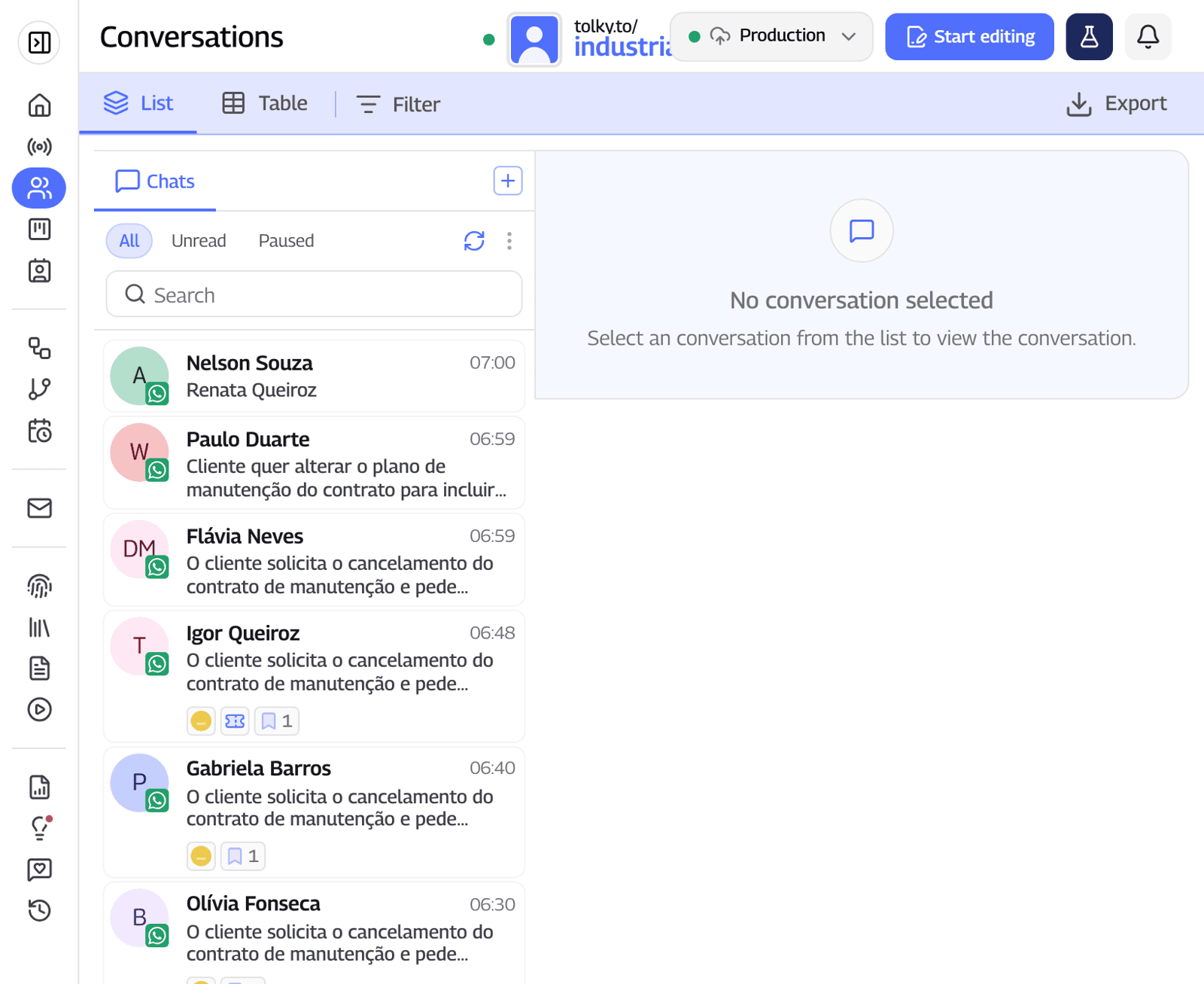
- Team alongside. Live calls show up in real time, filtered by AI or person. Operators can listen in and, when one joins the audio, the AI goes silent.
- Handoff. The AI transfers to an agent; if the assigned person doesn't answer, the call rings other operators.
- One history. The transcript lands in the contact's history, next to text conversations.
- Audio on WhatsApp. The agent understands incoming voice notes and can reply with audio when configured to.
For outbound callbot use, with the AI calling your customer base with a script and a goal, there's Voice Campaigns, with calling windows, a do-not-call list and a transcription notice on every call. What Tolky doesn't do: it isn't a voice cloning or voiceover tool, and voice requires activation.
Frequently asked questions
What is a voicebot?
It's software that talks by voice: it listens, understands and answers with a synthetic voice. It can run on any channel that carries audio, such as a website, an app, WhatsApp or the phone.
What is a callbot?
It's a voicebot that answers or places phone calls. It can be inbound, answering people who call, or outbound, calling a list with a specific goal.
What's the difference between a voicebot and a callbot?
The channel. Voicebot is the general term for any bot that talks by voice; a callbot is a voicebot that works on phone calls. Every callbot is a voicebot, but not the other way around.
Is a voice chatbot the same as a voicebot?
Not always. A voice chatbot is often a text chatbot that accepts and sends audio, while a voicebot holds a live spoken conversation. Ask the vendor whether there's a real call or just an exchange of voice notes.
Can a voicebot replace an IVR?
It can replace the keypad menu with a conversation, which is what an intelligent IVR does. Your team is still needed for cases that require judgment, and callers must be able to reach a person.
Can a callbot call people on WhatsApp?
Yes, if the platform supports WhatsApp calls. For a business to call, the contact must give permission first; without it, the fallback is regular phone calls.
Conclusion
Voicebot is the general term, a callbot is the phone version, and a generative AI voice agent is the one that understands free-form speech and resolves requests instead of just routing them. When choosing, the name matters less than testing with your real requests and checking how your team joins the call. For the full picture, see AI voice agents for customer service.
Explore Voice Customer Service, see Voice Campaigns, see the plans or talk to the team →. Let's talk?
Share
Tags
- voicebot
- callbot
- voice bot
- voice chatbot
- ai voice bot
- #ai voice agent
- intelligent ivr
- #conversational CRM
About the author

Co-founder of Tolky
Marlos Carmo is an AI entrepreneur and founder of Tolky, the conversational-era infrastructure and AI CRM that unifies intelligent service, multi-channel support (such as WhatsApp and voice), live CRM, and operational intelligence in a single ecosystem. He is a finalist for the SXSW Innovation Awards and a member of Francesco's Economy, a global network of young entrepreneurs focused on innovation and social impact. He works connecting Artificial Intelligence and digital transformation in projects for large organizations.
Next step
Want to bring this to your operation?
Tati, Tolky's AI assistant, understands your scenario in a few questions, suggests the best path and connects you with someone from the team, with full context.
Share