Voice broadcasting and mass calling: the rules and what AI changes
What voice broadcasting is, what mass calling is still good for, the Brazilian telecom rules that changed in November 2026, how to protect your number and what AI voice campaigns change.
TL;DR
Voice broadcasting is a recorded message sent by phone call to a list of numbers: the person answers and hears the audio, with no conversation. It works for short notices, but it cannot answer questions or objections, and in Brazil mass calling with many short calls can get the line blocked for 15 days by the telecom regulator Anatel. The alternative is an AI voice campaign, which holds a conversation and pursues a goal.
Share
People looking for mass calling software usually want something simple: reach a lot of people at once, by phone, without a team dialing. Voice broadcasting has done that for years and is still useful in some cases.
The landscape has changed, though. On November 12, 2026, Brazil's telecom regulator Anatel tightened its rules on abusive calls, and the typical pattern of a poorly planned voice blast (many calls, little conversation) is exactly what carriers now have to block. This guide explains what voice broadcasting is, where it still makes sense, the rules in Brazil and what changes when the call is made by an AI that talks. Rules vary by country, so check the regulator where your contacts live.
Updated in November 2026.
What is voice broadcasting?
Voice broadcasting is a recorded voice message sent automatically by phone call to a list of contacts: when the person answers, they hear the audio, and the call ends. It also goes by voice blast, automated voice message, mass calling or, in Brazil, "torpedo de voz."
Voice broadcasting is one-way communication. Some versions accept a keypress ("press 1 to confirm"), but nobody talks with the person.
That sets it apart from two similar tools. An outbound IVR calls and offers a keypad menu to route the person. An AI voice campaign calls and talks in natural language, with a script and a goal.
How does mass calling work?
Mass calling works with four pieces: a list of numbers, a recorded audio file, a dialer that places calls in parallel and a report of who answered. After setup, the process is almost entirely automatic.


- List. The company uploads the numbers, ideally of customers with an active relationship.
- Audio. A short message is recorded, 20 to 40 seconds (an illustrative range), with who is calling, why and what to do.
- Dialing. The dialer calls many numbers at once and plays the audio when someone answers. Unanswered numbers get a retry or a voicemail message.
- Report. The tool shows who answered, how long they listened and, if there was a keypress, what they chose.
The report does not show what matters most: whether the person understood and agreed.
What is voice broadcasting still good for?
Voice broadcasting is still good for short, informative, expected notices, where the person does not need to reply beyond "okay." Beyond that, the lack of conversation becomes a problem.
Common legitimate uses:
- Service interruptions. Scheduled power or water outages, system maintenance.
- Simple reminders. The date of an appointment or event, with confirmation by keypress.
- Group announcements. A school telling parents about a schedule change.
- Public safety. Civil defense or public health alerts, which Anatel does not treat as abusive when made by those services.
What they share: they reach people who already have a relationship with the caller and deliver information the person wants.
What are the limits of voice broadcasting?
The limit of voice broadcasting is that it talks and does not listen: it cannot answer questions, handle objections, understand someone asking not to be called or pass the person to the team with context.
- No conversation. "Is this a scam?", "how much is it?", "can you call later?" go unanswered.
- It sounds like a robot, because it is. Many people hang up in the first few seconds, and short calls weigh heavily under Anatel's rules.
- It measures delivery, not results. "Answered" does not mean "understood" or "agreed."
- It does not record opt-outs. Someone who says "stop calling me" is talking to audio that cannot hear.
For conversations at scale, there is another path: see the guide to AI telemarketing.
What rules apply to mass calling in Brazil?
In Brazil, mass calling is regulated mainly by Anatel, which blocks callers that place a high volume of short calls for 15 days, and by the LGPD data protection law, which requires purpose and transparency in using phone numbers. The rules below were checked on November 20, 2026.
Short calls and blocking by Anatel
Since November 12, 2026, Despacho Decisório nº 100/2026/CIDC has been in force, implementing part of Provisional Measure nº 1,396/2026. According to Anatel, use is abusive when, on the same day and within the same service, a user places more than 1,000 calls per line or more than 10,000 across all its lines, and at least 85% of them are short.
A short call is one that is not completed, goes to voicemail or, when completed, lasts up to six seconds. The block prevents placing calls for 15 days and covers every number tied to the caller's individual or company tax ID. The previous threshold was 100,000 calls a day. Calls by public bodies and by health, public safety and civil defense services, in the course of their duties, do not count as abuse.
For a voice blast to a cold list, the math is dangerous: unanswered calls, voicemail and hang-ups within six seconds all count as short calls.
The 0303 prefix and call authentication
The 0303 prefix, created in 2021 for outbound telemarketing, became optional under Acórdão nº 201 of August 14, 2025. The same decision requires call authentication from anyone placing more than 500,000 calls a month, according to Anatel's 0303 page. Provisional Measure nº 1,396/2026 also calls for digitally signed calls and blocking of unauthenticated ones, with part of the rules still pending Anatel regulation (Planalto).
Não Me Perturbe and the LGPD
Brazil's Não Me Perturbe registry blocks, within 30 days, telemarketing from participating companies, which are telecom carriers and payroll-loan lenders. Beyond it, the LGPD (Law 13,709/2018, art. 6) requires a stated purpose and transparency, and data subjects can object to processing (art. 18, § 2). If the call is about a debt, the Consumer Protection Code limits also apply, as explained in the guide to AI for debt collection.
| Rule | What it requires | Effect on voice broadcasting |
|---|---|---|
| Despacho nº 100/2026/CIDC (Anatel) | Abuse: over 1,000 calls per line or 10,000 in total per day, with 85% short | A cold list with many unanswered calls can get the line blocked for 15 days |
| Acórdão nº 201/2025 (Anatel) | 0303 optional; authentication above 500,000 calls a month | Large blasts need authenticated calls |
| Não Me Perturbe | Blocks telemarketing from participating companies | Respect the registry and your own do-not-call list |
| LGPD | Purpose, necessity, transparency and the right to object | Say who is calling and why, and stop when asked |
This summary is not legal advice, and part of the rules still depends on Anatel regulation: check before every large campaign.
How do you protect your number in mass calling?
To protect your number, call only people who have a relationship with the company, start slowly, raise the share of calls with real conversation and stop calling people who ask. A number's reputation takes months to build and a day to lose.


- Clean list. Remove invalid numbers and contacts without an active relationship before dialing.
- Gradual volume. Start with few calls per hour and watch the answer rate.
- Right hours. Call during business hours, when people are more likely to answer and talk.
- Do-not-call list. Anyone who asks not to be called comes off every campaign, not just the current one.
- Spacing between attempts. Do not call the same number several times on the same day.
- Warning sign. A sudden drop in answers usually means the number was flagged as spam.
The same care applies to messaging: the post on bulk WhatsApp messaging covers the text side.
Voice broadcasting, outbound IVR or AI campaign: which should you choose?
Choose voice broadcasting for notices that need no reply, an outbound IVR to route by keypress and an AI voice campaign when the call needs conversation, objection handling and a recorded result.
| Criterion | Voice broadcasting | Outbound IVR | AI voice campaign |
|---|---|---|---|
| What the person hears | Recorded audio | Audio with a menu | A conversation |
| How they respond | No reply or a keypress | Keypad | Free speech |
| Questions and objections | Unanswered | Routed to a queue | The AI answers from the script |
| Handoff to a person | No | To a queue | During the call, with context |
| Do-not-call request | Not recorded | By keypress, if set up | Understood and recorded |
| What it measures | Answered and listened | Key pressed | Goal reached |
| Short-call risk | High | Medium | Lower once the conversation starts |
The risk in the last row is qualitative and depends on the list, the hours and the script.
What changes when an AI holds the conversation?
With AI, mass calling stops being pushed audio and becomes a conversation with a goal: the AI introduces itself, asks if it is a good time, listens, answers and records the outcome. That changes what you measure and who picks up the call.
The AI can hear "I can't talk now" and schedule a callback, hear "don't call me again" and add the number to the do-not-call list, and pass people ready to buy to a person. The transcript goes to the contact's history. For use cases, read AI that calls customers.
Two precautions still apply: say at the start that it is a virtual assistant, and do not use AI to push more volume to a cold list, because the short-call rule applies all the same.
Where Tolky fits in mass calling
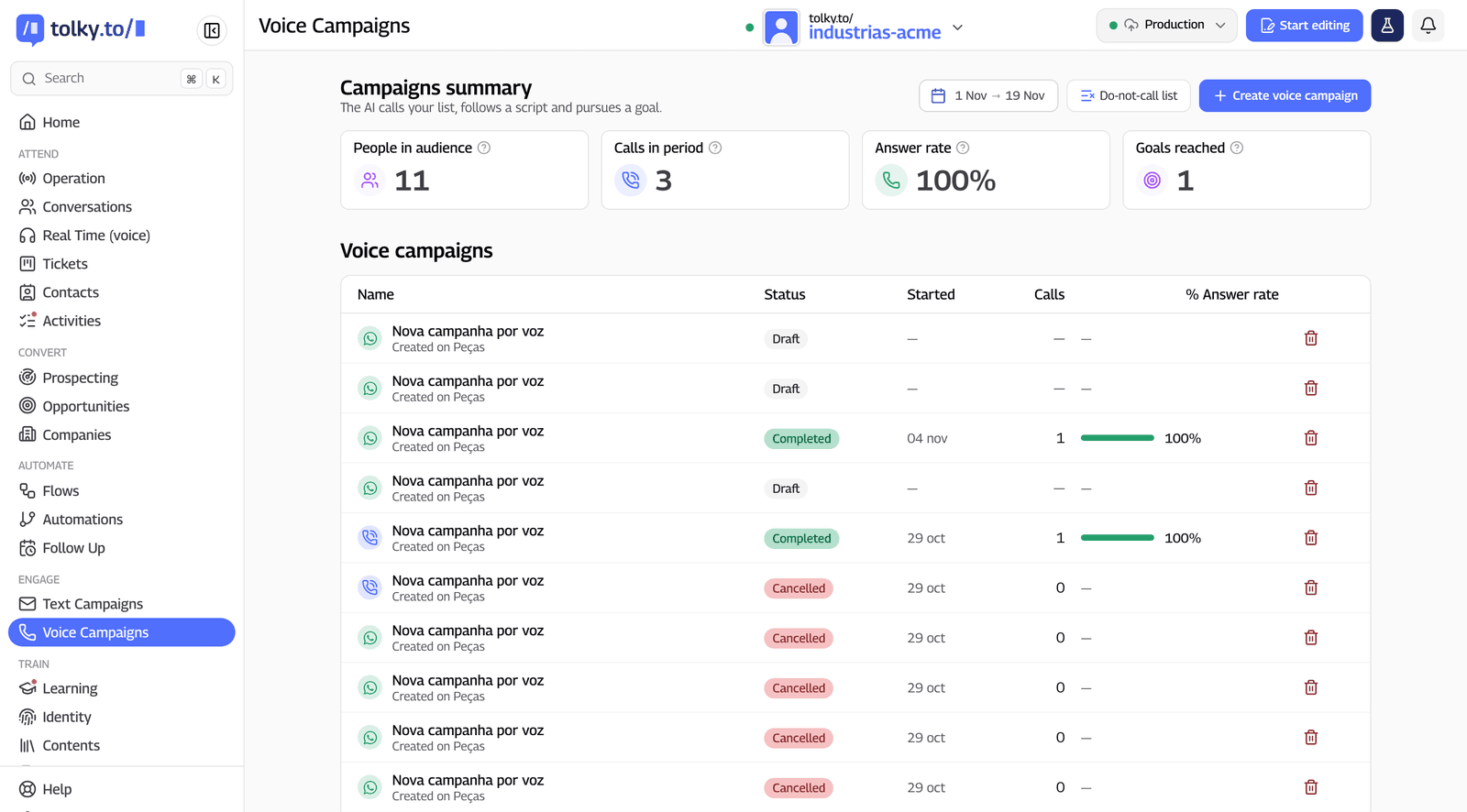
Tolky does not do voice broadcasting with recorded audio: in Voice Campaigns, the AI calls your contact list over WhatsApp, regular phone lines or both, holds a conversation, follows a script and pursues a goal. That is the Voice Campaigns solution.
- Goal and script. A goal in plain text or a flow node; an AI-generated script, with a rehearsal where you play the contact.
- Number protection. Gradual calling, skipping people called recently, a do-not-call list that applies to every campaign and an alert when the number may have been flagged as spam.
- Hours and retries. Calling windows, retries with an interval and a voicemail message.
- Transparency. A transcription notice at the start of every call, which cannot be turned off.
- Cost under control. A credit estimate before you start, a daily spending cap and cost per goal reached on the real-time dashboard.
Anyone who calls back is answered by Voice Service, available on activation, with the same AI and the transcript in the contact's history.
What Tolky does not do: it does not blast recorded audio to thousands of numbers at once, it is not a narration tool and it does not replace a legal review of your campaign. For one-way notices at very high volume, a voice broadcasting provider may be the right choice.
Frequently asked questions
What is voice broadcasting?
It is a recorded voice message sent by phone call to a list of numbers. When the person answers, they hear the audio and the call ends, sometimes with a keypress reply.
Is voice broadcasting allowed in Brazil?
Voice broadcasting itself is not banned, but it must respect the LGPD, the Não Me Perturbe registry in participating sectors and Anatel's rules on abusive calls. Since November 12, 2026, callers placing more than 1,000 calls per line or 10,000 in total per day, with 85% short calls, can have the line blocked for 15 days. Other countries have their own rules.
Is the 0303 prefix still required for mass calling in Brazil?
No. Anatel made 0303 optional under Acórdão nº 201 of August 14, 2025. The same decision requires call authentication from anyone placing more than 500,000 calls a month.
What is the difference between voice broadcasting and an outbound IVR?
Voice broadcasting only plays audio. An outbound IVR calls and offers a keypad menu to route the person, for example to reach an agent or confirm a detail.
Can an AI make mass calls?
Yes, and the difference is that it talks: it answers questions, handles objections, records who asks not to be called and transfers to a person. Volume and short-call rules apply all the same.
How do you keep your number from being blocked?
Call only people who have a relationship with the company, start with low volume, respect calling hours and the do-not-call list and track the answer rate.
Conclusion
Voice broadcasting still works for short, expected notices, but it does not talk, and mass calling to a cold list became risky under Anatel's November 2026 rules. When a call needs a reply, a result and care for your number, an AI voice campaign makes fewer empty calls and more conversations.
See Voice Campaigns, explore Voice Service, see the plans or talk to the team →. Let's talk?
Share
Tags
- voice broadcasting
- mass voice messages
- voice blast
- mass calling
- automated voice message
- mass calling software
- #voice campaigns
- #conversational CRM
Cited in
- AI for debt collection: voice agent calls and WhatsApp reminders
- AI that calls customers: use cases, rules and how to get started
- Inbound vs outbound IVR: differences, examples and when to use each
- Outbound IVR: what it is, how it works, pricing and the AI version
- Voicebot vs callbot: what they are and how voice agents differ
About the author

Co-founder of Tolky
Marlos Carmo is an AI entrepreneur and founder of Tolky, the conversational-era infrastructure and AI CRM that unifies intelligent service, multi-channel support (such as WhatsApp and voice), live CRM, and operational intelligence in a single ecosystem. He is a finalist for the SXSW Innovation Awards and a member of Francesco's Economy, a global network of young entrepreneurs focused on innovation and social impact. He works connecting Artificial Intelligence and digital transformation in projects for large organizations.
Next step
Want to bring this to your operation?
Tati, Tolky's AI assistant, understands your scenario in a few questions, suggests the best path and connects you with someone from the team, with full context.
Share