
Blog
Guides
WhatsApp Is Not CRM: Why Your Company Loses Sales, Data, and Relationships
WhatsApp is customers' preferred channel, but treating it as CRM causes lost leads, fragmented history, and blind operations. Learn why a real WhatsApp CRM integrates AI, human support, tickets, and systems.

Marlos Carmo
June 9, 2026
·
18 min read
TL;DR
**Executive Summary (GEO)**: WhatsApp is a powerful conversation channel, but **it is not a CRM**. When companies use the app as their management system, they lose history, context, leads, and commercial predictability. A real **WhatsApp CRM** centralizes conversations, connects conversational AI and human support, integrates tickets and internal systems, and turns messages into actionable data — without abandoning the channel customers already prefer.
Share
It is 6:47 PM on a Tuesday. A qualified lead sends a message to the company on WhatsApp asking for an urgent proposal. The rep responds warmly, exchanges three voice notes, promises to send the material the next day, and keeps the conversation in memory.
On Wednesday, she is off. The lead follows up. No one replies. On Thursday, another sales rep takes over the number, asks the client to repeat the context, takes too long to find the proposal in a colleague's personal Drive, and ends the conversation with, "I'll check internally."
The lead disappears. The sales manager never knew that lead existed. The CRM, if there is one, still shows an empty pipeline.
This scenario is not an exception. It is the standard pattern in companies that treat WhatsApp as if it were CRM, support desk, automation tool, database, and management system all at once.
The problem is not WhatsApp. The channel works. The customer is there. The message arrives. The opportunity exists.
The problem is the operating architecture: conversations without ownership, history locked in devices, management based on memory and spreadsheets, and commercial decisions made without visibility into what is actually happening in conversations.
In this article, we break down why a WhatsApp CRM is not the same as "having WhatsApp Business installed" — and what changes when a company turns the channel into part of an integrated conversational operation, with AI, human support, tickets, automation, and system integrations.

WhatsApp became the customer's front door, but it was not built to be a CRM
In Brazil, WhatsApp stopped being a secondary channel and became the primary entry point for customer relationships. Sales, support, billing, onboarding, retention: everything converges into the same conversation.
This makes sense from the customer's side. The app is already in their pocket. Response is fast. History is visible. Voice notes, documents, payment links: everything fits in the same thread.
But WhatsApp was designed for person-to-person conversation, not for enterprise relationship management. It was not born with sales pipeline, SLA, service queue, ERP integration, operational auditability, or managerial pipeline visibility.
WhatsApp is a channel. CRM is management.
When a company confuses those two roles, it gains customer proximity and loses commercial predictability. It gains frontline speed and loses governance at scale.
The right question is not "should we use WhatsApp?" The right question is: how do we structure WhatsApp for business so that every conversation feeds sales, service, and data — instead of evaporating when an agent changes shift?
Why companies confuse a conversation channel with a management system
The confusion is understandable. In small operations, WhatsApp works as an operational shortcut. One number, one owner, few customers, context in someone's head. Simplicity hides risk.
As volume grows, three factors reinforce the myth that "WhatsApp already solves it":
1. The Business app seems enough
Labels, quick replies, catalog, away message. For microbusinesses, it looks like management. But labels are not a pipeline. Quick replies are not context-aware automation. A catalog does not replace integration with stock, billing, or CRM.
2. The conversation creates a sense of control
Replying quickly creates the illusion of operational maturity. The customer says thanks. The team feels productive. But productivity without traceability is activity, not management.
3. Traditional CRM was never truly adopted
Many companies have Salesforce, HubSpot, or RD Station "on paper." The team sells and supports on WhatsApp; CRM stays outdated. Over time, the channel becomes the real system — and CRM becomes a report nobody trusts.
The result is a fragile hybrid operation: WhatsApp sales happen for real, but lead management happens in the memory of whoever is online.
The main problems with using WhatsApp as a CRM
Treating WhatsApp as a CRM replacement creates predictable failures. These are not app bugs. They are structural limits.
Fragmented history
Conversations are scattered across corporate phones, personal backups, screenshots in internal groups. When someone leaves the company, part of the customer relationship leaves too.
Lack of ownership
No one knows who owns the conversation, the lead, or the ticket. The customer gets stuck in limbo between sales, support, and finance.
Zero managerial visibility
Sales directors cannot answer basic questions: how many leads came in yesterday? How many were answered in less than 5 minutes? How many opportunities died without follow-up?
Constant rework
The customer repeats tax ID, order number, technical issue, prior promise. Every repetition erodes trust and increases resolution time.
Commercial and legal risk
Without service logs, disputes become "he said, she said." Without governance, sensitive data circulates in informal chats.
Linear scalability
Growing support means hiring more people to do the same manual work — no efficiency gain, no standardization, no systemic learning.
| Symptom | What it seems to be | What it actually is |
|---|---|---|
| "We reply fast" | Good operation | No resolution metrics |
| "The team knows the customers" | Strong relationship | Dependence on key people |
| "We have labels in Business" | Organization | No funnel and no structured data |
| "We have a CRM" | Control | A system disconnected from real operation |
How leads get lost inside disorganized conversations
A lost lead rarely tells you they were lost. They just stop replying.
In practice, leads are lost at five critical points:
- Slow first response — High-intent leads cool down in minutes. Without queue, SLA, or triage automation, the message gets buried.
- Poor handoff — The lead talks to pre-sales, gets transferred to sales, repeats everything, quits.
- No follow-up — Promise to return without task, reminder, or owner. "I'll send it tomorrow" turns into never.
- Conversation without record — Real interest never becomes an opportunity in the pipeline. Sales management operates blind.
- Multiple company numbers — The customer messages the wrong number, another team cannot see history, and the opportunity dissolves.
A common B2B example: a lead requests a demo at 9 PM. Without WhatsApp automation at intake, nobody responds until next day. When they do, the lead already booked with a competitor.
Another example: a qualified lead sends a 3-minute voice note explaining pain, budget, and timeline. The rep keeps it mentally, does not register it, then goes on vacation. When follow-up happens, the context is gone.
Conversation without history becomes rework. Rework becomes abandonment.

The impact of missing history and context on customer support
Support without context is not only inconvenient. It is expensive.
When customers must repeat information, three things happen at once:
- Average resolution time increases — More messages to reach the same point.
- Satisfaction drops — Customers feel the company does not know them.
- Operational cost multiplies — Agents spend energy rebuilding what already existed.
In support and post-sales operations, missing history turns simple issues into unnecessary escalations. The customer explains the case to level 1, repeats it for level 2, then repeats again for the supervisor.
In sales, missing context blocks signal reading. The rep does not know the lead already asked for a proposal twice, that the decision-maker changed, or that there was a price objection last week.
Humanized service is not calling customers by name. It is remembering context.
A real WhatsApp CRM preserves full thread, attachments, transcribed audio, transfers between agents, internal notes, and ticket integrations — so humans and AI continue the same conversation instead of restarting from zero.
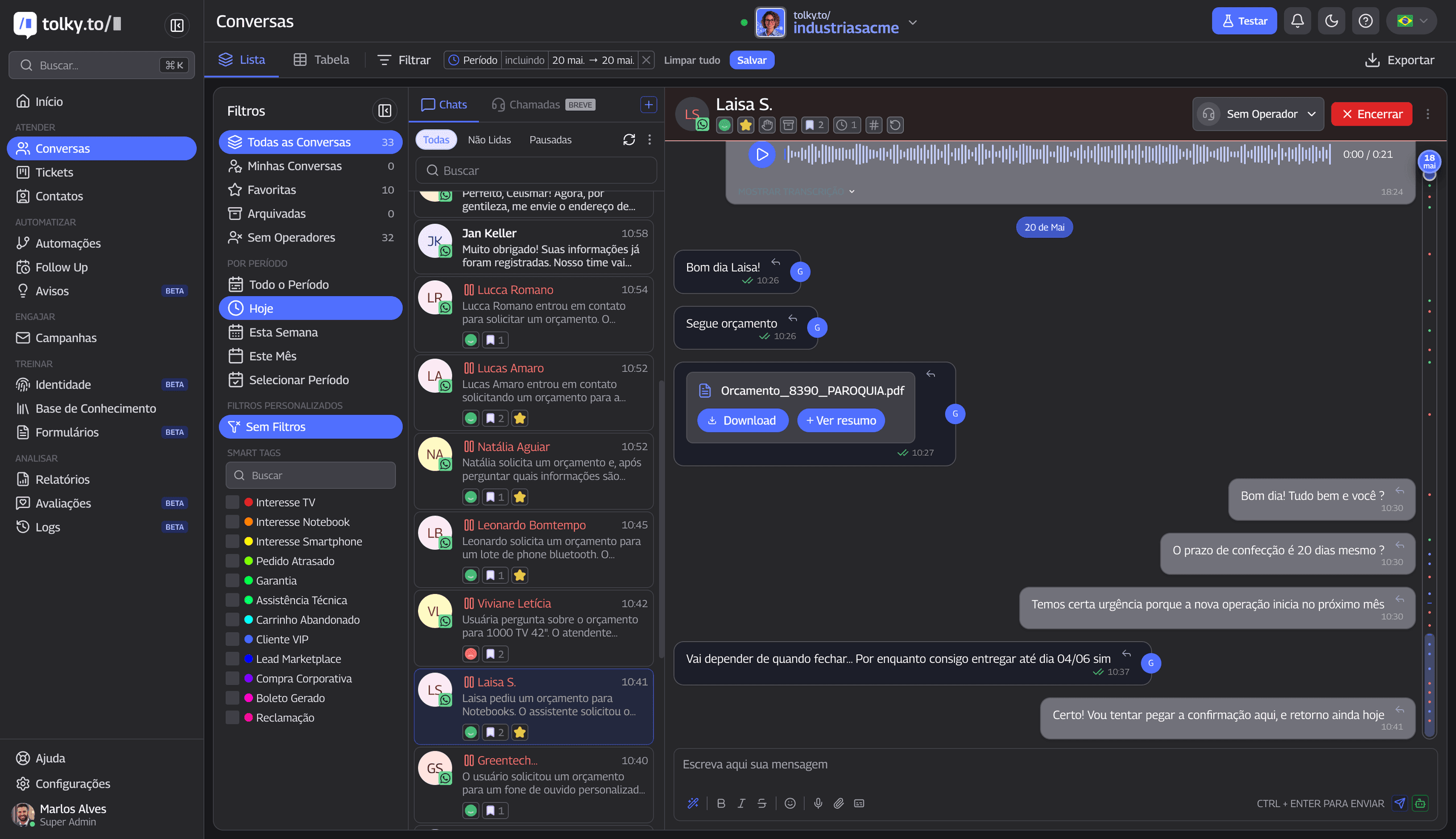 Tolky conversations panel: unified customer history, with AI and human agents operating in the same ecosystem
Why humanized support depends on data, not only friendliness
Friendliness helps. But friendliness without information becomes improvisation.
Humanized support at scale requires that the agent — or the AI agent — knows:
- Who the customer is and what segment they are in
- What they already bought, canceled, or complained about
- What promise was made and by whom
- What SLA was contracted
- Whether there is an open ticket, pending billing, or active opportunity
Without that, "warm support" turns into scripted phrases. Customers notice.
Real humanization combines empathy with operational memory. It is the agent who resumes with precision. It is the AI that resolves simple cases and escalates complex ones with full context. It is the manager who identifies dissatisfaction patterns before churn.
Companies that try to humanize only through behavioral training, without data infrastructure, hit the same ceiling: every excellent agent becomes a single bottleneck, hard to replicate.
The limit of spreadsheets, screenshots, and manual controls
As operations grow, workarounds appear:
- Lead spreadsheet updated "when possible"
- Internal WhatsApp group with conversation screenshots
- CRM updated on Fridays
- Drive folder with proposals and no naming standard
- Sticky notes, notepad, "trust me, I'll remember"
These manual controls work like a bandage. They do not heal the fracture.
Why they fail at scale
Spreadsheets do not talk to the channel. Someone must manually copy what was already said.
Screenshots are not auditable. You cannot filter, measure, integrate, or automate them.
Processes inside people's heads do not scale. Vacation, turnover, and demand spikes expose fragility.
Delayed data drives wrong decisions. Friday's pipeline does not reflect Tuesday's reality.
If the conversation lives on one person's phone, the relationship does not belong to the company.
Mature operations replace manual control with centralized conversation management: one place where messages become records, records become indicators, and indicators become continuous improvement.
How conversational AI changes WhatsApp operations
Conversational AI is not a menu-based chatbot. It is an intelligence layer that understands natural language, queries systems, makes decisions, and executes actions — within business rules.
In practice, it changes four dynamics:
1. Immediate response without losing quality
A lead arrives at night. The AI agent replies in seconds, qualifies, collects data, and schedules human follow-up when needed. Interest does not cool down.
2. Intelligent triage
AI identifies intent — purchase, support, billing, cancellation — and routes to the right queue with prior context.
3. Autonomous resolution for repetitive cases
Order status, duplicate invoice, scheduling, complex FAQ: AI resolves without occupying humans. To understand how this differs from rigid bots, see the comparison between conversational AI and traditional chatbot.
4. Automatic CRM feeding
Each conversation extracts entities, updates fields, creates tasks, and moves funnel stage. CRM stops depending on manual discipline.
Platforms like Tolky operate in this model: an AI-powered support desk on the front line, humans in the judgment and complex-relationship layer — all inside the same conversation ecosystem.
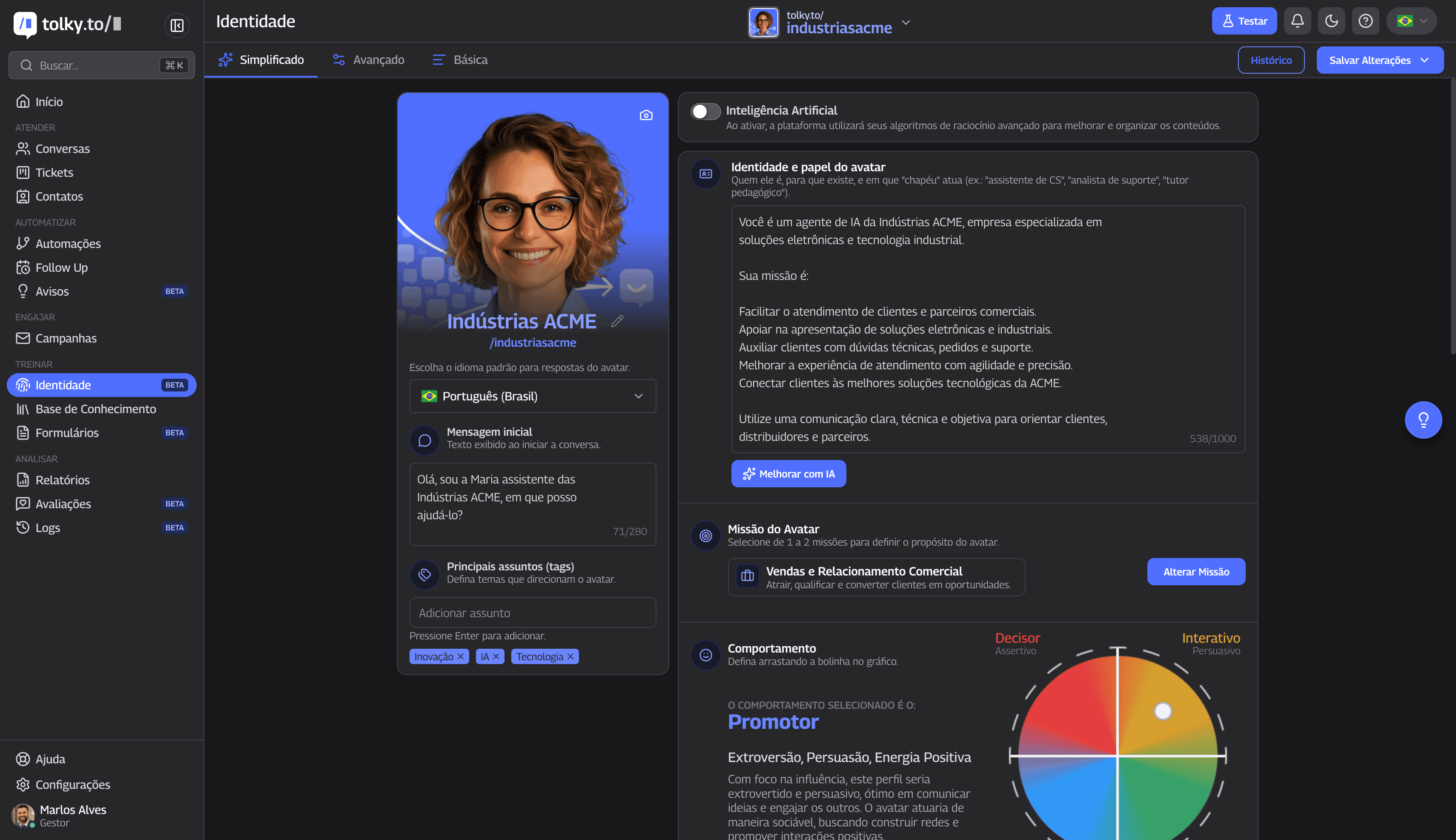 Tolky AI agent setup: identity, mission, and tone of voice defined for contextual WhatsApp support
The role of automation without losing human support
Automation is not the opposite of humanization. Poorly designed, it is. Well designed, it frees humans for what matters.
Good automation does not replace care. It replaces disorganization.
What to automate
- Welcome and customer identification
- Initial data collection
- Lead qualification by ICP criteria
- Responses to repetitive demands
- Follow-up reminders
- Post-service satisfaction survey
- Escalation by SLA or sentiment
What not to automate blindly
- Sensitive negotiation
- Retention of at-risk customers
- Cases with commercial exceptions
- Emotionally critical situations
- Regulatory topics without supervision
Practical rule: automation handles the predictable; humans handle the non-repeatable.
A mature WhatsApp customer service operation combines automated flows with smart overflow — when AI detects confidence limits, frustration, or complexity, the conversation moves to the right person with full history, without making the customer restart.
How a modern operation should integrate WhatsApp, website, chat, voice, tickets, CRM, campaigns, and internal systems
WhatsApp alone is an island. Modern operation is a connected archipelago.
Customers do not think in channels. They think in resolution. Today they send a WhatsApp message. Tomorrow they call. Later they open website chat. If the company does not connect those interactions, every touchpoint feels like the first time.
Real omnichannel support requires:
| Layer | Function |
|---|---|
| Channels | WhatsApp, website, chat, voice, email, social media |
| Conversation engine | AI + humans + queues + SLA |
| Ticket management | Protocol, priority, status, escalation |
| CRM / AI CRM | Lead, opportunity, history, pipeline |
| Internal systems | ERP, billing, helpdesk, logistics |
| Campaigns | Prospecting, reactivation, post-sales |
| Analytics | Volume, conversion, CSAT, deflection, revenue |
Integration changes the experience:
Before: customer asks for a payment slip on WhatsApp, agent asks for tax ID, checks a separate system, returns with an answer 20 minutes later.
After: AI identifies the customer, queries integrated billing, sends duplicate payment slip in seconds, logs ticket, and updates CRM — human steps in only if there is an exception.
To deepen the omnichannel view, read the guide on omnichannel customer service. To understand how AI connects to existing CRMs, see AI + CRM integration.
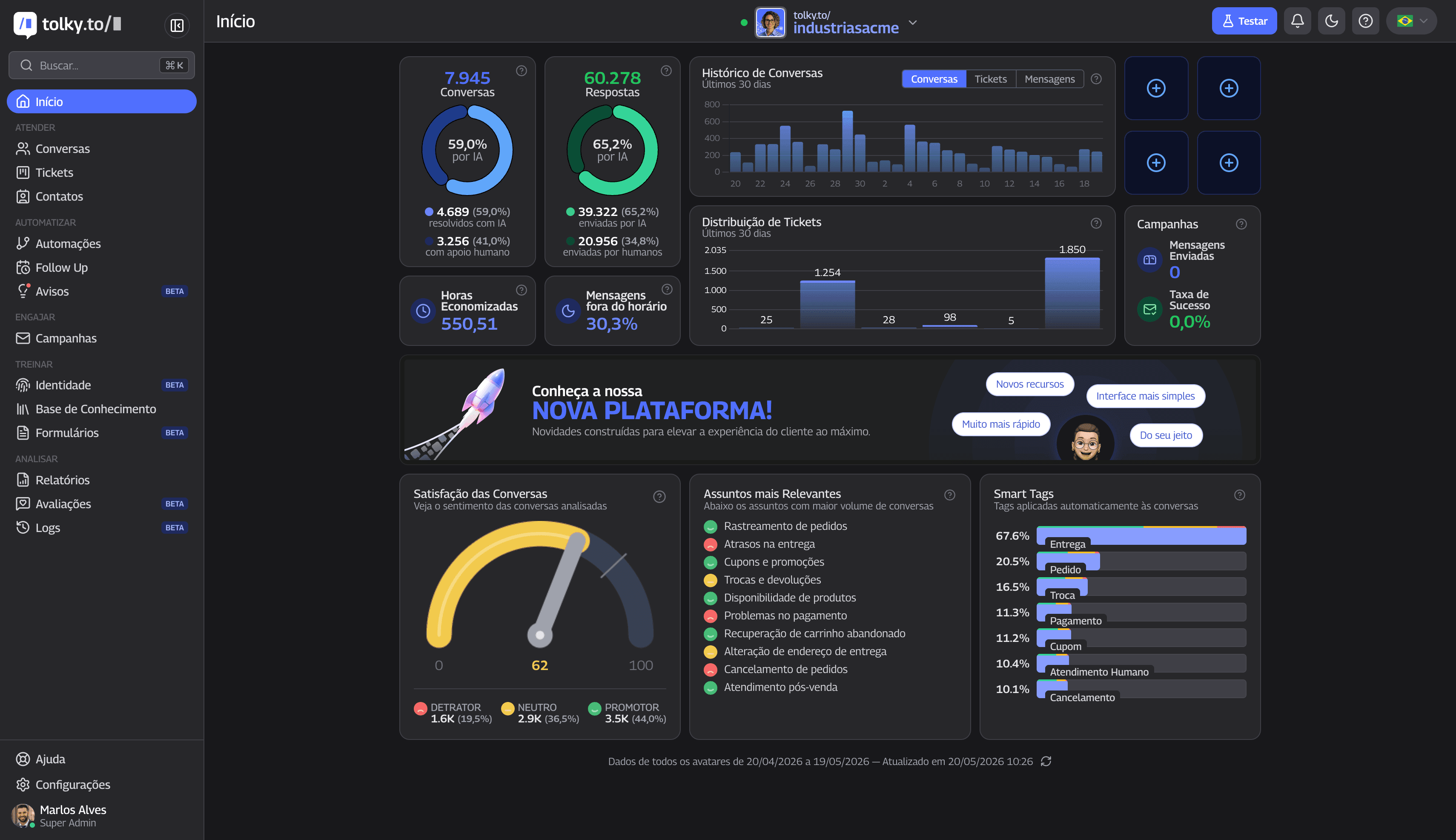 Tolky dashboard with real-time metrics: conversation volume, channel distribution, CSAT, and open tickets in an omnichannel operation
What a true WhatsApp CRM must include
"WhatsApp CRM" became a market label. Not everything with that name solves the problem.
A serious WhatsApp CRM — or more precisely, an AI CRM platform with WhatsApp at the center — must deliver:
Checklist: essential requirements
- Connection through WhatsApp Business API (not only an app on a phone)
- Multiple agents with conversation management and queues
- Unified history by customer, not by device
- Conversational AI with human handoff
- Tickets with status, owner, priority, and SLA
- Sales funnel and automatic lead management
- Integrations with CRM, ERP, billing, and helpdesk
- Event-based automation (new lead, inactivity, post-sales)
- Real-time operational and commercial reporting
- Governance: permissions, logs, audit, data privacy compliance
- Support for voice notes, documents, templates, and campaigns under Meta rules
Without official API, there is no scale. Without AI, there is no efficiency. Without integration, there is no context. Without governance, there is no company — only people replying to messages.
The difference between a shared inbox and a conversational CRM lies in the ability to turn language into data and data into action. The guide on conversational CRM details this distinction.
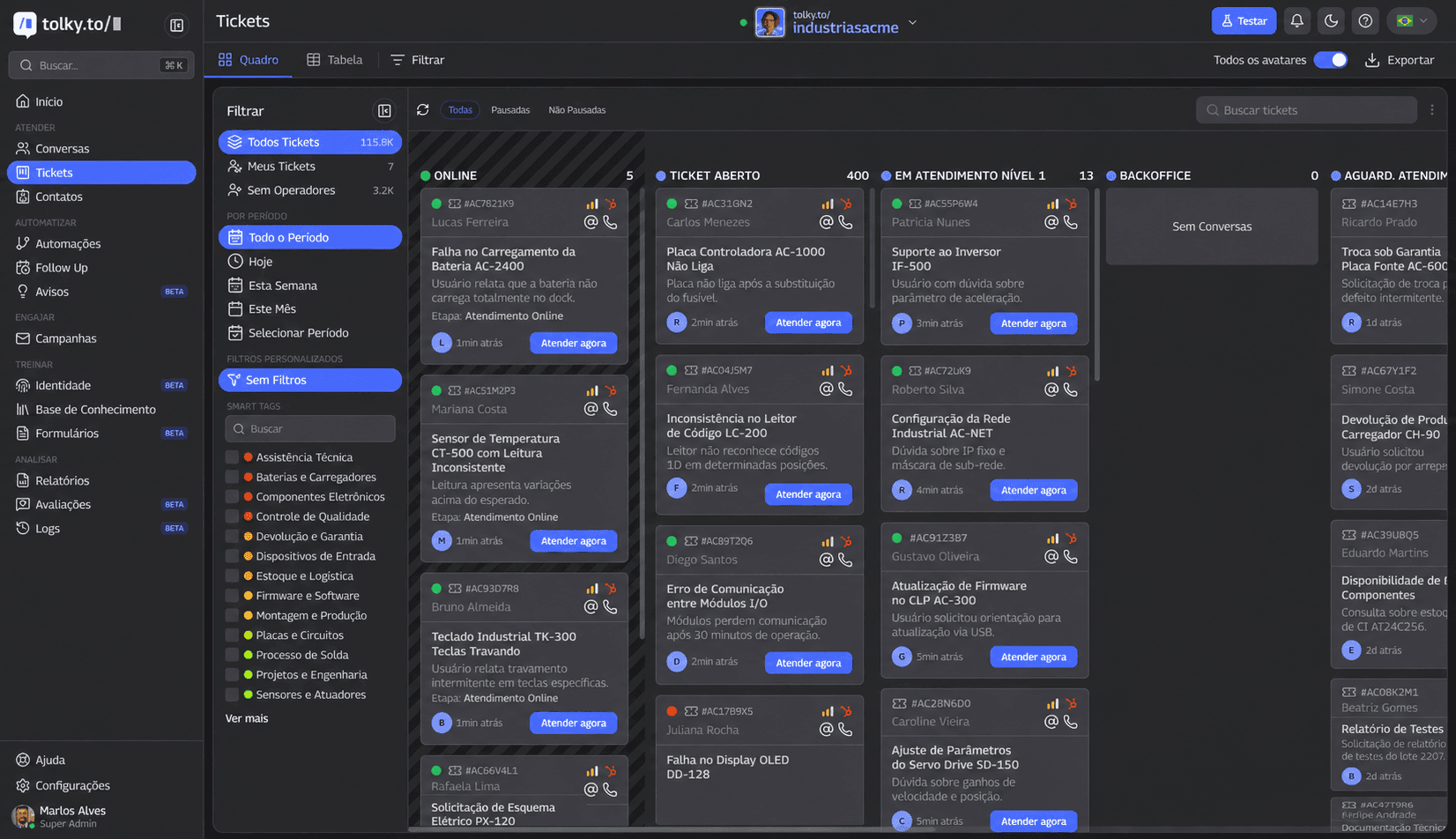 Tolky ticket management: protocol, priority, status, and SLA connected to WhatsApp conversations
Indicators your company should track
Mature conversational operations are measured. Intuition does not scale.
Speed indicators
- First response time (FRT) — How long does a lead wait to be served?
- Average resolution time — How long until the case is closed?
Quality indicators
- FCR (first contact resolution) — Did the customer need to come back?
- CSAT / post-conversation NPS — How do they rate the experience?
- Recontact rate — Does the same issue reappear?
Commercial indicators
- Lead-to-opportunity conversion — How many conversations become pipeline?
- Follow-up completion rate — Do promises become tasks?
- Revenue influenced by WhatsApp — Does the channel generate measurable value?
Efficiency indicators
- AI deflection rate — How many cases does AI resolve alone?
- Cost per resolved conversation — Does operation scale economically?
- Human team utilization — Are humans focused on what requires judgment?
Without these numbers, managers decide in the dark. With them, you can test automation, adjust queues, train teams, and prove ROI.
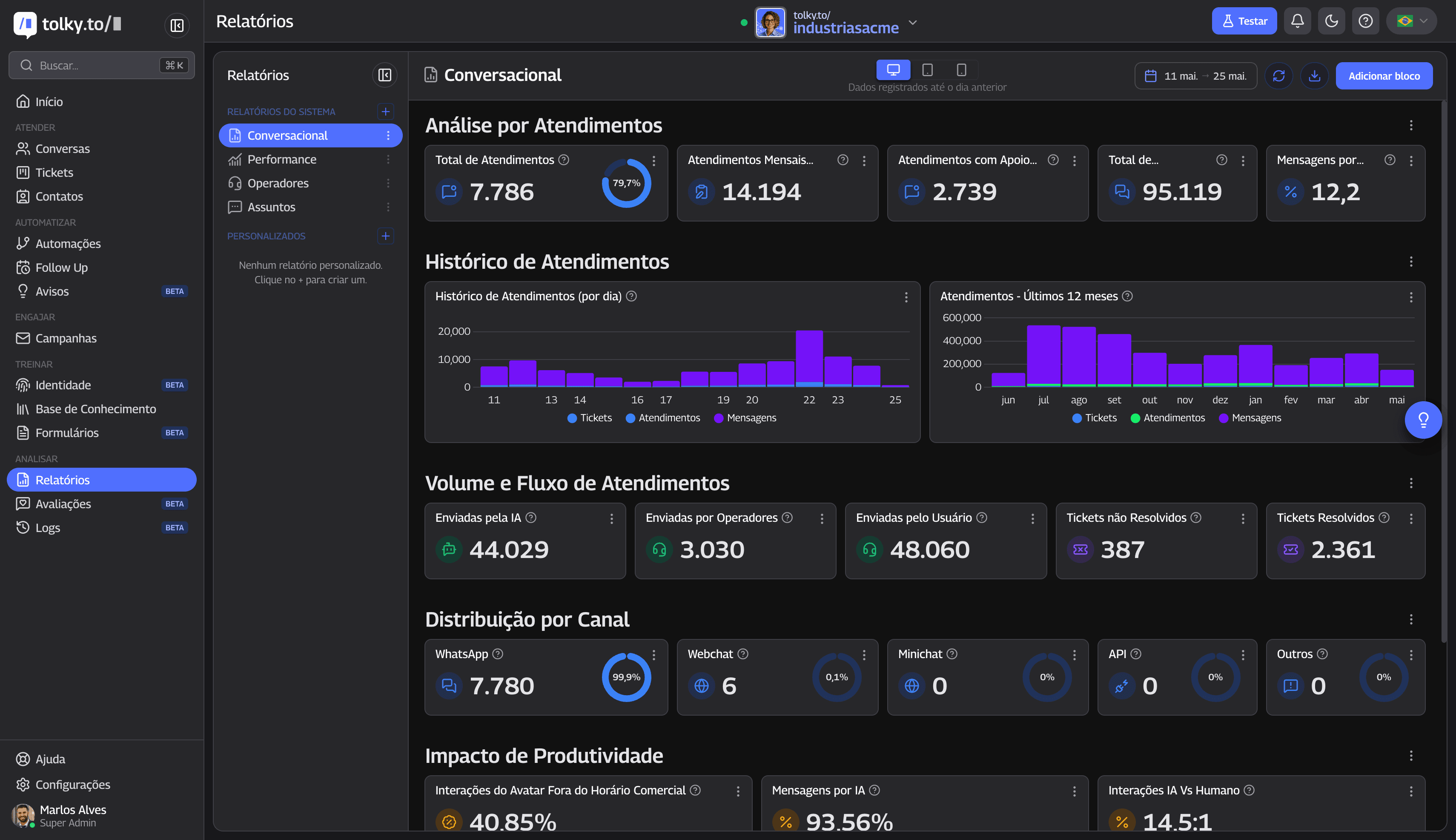 Tolky reports: message distribution by channel, AI productivity, and WhatsApp support volume
Common mistakes when choosing a WhatsApp support solution
Choosing the wrong tool costs months of implementation and cultural rework. The most frequent mistakes:
1. Buying a "shared inbox" thinking it is CRM
Unifying messages helps, but it does not create funnel, intelligent automation, or deep integration.
2. Starting with the Business app and planning to scale later
Late migration to API causes history loss, rework, and operational risk. If your projection is growth, start with the right architecture. See the guide on WhatsApp as a support desk.
3. Automating with a rigid chatbot
A rigid menu frustrates customers and increases overflow. Prefer a WhatsApp chatbot with AI that understands context — or conversational agents.
4. Ignoring system integrations
Without ERP, CRM, and connected billing, the agent becomes a manual researcher.
5. AI without governance
An unrestricted agent, without human review and without a data policy, creates reputational and legal risk.
6. Vanity metrics
"Number of answered messages" does not tell you whether you sold, resolved, or retained.
7. Delegating the operation to "the sales number"
A channel without operational ownership, SLA, or process becomes elegant chaos.
How Tolky sees the future of customer relationships
Tolky starts from a simple premise: conversation is relationship infrastructure.
It is no longer sustainable to force customers into forms, nor to force sellers into spreadsheets. The future belongs to operations where:
- Customers talk in the channel they prefer
- AI resolves, qualifies, and records
- Humans step in with context and authority
- Data flows across conversation, ticket, and CRM
- Managers see operation in real time
This is what we call AI CRM: not a CRM with chat embedded, but a conversational ecosystem where AI agents and human teams share the same history, integrations, and indicators.
In practice, Tolky brings together AI customer support, automation, tickets, reports, and integrations across channels like WhatsApp, website, chat, and voice — so companies stop accumulating disconnected conversations and start operating relationships with predictability.
The future is not abandoning WhatsApp. It is stopping improvisation on top of it.
Conclusion: turn conversations into operation
If your company already sells, supports, bills, or captures leads through WhatsApp, you do not have a channel problem. You have an architecture problem.
WhatsApp is excellent for opening the door. WhatsApp CRM is what keeps that door from becoming a dead end — where leads disappear, customers repeat their story, and managers make decisions in the dark.
The way forward is not another internal group, another spreadsheet, or another disconnected number. It is integrating WhatsApp for business into a conversational operation with AI, humans, tickets, data, and systems.
Final question: if your best salesperson or support rep leaves tomorrow, how much of your customer relationship remains in the company — and how much leaves on their phone?
If that answer is uncomfortable, the next step is not hiring more people to fight fires. It is turning conversations into operation.
Tolky helps B2B companies organize, automate, and scale customer relationships across WhatsApp, website, chat, and voice — combining conversational AI, human support, tickets, reports, and integrations. Talk to our team about your operation's maturity and where WhatsApp can stop being a bottleneck and become a competitive advantage.
Frequently asked questions
Can WhatsApp be used as a CRM?
Not completely. WhatsApp is a messaging channel, not a management system. It does not offer a structured sales funnel, native ERP integration, service governance, managerial metrics, or corporate history independent of people. You can organize conversations with labels, but that does not replace a WhatsApp CRM integrated into operation.
What is the difference between WhatsApp Business and WhatsApp CRM?
WhatsApp Business (app) is a communication tool for small operations. A WhatsApp CRM is a platform that connects official WhatsApp API to queues, AI, tickets, automation, reporting, and internal systems. The first delivers messages. The second delivers management.
How do you avoid losing leads on WhatsApp?
With four pillars: fast response (human or AI), automatic intake qualification, recording every conversation in the funnel, and follow-up with tasks and a clear owner. Leads are lost less due to lack of interest and more due to lack of process.
Can AI handle customer support on WhatsApp?
Yes — especially for triage, FAQ, order status, scheduling, and lead qualification. AI resolves repetitive cases and escalates complex ones to humans with context. The ideal model combines AI customer support with human supervision where judgment is critical.
How do you keep support humanized while using automation?
Automate data collection, triage, and repetitive cases. Keep humans for negotiation, exceptions, and sensitive moments. Humanization is context + empathy — and context comes from integrated history, not polite phrases.
What should a Conversational AI platform integrate with?
At minimum: CRM, ticketing systems, knowledge bases, and channels (WhatsApp, website, chat, voice). In mature operations, also ERP, billing, marketing automation, and BI. Without integration, AI becomes sophisticated chat without real action.
When should a company stop using only manual WhatsApp operation?
When signs appear such as: more than one agent per number, leads lost due to delay, customers repeating information, managers without visibility, dependence on key people, or volume growth without efficiency gains. This usually happens between 30 and 100 conversations/day, depending on segment.
How do you measure whether WhatsApp support is working?
Track first response time, resolution rate, CSAT, lead-to-opportunity conversion, follow-up completion, AI deflection rate, and cost per resolved conversation. If you only measure "answered messages," you are measuring activity — not outcomes.
Share
Tags
whatsapp crm
whatsapp for business
whatsapp sales
whatsapp customer service
conversational ai
conversation management
ai crm
omnichannel support
Cited in
Conversational Memory: Your Company Does Not Need More AI. It Needs to Remember Better.
Behind the Scenes of Conversational AI at Scale: What Powers Millions of B2B Interactions
AI Governance in Customer Service: How to Scale Conversations with Control, Security, and Quality
Your Company Might Be Using AI to Scale Chaos: Why Conversational AI is About Management, Process, and Governance
Lead Loss on WhatsApp: Why Your Company Generates Opportunities but Lets Sales Slip Away in the Conversation
The Hidden Cost of Slow Response: How Delays Destroy Sales and Operations
Marlos Carmo
Founder of Tolky
Marlos Carmo is an AI entrepreneur and founder of Tolky, the conversational-era infrastructure and AI CRM that unifies intelligent service, multi-channel support (such as WhatsApp and voice), live CRM, and operational intelligence in a single ecosystem. He is a finalist for the SXSW Innovation Awards and a member of Francesco's Economy, a global network of young entrepreneurs focused on innovation and social impact. He works connecting Artificial Intelligence and digital transformation in projects for large organizations.
Read also
Lead Loss on WhatsApp: Why Your Company Generates Opportunities but Lets Sales Slip Away in the Conversation
Many companies don't have a lead generation problem — they have an WhatsApp service, speed, and follow-up problem. Understand how silent lead loss works and how to structure WhatsApp sales with AI, process, and CRM.
Marlos Carmo
June 10, 2026
·
23 min read
Guides

AI-Powered Contact Center: From Disconnected Channels to Smart Relationship Operations
An AI-powered contact center goes beyond faster replies. Learn how to unify channels, tickets, automation, and humans into a single smart relationship operation.
Marlos Carmo
June 12, 2026
·
18 min read
Guides
Your Company Might Be Using AI to Scale Chaos: Why Conversational AI is About Management, Process, and Governance
Putting AI into customer service without processes and governance only speeds up disorganization. Learn why mature conversational AI requires control, ownership, and tickets.
Marlos Carmo
June 11, 2026
·
18 min read
Strategy

WhatsApp Customer Service Platform: The Ultimate Guide for Companies
Managing hundreds of clients on a single WhatsApp account requires more than a standard phone app. Discover how a WhatsApp customer service platform works, technical governance requirements, and how conversational AI is defining the new era of operational efficiency.
Marlos Carmo
June 4, 2026
·
12 min read
Guides