WhatsApp Pay in Brazil: what works today, Pix and its history
WhatsApp Pay in Brazil in 2026: the story since 2020, what works today for people and businesses, how Pix fits into the chat and the precautions for collecting payments on WhatsApp safely.
TL;DR
WhatsApp Pay is the popular name for WhatsApp's payments feature, launched in Brazil in 2020, suspended by the Central Bank days later and gradually allowed back from 2021. As of November 2026, the main path for businesses is to request payment in the chat with a Pix code (Brazil's instant payment system), a payment link or a boleto, with the payment made in the bank app or with the business's provider, which confirms the transaction: WhatsApp carries the request but does not reconcile the payment.
Share
"Can I pay through WhatsApp?" The answer has changed several times since 2020. There was a launch with fanfare, a suspension by Brazil's Central Bank, a comeback for transfers between people, payments to small businesses, the end of debit cards and, now, Pix taking center stage.
For anyone who sells or collects payments on WhatsApp, what matters is the present: what works today, who confirms the payment and how to avoid scams. This guide separates history from what is in effect, with official sources checked on November 23, 2026. Brazil is the focus because it is where WhatsApp Pay has had the longest and most turbulent run.
Updated November 2026.
What is WhatsApp Pay?
WhatsApp Pay is the popular name for WhatsApp's payments feature, officially called payments on WhatsApp, which lets people send money or pay businesses without leaving the chat in the countries where it is available. In Brazil it ran on cards and, today, payment requests in the chat revolve around Pix, the instant payment system run by the Central Bank.
The point that confuses many people: WhatsApp is not a bank or a digital wallet. It carries the payment request to the customer, and the money moves through a bank, a card processor or a payment provider. The Help Center page on encryption notes that payments are not end-to-end encrypted, because financial institutions need the data to process the transaction.
WhatsApp Pay timeline in Brazil
WhatsApp Pay debuted in Brazil in June 2020, was suspended by the Central Bank a week later and came back in stages: transfers between people in 2021, payments to small businesses in 2023 and Pix from 2024. The table summarizes each step with its source.


| Date | What happened | Source |
|---|---|---|
| June 15, 2020 | Launch in Brazil: sending money between people and paying businesses, with Visa and Mastercard cards and Cielo as processor | Meta |
| June 23, 2020 | The Central Bank orders Visa and Mastercard to suspend payments and transfers on WhatsApp, citing competition | CNN Brasil |
| March 30, 2021 | The Central Bank authorizes transfers; purchases through Facebook Pay remain under review | Agência Brasil |
| May 4, 2021 | Transfers between people with debit cards begin | Mastercard |
| April 11, 2023 | Customers can pay small businesses in the chat, with cards and partners such as Cielo, Mercado Pago and Rede | Meta |
| June 6, 2024 | Meta announces Pix as a more structured payment option for businesses | Meta |
| December 19, 2024 | Sending money between people with a debit card ends | Tecnoblog |
| January 15, 2026 | A payments partner announces the end of the WhatsApp Business payments service by Meta's decision, with migration to payment links | Getnet |
| March 9, 2026 | A report says WhatsApp will test Pix without leaving the chat, through a payment initiator | Mobile Time |
Sources checked on November 23, 2026. The timeline shows the pattern: every version of WhatsApp Pay in Brazil was shaped by Pix and by the Central Bank.
What works today for people?
As of November 2026, the WhatsApp Help Center describes, for Brazil, payments to businesses registered on WhatsApp; sending money between people with a debit card ended in December 2024. To send money to a friend, the practical route is Pix through the bank app.
The participating countries page, checked on November 23, 2026, says you can send payments to businesses registered on WhatsApp in India, Brazil, Mexico and Indonesia. It does not mention transfers between people in Brazil.
When Tecnoblog reported the end of debit, WhatsApp said the payments service would be kept for other options. Since partners and options have changed since then, check your app, under Settings, to see whether the payments option appears for you.
What works today for businesses?
Today, businesses collect payments on WhatsApp in two official ways: in the Business app, by sharing their Pix key in the chat, and on the official API, by sending orders with a Pix code, payment link or boleto generated by the business's payment provider. In neither case does WhatsApp confirm the payment for you.


- WhatsApp Business app. The page on Pix integration shows that a business registers a Pix key and shares it as a quick reply, a charge or an attachment. The feature is only available in Brazil, allows one key at a time and does not appear in groups, in chats with foreign numbers or in chats with businesses connected to the API. The customer pays the Pix in their bank app.
- Official API. The Payments API for Brazil lists dynamic Pix codes, payment links, boleto (a Brazilian bank payment slip), one-click card payment outside the chat, an order details template and a template with a payment button. The documentation says WhatsApp does not reconcile payments: the business checks the payment with its bank or provider using the order's reference code.
- Cards inside the chat. In January 2026, Getnet told its customers that the WhatsApp Business payments service would be discontinued by Meta's decision and that sales would continue with payment links. If your business used that feature, check with your partner what applies to your account.
In practice, collecting payment on WhatsApp has become a conversation with a button: the business sends the order summary and the code, and the payment happens at the customer's bank.
How does Pix on WhatsApp work in practice?
Pix on WhatsApp works in four steps: the business generates a Pix code with its bank or provider, sends it in the chat, the customer copies it and pays in the bank app, and the business confirms the payment and updates the order. That is the flow described in the Payments API Pix documentation, checked on November 23, 2026.
- Generate the code. The business integrates with a bank or payment service provider (PSP) to create a dynamic Pix code for each order.
- Send the request. The message carries the items, the amount and a "Copy Pix code" button.
- Pay at the bank. The customer copies the code, opens the bank app and pastes it. The documentation also allows the code to open the bank app directly.
- Confirm. The business checks the payment with its PSP and sends an order update marking it as paid. In the redirect flow, WhatsApp marks the order as paid when the customer's bank completes the transaction.
The next step reported by the press is paying without leaving the chat. According to Mobile Time, on March 9, 2026, WhatsApp would test a payment initiator: a bank window would open only to authenticate and then close, offered first to API partners. As of this review, we found no official Meta announcement of a general launch.
What precautions should you take when collecting payment on WhatsApp?
To collect payment on WhatsApp safely, use an official business number, generate Pix codes per order with your provider and confirm the payment at the bank, never from a receipt sent in the chat. Payment collection is the scammers' favorite ground.
| Way to collect | Where the customer pays | Who confirms the payment | Good for |
|---|---|---|---|
| Pix key in the Business app | The customer's bank app | The business, on its statement | A small business with few orders a day |
| Dynamic Pix code via the API | The customer's bank app | The business's PSP, through integration | Operations with many orders and automatic reconciliation |
| Payment link | The provider's page | The provider | Cards, installments and higher-value sales |
| Boleto | The customer's bank or app | The issuing bank | Recurring billing and business customers |
Three precautions that prevent losses:
- Show who is collecting. The recipient name on the Pix must match the business name. An official business account helps customers recognize the real number.
- Don't trust screenshots. A receipt sent in the chat can be edited. Confirm on your statement or with your provider.
- Say what you never ask for. Passwords, verification codes and payment to another number. The guide to WhatsApp scams covers the most common scams against businesses and customers.
Where Tolky fits
Tolky is an AI conversational CRM that organizes payment collection conversations on WhatsApp through the official API, with reminders, campaigns and AI agents, but it does not process payments. The money still moves through your bank or provider.
- Collection campaigns: Meta-approved templates, with variables and a button to copy the Pix code, in text campaigns.
- Conversation: AI answers questions about the boleto or the due date and hands anything that needs negotiation to the team, in WhatsApp customer service.
- Integration: in Flows, HTTP requests, webhooks and the REST API connect the conversation to the system that generates the charge and confirms the payment.
- Voice: for late payments, AI can also call; see AI for debt collection and debt collection chatbot.
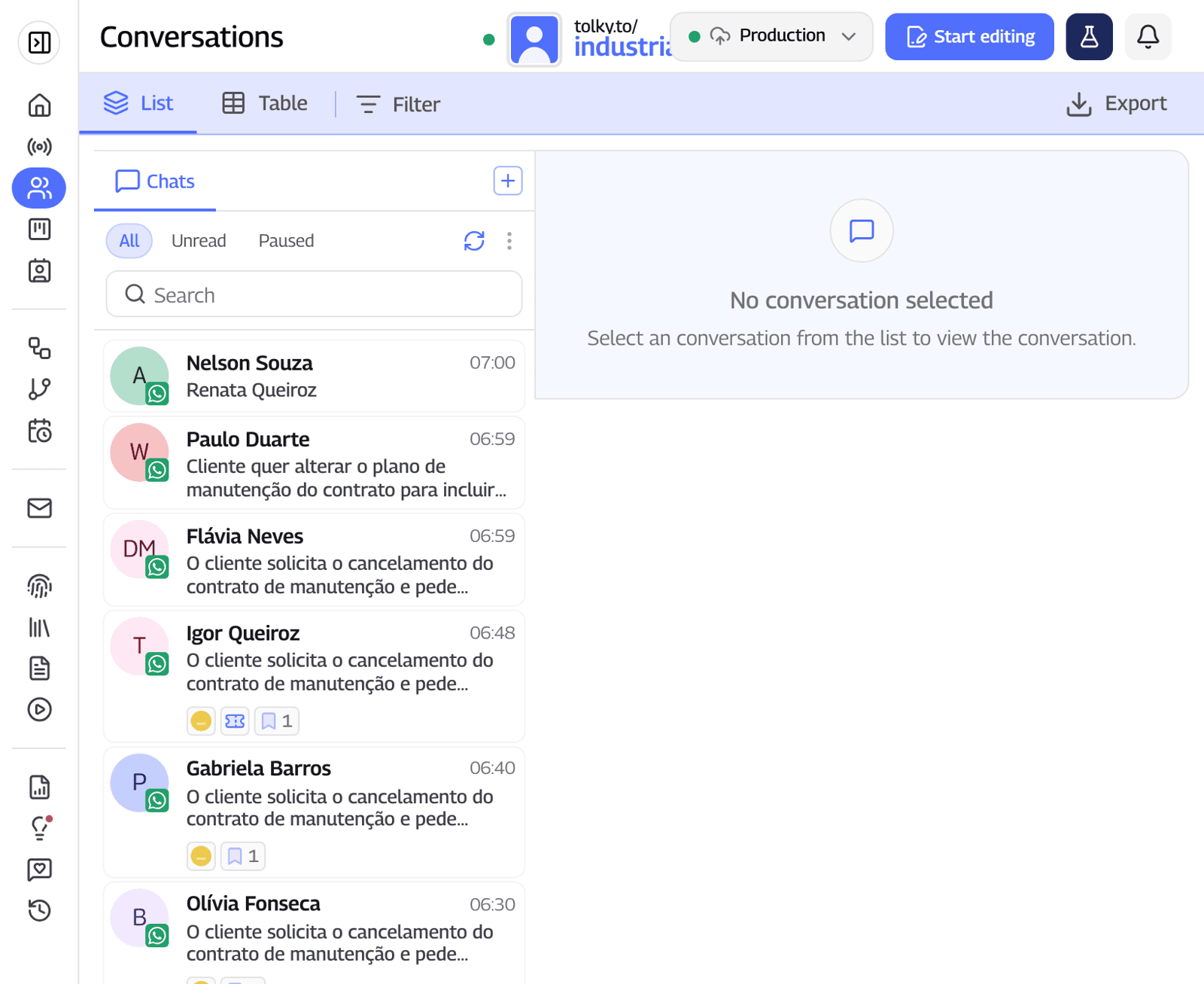
What Tolky does not do: it is not a payment method, it does not generate Pix codes on its own, it does not store card data and it does not confirm payments without an integration with your provider. In financial services, Tolky acts as the channel and CRM, not as a payment institution.
Frequently asked questions
Does WhatsApp Pay still exist in Brazil?
The payments feature is still described in the Help Center, which lists Brazil among the countries where you can pay businesses registered on WhatsApp. Sending money between people with a debit card ended in December 2024, and payment collection for businesses now revolves around Pix, payment links and boletos.
Can you make a Pix payment through WhatsApp?
You can receive a Pix payment request on WhatsApp: the business sends its key or a code, and the customer pays in the bank app. Paying the Pix without leaving the chat was reported as a test in March 2026, with no official general launch as of this review.
Does WhatsApp charge fees for payments?
In the 2020 version, Meta said sending money and making purchases was free for people and that businesses paid a processing fee. Today, the fee for a Pix, payment link or boleto is the one charged by the business's bank or provider.
Does WhatsApp confirm whether the customer paid?
Not in most cases. The Payments API documentation says WhatsApp does not reconcile payments; the business confirms with its bank or provider and updates the order. In the Pix redirect flow, the order is marked as paid when the bank completes the transaction.
Why did Brazil's Central Bank suspend WhatsApp Pay in 2020?
On June 23, 2020, the Central Bank ordered Visa and Mastercard to suspend the service to assess its effects on competition, efficiency and data privacy. Transfers were authorized in March 2021.
Do I need the official API to collect payments on WhatsApp?
For a few orders, a Pix key in the Business app is enough. For many orders, codes per customer, automatic confirmation and a team handling chats, the official API with an integration to your payment provider is the way to go.
Conclusion
WhatsApp Pay in Brazil has, in practice, become payment requests in the chat with payment at the bank: a Pix key for small businesses, and Pix codes, payment links and boletos through the API for larger operations. WhatsApp carries the message; the bank or provider confirms the money. For a business, the gain is in organizing that conversation, with a reminder at the right time, a fast answer and each customer's history.
Explore text campaigns, see WhatsApp customer service, check the plans or talk to the team →. Let's talk?
Share
Tags
- whatsapp pay
- whatsapp payments
- whatsapp pay brazil
- pix on whatsapp
- pay through whatsapp
- accept payments on whatsapp
- whatsapp payment collection
- #conversational CRM
Cited in
- Blip: products, pricing and alternatives to the former Take Blip
- Debt collection chatbot on WhatsApp: reminders, bills and deals
- Conversational commerce: what it is and how to sell on WhatsApp
- How to sell on WhatsApp: catalog, sales script, follow-up and AI
- WhatsApp bulk messaging: how to send mass messages without a ban
- WhatsApp Business: what it is, benefits, tools and when to migrate
About the author

Co-founder of Tolky
Marlos Carmo is an AI entrepreneur and founder of Tolky, the conversational-era infrastructure and AI CRM that unifies intelligent service, multi-channel support (such as WhatsApp and voice), live CRM, and operational intelligence in a single ecosystem. He is a finalist for the SXSW Innovation Awards and a member of Francesco's Economy, a global network of young entrepreneurs focused on innovation and social impact. He works connecting Artificial Intelligence and digital transformation in projects for large organizations.
Next step
Want to bring this to your operation?
Tati, Tolky's AI assistant, understands your scenario in a few questions, suggests the best path and connects you with someone from the team, with full context.
Share