Conversational commerce: what it is and how to sell on WhatsApp
What conversational commerce is, where the term came from, how it works on WhatsApp at each stage of the buying journey, which metrics to track and how it connects to a conversational CRM.

TL;DR
Conversational commerce is selling through conversations in messaging apps, chat and voice: the customer discovers, asks questions, buys and gets support without leaving the conversation. In Brazil it happens mostly on WhatsApp, and it works best when every conversation is recorded in a conversational CRM, with AI handling volume and people negotiating and resolving exceptions.
Share
Customers no longer want to fill out a form, wait for an email and call to check stock. They send a message: "do you have it in size 40?", "do you deliver to Campinas?", "can I pay in 3 installments?". Whoever answers quickly and well makes the sale; whoever is slow loses it to the store that answered first.
Conversational commerce is the name for this way of selling. This guide explains what it is, where the term came from, how it works on WhatsApp at each stage of the journey, which numbers to track and why it depends on a conversational CRM so it doesn't turn into a pile of disconnected chats.
Updated November 2026.
What is conversational commerce?
Conversational commerce is the sale of products and services through conversations in messaging, chat and voice channels, where the customer discovers, asks questions, buys and gets support inside the conversation itself, served by people, by AI or by both.
The term conversational commerce gained traction with a piece by Chris Messina, the same person who proposed the hashtag on Twitter, published on Medium in January 2015 with the subtitle "Messaging apps bring the point of sale to you". The idea was simple: instead of the customer going to the store or the website, the store comes to the app they already use (original piece on Medium, checked on November 23, 2026).
A decade later, the idea became concrete for two reasons. Messaging apps became an official business channel, with their own APIs and rules, and generative AI learned to understand requests in natural language. The short definition is in the conversational commerce entry of the glossary.
Conversational commerce, ecommerce and conversational marketing
The three overlap, but they are not the same thing. Traditional ecommerce is self-service: the customer browses, chooses and pays alone. Conversational commerce puts a conversation in the middle of that journey. And conversational marketing uses conversations to attract and qualify prospects, before the sale.
| Approach | Where it happens | Who leads | Main goal |
|---|---|---|---|
| Traditional ecommerce | The store's website or app | The customer, alone | Self-service purchase |
| Conversational marketing | Website chat, WhatsApp, ads | AI and the marketing or pre-sales team | Generate and qualify leads |
| Conversational commerce | WhatsApp, chat, voice | AI and salespeople | Sell and serve inside the conversation |
| Conversational customer service | WhatsApp, chat, voice, email | AI and the support team | Resolve questions and problems |
In practice, a mature company uses all four and connects them to the same customer history.
Why did conversational commerce grow in Brazil?
Conversational commerce grew in Brazil because WhatsApp is already the channel Brazilians use to talk to businesses, and Meta's official API let those conversations become an operation with multiple agents, integrations and AI. The customer doesn't need to install anything new or learn a different flow.
Three changes made this viable for companies of every size:
- Official WhatsApp API. One number can be used by several agents and by AI agents, with approved templates for outbound messages. See how the WhatsApp Business API works.
- Ads that open a conversation. Click-to-WhatsApp campaigns take the prospect straight to the chat, as explained in the post on click-to-WhatsApp ads.
- AI that understands requests. AI agents answer questions about product, delivery time and payment based on what the company has taught them, and hand anything outside the rules to a person.
For a step-by-step guide to selling on the channel, see how to sell on WhatsApp.
How does conversational commerce work on WhatsApp?
On WhatsApp, conversational commerce works as a single conversation that covers the whole journey: the customer arrives through an ad, link or message, is served by AI or a person, gets a recommendation, places the order and comes back through the same conversation for support and repeat purchases.
An illustrative example, at a shoe store:
- The customer clicks an ad and writes "saw these sneakers, do you have them in a 37?".
- The AI agent checks stock through the integration with the store's system and replies with the available colors.
- She asks about delivery time to her postal code (CEP); the agent calculates it and lets her know.
- She asks to pay in 3 installments. The agent sends the payment link generated by the store's payment system.
- The order is confirmed in the conversation, and delivery updates arrive through the same number.
- Thirty days later, a follow-up message asks whether the size fit and offers a matching model.


Two Meta rules shape this conversation. Within the 24-hour window after the customer's last message, the business can reply freely. Outside it, only with an approved template, and outbound messaging requires opt-in. In-app payment is a separate topic, covered in the post on WhatsApp Pay.
What are the stages of the conversational commerce journey?
The conversational commerce journey has five stages: discovery, consideration, purchase, post-sale and repeat purchase, and each one calls for a different kind of message and a different owner. The common mistake is to invest only in the first reply and forget what comes after the sale.
| Stage | What the customer does | Role of AI | Role of the person | Typical message (illustrative) |
|---|---|---|---|---|
| Discovery | Clicks an ad, link or QR code | Replies instantly and understands the interest | Adjusts the offer and the ad | "Hi, I saw the ad for the annual plan" |
| Consideration | Compares, asks questions, asks for a recommendation | Answers about product, delivery time and price based on the knowledge base | Takes over negotiation and special requests | "What's the difference between the two models?" |
| Purchase | Places the order and pays | Sends the payment link and confirms | Resolves payment and discount exceptions | "Can you send me the link to pay by card?" |
| Post-sale | Tracks delivery and asks for support | Shares status and answers questions | Handles returns, complaints and sensitive cases | "My order still hasn't arrived" |
| Repeat purchase | Comes back to buy again | Sends refill reminders and suggests add-ons | Looks after higher-value customers | "It's time to replace your filter" |
What connects the stages is the history. If the consideration conversation isn't visible to whoever handles post-sale, the customer repeats everything and the repeat purchase gets harder.
Which industries use conversational commerce the most?
Conversational commerce pays off most where the purchase raises questions before the decision: retail, education, insurance, real estate, financial services and local services. When the product is simple and cheap, the website does the job; when the person needs to ask, the conversation sells.
- Retail and ecommerce. Size, color, stock, delivery time and returns. The post on chatbots for ecommerce and the retail and ecommerce page cover the industry in detail.
- Education. Course, scholarship, enrollment and documents, with many questions before signing up.
- Insurance and vehicle protection. Quote, coverage and inspection, with steps that require documents.
- Real estate. Viewing, financing simulation and offer, where the broker takes over the negotiation.
- Local services. Scheduling, estimates and confirmation, with recurring service.
How do you measure conversational commerce?
Measure conversational commerce by the revenue generated per conversation and by response speed, not by the volume of messages sent. Lots of messages with few sales only increase cost and the risk of the number being blocked.
| Metric | How to calculate | What to watch |
|---|---|---|
| First response time | Time between the customer's first message and the first reply | A lead that waits goes cold; see speed to lead |
| Conversion per conversation | Orders closed ÷ conversations started | Compare by source (ad, website, campaign) |
| Revenue per conversation | Attributed revenue ÷ conversations | Shows whether the conversation sells or only answers questions |
| Handoff rate | Conversations passed from AI to people ÷ conversations | Recurring reasons call for adjustments to the knowledge base |
| Repeat purchase | Customers who buy again through the conversation ÷ customers | Shows whether post-sale is working |
| Satisfaction | NPS at the end of the conversation | A drop after a script change is a warning sign |
Cost matters too: Meta charges per template sent in some categories, and the rules have changed in recent years. See the summary in WhatsApp Business's new pricing before planning campaigns.
How is conversational commerce related to a conversational CRM?
A conversational CRM is the foundation that supports conversational commerce: it keeps every conversation, every contact and every opportunity in one place, so the AI and the team sell with context. Without it, conversational commerce turns into a heap of chats on different phones.
In practice, a conversational CRM does three things conversational commerce needs:
- Single history. Every conversation, from any channel, is stored on the contact. Whoever handles post-sale sees what was agreed during the sale.
- Pipeline from the conversation. The opportunity is created from the message and moves through stages as the dialogue progresses, with no manual data entry.
- Action after the conversation. Follow-ups, repeat purchase campaigns and reminders come from the same system, based on what the customer said.
The full concept is in the guide Conversational CRM: what it is, how it works and how to choose one. For the technical basis of conversations with AI, see the guide to conversational AI.
Common mistakes in conversational commerce
The costliest mistakes in conversational commerce are replying slowly, promising what the AI doesn't know and treating WhatsApp as a mass messaging channel. All three hurt conversion and can get the number blocked.
- Slow first response. Someone who clicked an ad is comparing with other stores that very minute.
- AI without a knowledge base. An agent that makes up delivery times or prices generates complaints. Teach it what it can answer and what it should pass to a person.
- No path to a human. Negotiation, complaints and sensitive cases need someone from the team.
- Messaging without consent. Outbound messages without opt-in lead to reports and a drop in the number's quality rating.
- Conversations outside the system. A salesperson serving customers on a personal phone takes the history with them when they leave the company.
- Measuring only messages. Volume is not sales; track conversion and revenue per conversation.
Where Tolky fits in conversational commerce
Tolky is a conversational AI CRM: it brings together WhatsApp customer service (official API), website, voice, email and Microsoft Teams, AI agents and its own CRM, so that every sales conversation is recorded and becomes an opportunity. It organizes the conversation; the store stays on its own ecommerce and payment systems.


- Customer service. WhatsApp Service brings AI and people together on the same number, with handoffs that carry the history.
- Agents by mission. You configure the agent for sales and customer relationships, with a knowledge base, limits and handoff rules.
- CRM. Tolky CRM stores contacts, conversations and opportunities, with a pipeline that moves forward from the dialogue.
- Campaigns and follow-up. Text Campaigns with approved templates and Follow Up for repeat purchases and reminders.
- Integrations. REST API, webhooks, HTTP requests and more than 1,000 apps in the Integration node of Flows to look up stock, orders and shipping; native integration with HubSpot.
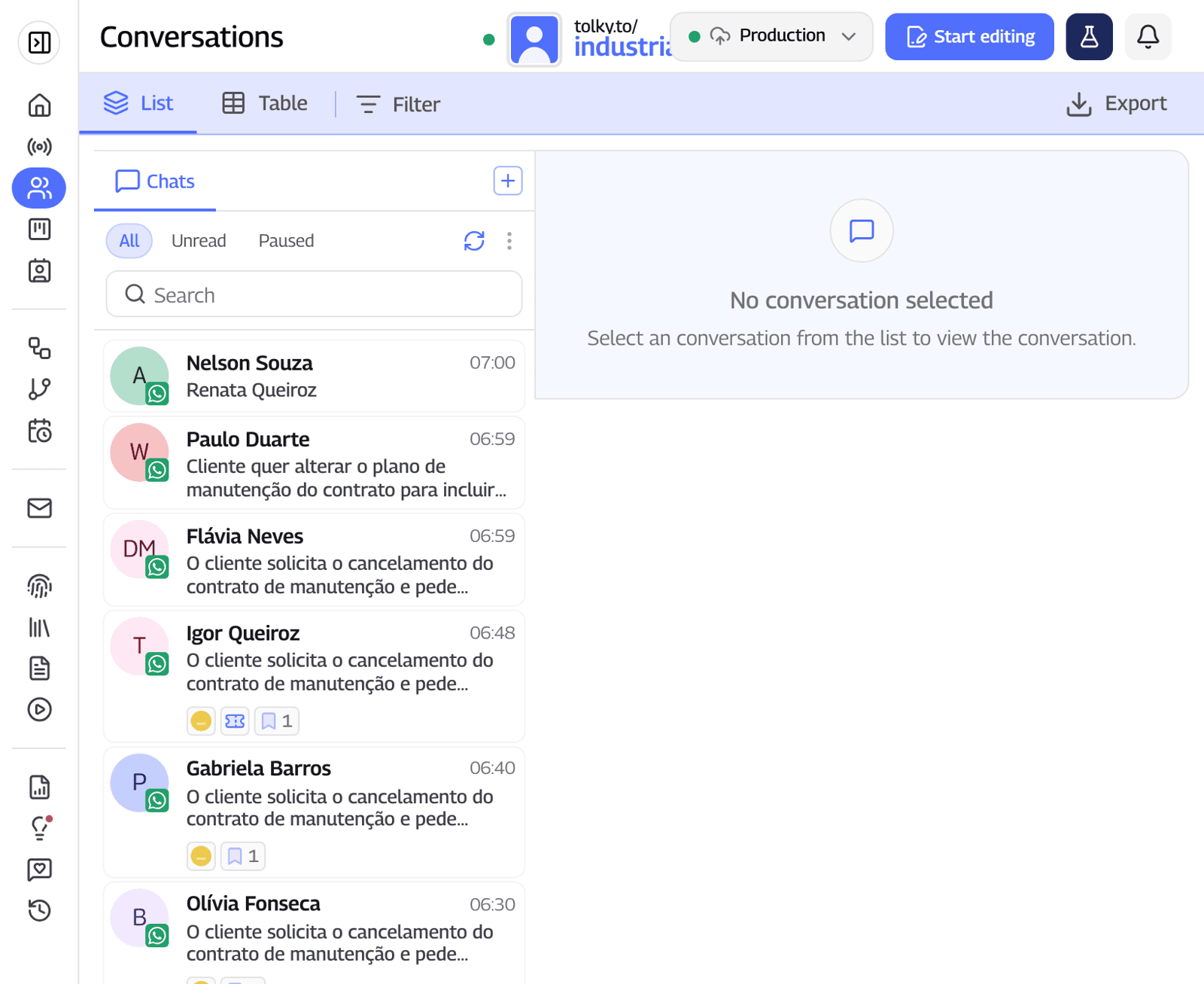
What Tolky doesn't do: it is not an online store and it doesn't process payments. The catalog, checkout and payment link come from your ecommerce platform and your payment provider, connected through integration. If your operation is just a simple catalog with a few messages a day, the free WhatsApp Business app may be enough for a while.
Frequently asked questions
What is conversational commerce in a few words?
It's selling through conversation. The customer discovers, asks questions, buys and gets support in messaging apps, chat or voice, served by AI, by people or by both, without having to leave the conversation.
Who coined the term conversational commerce?
The term conversational commerce was popularized by Chris Messina in a piece published on Medium in January 2015. He described how messaging apps would bring the point of sale to the customer.
What is the difference between conversational commerce and conversational marketing?
Conversational marketing uses conversations to attract and qualify prospects. Conversational commerce uses conversations to sell and serve. In practice, the first feeds the second, and both should use the same customer history.
Can you do conversational commerce with the free WhatsApp Business app?
You can start with it, using the catalog and quick replies, but the app has a device limit and wasn't built for multiple agents with AI and integrations. When volume grows, the official API and a conversational CRM organize the operation.
Can AI close sales on its own on WhatsApp?
It can handle simple sales within the company's rules: answering about product, delivery time and price and sending the payment link. Negotiation, discounts outside the rules and complaints should go to a person, along with the conversation history.
How do you measure whether conversational commerce is delivering results?
Track first response time, conversion per conversation, revenue per conversation, handoff rate to people, repeat purchases and NPS. Message volume alone doesn't show results.
Conclusion
Conversational commerce means taking the sale to where the customer already talks, and in Brazil that means WhatsApp. It works when replies are fast, the AI knows what it can answer, a person takes over whatever falls outside the rules and every conversation lives in a conversational CRM that connects sale, post-sale and repeat purchase.
Discover Tolky CRM, see WhatsApp Service, see the plans or talk to the team →. Let's talk?
Share
Tags
- conversational commerce
- selling on whatsapp
- #whatsapp sales
- buying journey
- whatsapp ecommerce
- sales metrics
- #conversational CRM
Cited in
- Ecommerce chatbot: orders, tracking, returns and abandoned carts
- Chatbot for clothing stores: sizing, exchanges and WhatsApp sales
- How to sell on WhatsApp: catalog, sales script, follow-up and AI
- Conversational marketing: what it is, tactics and how to qualify leads
- Conversational AI Is Not a Chatbot: Why Go Beyond Automated Replies
- Conversational CRM: What It Is, How It Works and How to Choose
- Omnichannel strategy: what omnichannel service is and how to build it
- Conversational AI: what it is, how it works and customer service
About the author

Co-founder of Tolky
Marlos Carmo is an AI entrepreneur and founder of Tolky, the conversational-era infrastructure and AI CRM that unifies intelligent service, multi-channel support (such as WhatsApp and voice), live CRM, and operational intelligence in a single ecosystem. He is a finalist for the SXSW Innovation Awards and a member of Francesco's Economy, a global network of young entrepreneurs focused on innovation and social impact. He works connecting Artificial Intelligence and digital transformation in projects for large organizations.
Next step
Want to bring this to your operation?
Tati, Tolky's AI assistant, understands your scenario in a few questions, suggests the best path and connects you with someone from the team, with full context.
Share