Debt collection chatbot on WhatsApp: reminders, bills and deals
How to build a debt collection chatbot on WhatsApp: utility reminders, duplicate bills and payment codes in the chat, promises to pay, rule-based negotiation and what Brazilian law requires.
TL;DR
A debt collection chatbot sends due date reminders, duplicate bills and instant payment codes, records promises to pay and negotiates within the company's rules on WhatsApp, in text, passing anything outside the rules to a person. Meta treats a payment reminder without an offer as a utility message, and in Brazil every collection message follows article 42 of the Consumer Protection Code: no embarrassment and no threats.
Share
Most collections do not need negotiation. They need a reminder at the right time, with the amount, the date and an easy way to pay. People who forgot will pay; people who cannot pay will reply, and that is when the conversation that matters begins.
A debt collection chatbot does that work at scale on WhatsApp, in text: it reminds, sends the duplicate bill, records the promise to pay and offers what the company has approved. This guide covers how to build the sequence, what to say at each step, what the law requires (using Brazil as the reference market) and when to swap the message for a call or a person.
Updated November 2026.
What is a debt collection chatbot?
A debt collection chatbot is an automated assistant that contacts customers with bills coming due or past due by message, understands their replies and steers the conversation toward a goal: payment, a promise to pay with a date or an agreement within the company's rules. With AI, it understands "I only get paid on the 10th" or "I paid yesterday" and responds accordingly, with no numbered menu.
This guide covers collections in text, mainly on WhatsApp. When the sequence includes calls made by a voice agent, the design changes (spoken script, calling hours, voicemail), and that is covered in the guide to AI for debt collection with calls and WhatsApp.


Why collect on WhatsApp in text?
Text collections on WhatsApp work because the message arrives in the channel the customer already uses, stays on record and lets them pay when they can, with the instant payment code or the bill in the same conversation. Nobody is interrupted, and the agreement is in writing for both sides.
Text has three clear advantages over the phone in the early stage:
- Cost and scale. A reminder sequence reaches the whole base on the same day, with no call queue.
- Record. Amount, date and agreement stay in the conversation, which reduces disputes later.
- Autonomy. The customer settles it in two taps, at any hour, without talking to anyone.
The limit is just as clear: once an account is further past due, messages often go unanswered. That is when a call, by a person or by a voice agent, opens the conversation text could not.
How do you build a collection sequence on WhatsApp?
A WhatsApp collection sequence is the series of messages that follows the account from the reminder before the due date to negotiation, with a different goal at each step and an automatic stop when payment comes in. The company sets the timing; the chatbot runs it and talks to whoever replies.


| Step | When (illustrative) | Message content | Likely Meta category |
|---|---|---|---|
| Reminder | 3 days before the due date | Amount, date and a button to copy the instant payment code | Utility |
| Due date | On the day | Reminder with the code or the bill | Utility |
| Early delinquency | 1 to 5 days late | Notice that the bill is still open and an invitation to reply | Utility, if there is no offer |
| Negotiation | 10 to 30 days late | Invitation to talk about a new date or installments | Depends on the text; an offer can make it marketing |
| Confirmation | When payment is received | Thank-you and receipt | Utility |
The timing is an example, not a rule. Your base's history shows the best day for each step.
Outside the 24-hour window, every message the company starts is an approved template. In Meta's guidelines, a payment reminder appears as an example of a utility message, which must be non-promotional and specific to the customer. The guidelines do not address overdue accounts separately, and text with an offer or mixed content is classified as marketing (template category guidelines, checked November 23, 2026). A "pay today and get 30% off" changes the category and the price.
Ready-to-use texts for each step are in the WhatsApp message templates.
Duplicate bills and instant payments in the chat
A duplicate bill on WhatsApp works when the chatbot confirms it is talking to the account holder, fetches the document from the billing system and delivers the instant payment code or the bill in the conversation itself. It is the most common collections request and the one the chatbot resolves on its own most often.
The flow has four steps: identify the account holder (by the registered number plus a detail such as part of their tax ID), find the open bill, generate or retrieve the payment method and confirm receipt when the payment lands. Without an integration with the billing system, the chatbot can only send what came in the campaign spreadsheet.
In Brazil, the Pix copy-and-paste code solves most cases on a phone. The customer taps the button, pastes it into the banking app and pays. For cards or installments, a payment link generated in the flow does the same job. Paying inside WhatsApp itself is a separate topic, covered in WhatsApp Pay.
How do you record a promise to pay?
A promise to pay only counts when it has a date and an amount, is recorded in the customer's history and triggers a new contact the day after the promised date if payment does not arrive. "I'll see" is not a promise; "I'll pay the R$ 189.90 on the 15th" is.
The chatbot asks for the date, repeats the agreement ("so that's the 15th, for R$ 189.90, right?"), records it and pauses the sequence until then. On the 16th, if nothing came in, it follows up in a reminder tone, not a scolding one. Promises broken twice go to a person, because the problem is probably not forgetfulness.
Track the promise-kept rate. It shows whether the sequence is accepting unrealistic dates just to close the conversation.
How do you negotiate within the rules?
The chatbot negotiates only what the company wrote down as a rule, such as the number of installments, a new date and discount limits, and passes any request outside those rules to a person, with the reason and the conversation. It does not invent terms and does not decide exceptions.


| Situation | The chatbot can | Hands off to a person |
|---|---|---|
| Asks for a new date within the allowed period | Record the promise | Date beyond the limit |
| Asks for installments | Offer the approved options | More installments than the rule allows |
| Asks for a discount or a waived late fee | Explain the current rule | Any discount outside the table |
| Says they already paid | Ask for the receipt and check | Payment not found |
| Does not recognize the debt | Log the dispute | Always: disputes need analysis |
| Mentions illness, bereavement or unemployment | Acknowledge and offer help | Always, as a priority |
Write the rules as you would for a new team member: what is allowed, up to how much and what is never allowed. The guide to AI-to-human handoff has ready-made handoff triggers.
What does the law say about collecting by message?
Under Brazil's Consumer Protection Code, collections cannot expose consumers to ridicule, embarrassment or threats, and every collection document must identify the supplier by name, address and individual or company tax ID. The rules apply to the chatbot's messages just as they apply to letters and calls.
- Art. 42. A consumer in default "will not be exposed to ridicule, nor subjected to any kind of embarrassment or threat" in debt collection. Anyone charged an undue amount is entitled to a refund of double the excess paid, except in cases of justifiable error.
- Art. 42-A. Collection documents presented to consumers must include the supplier's name, address and tax ID. In practice, put that information on the duplicate bill and payment slip you send in the conversation.
- Art. 71. It is a crime to use threats, coercion, false statements or any procedure that interferes with the consumer's work, rest or leisure in collections. Set messaging hours and do not insist several times on the same day.
All three articles are in Law No. 8,078/1990, checked November 23, 2026. Brazil's data protection law, the LGPD, allows data processing for credit protection (art. 7, X), with a stated purpose and the minimum data necessary.
One point specific to WhatsApp: the number may now belong to someone else. The first message should not detail the debt; it identifies the company and asks the account holder to confirm before seeing the details. And anyone who asks to stop receiving messages leaves the sequence, with the opt-out recorded. Rules vary by country, and this summary does not replace review by your legal team.
When should you switch from messages to a call or a person?
Switch from messages to a call when the account moves past the reminder stage and messages go unanswered, and to a person when the customer disputes the debt, asks for an exception or describes a hard situation. The text chatbot is the first layer, not the only one.


In practice, the most complete sequences combine all three: messages up to early delinquency, a call when the account is further behind and a person for negotiation outside the rules. The voice side, with scripts, calling hours and Brazil's telecom rules, is in the guide to AI for debt collection. Banks and lenders have additional customer service rules, summarized in the guide to the chatbot for banks.
How do you measure a debt collection chatbot?
Measure a debt collection chatbot by the amount recovered and promises kept, not by the number of messages sent. Five numbers are enough:
- Payment by the due date among people who received the reminder, compared with a period without the sequence.
- Reply rate at each step. A sudden drop may point to weak copy or a number with a low quality rating.
- Promises recorded and kept. A promise without a date does not count.
- Amount recovered per campaign, the number finance tracks.
- Opt-outs and complaints per thousand messages. If they rise, review tone and frequency.
Where Tolky fits in WhatsApp collections
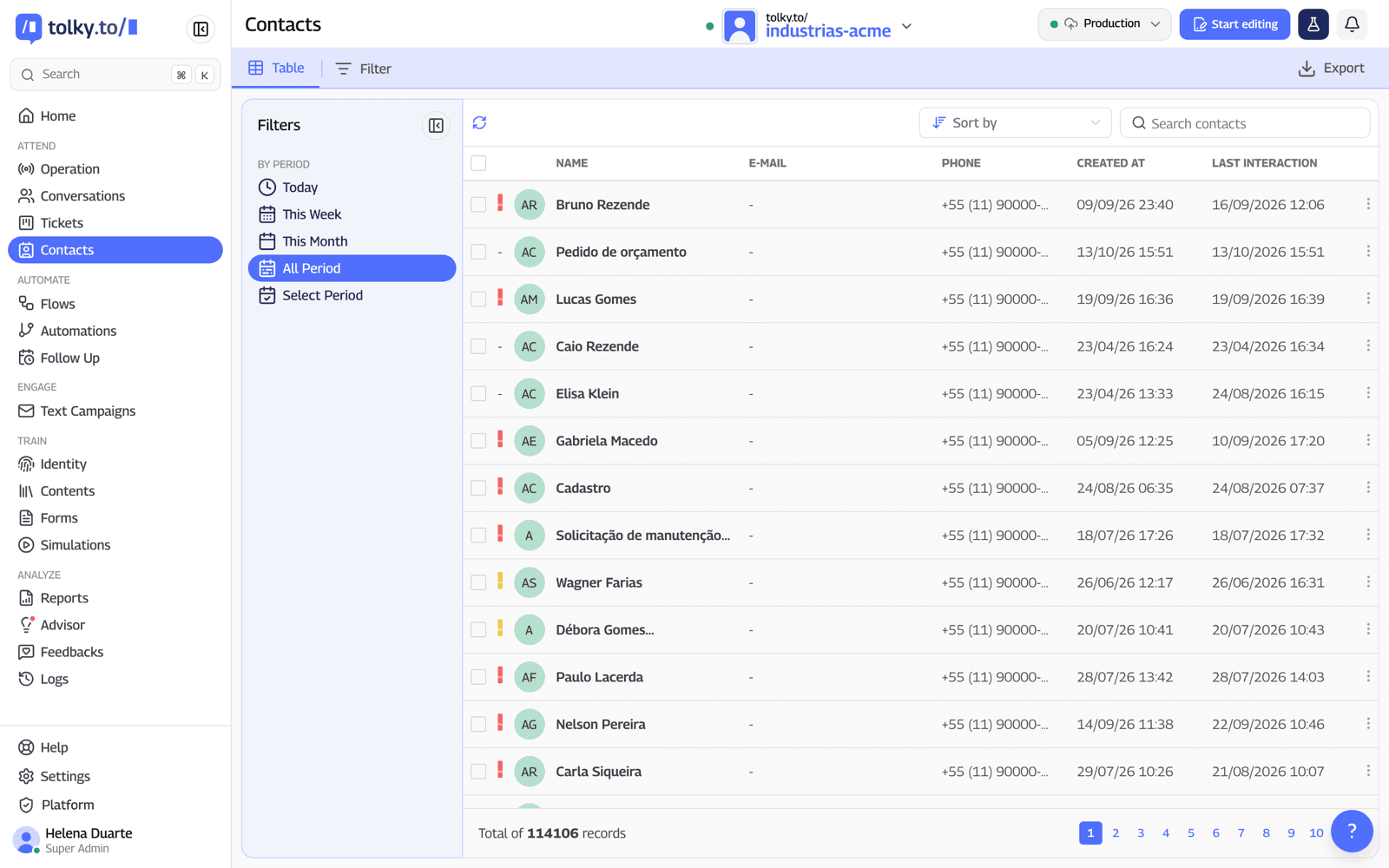
Tolky is a conversational AI CRM that sends collection campaigns on WhatsApp, Teams and email and puts an AI agent in charge of talking to whoever replies, within your company's rules. The complete setup is on the collections and debt recovery page.
- Text Campaigns. Audience from a spreadsheet or the CRM, variables by column, a message personalized by the AI and a button to copy the Pix code, fixed or one per contact.
- A clean base. Numbers with and without Brazil's extra ninth digit and duplicate records resolved before sending, and contacts marked as not interested left out of the campaign.
- The AI after the send. Campaign-specific instructions, negotiation within the rules and routing to chosen agents.
- Payment links. In Flows, a payment link through Stripe, plus the REST API, webhooks and HTTP requests for your billing system.
- Follow-up. Follow Up resumes conversations with people who stopped replying and respects quiet hours.
- Voice when needed. Voice Campaigns call people who did not reply, with a do-not-call list.
What Tolky does not do: it is not a portfolio management system or a credit bureau, it does not issue payment slips on its own and it does not decide what discount can be offered. Meta's fees are charged separately from the plan.
Frequently asked questions
What is a debt collection chatbot?
It is an automated assistant that sends due date reminders, duplicate bills and payment codes, records promises to pay and negotiates within the company's rules by message. It passes disputes, requests outside the rules and sensitive situations to a person.
Is a WhatsApp collection message utility or marketing?
A payment reminder without an offer is an example of utility in Meta's guidelines. If the message includes a promotion or mixed content, such as a discount for paying today, Meta classifies it as marketing, which is priced differently.
Is it allowed to collect debts on WhatsApp?
In Brazil, yes, as long as collections follow the Consumer Protection Code: no embarrassment, threats or exposure, no interference with the customer's rest and the supplier identified on collection documents. Confirm you are talking to the account holder before detailing the debt.
What is the difference between a debt collection chatbot and voice AI for collections?
The debt collection chatbot works in text, with reminders, duplicate bills and negotiation in the conversation. Voice AI for collections calls the customer, which works better once the account is late and messages go unanswered. The most complete sequences use both.
Can the chatbot offer a discount to settle the debt?
Only the discount the company wrote down as a rule, with a set limit. Any request outside the table goes to a person, with the reason and the conversation, so nobody repeats the story.
How do you avoid discussing the debt with someone else on WhatsApp?
The first message identifies the company and asks the account holder to confirm, without detailing amounts. Only after confirmation does the chatbot show the bill. If the person replying is not the account holder, the conversation ends without mentioning the debt.
Conclusion
A debt collection chatbot handles reminders, duplicate bills and promises to pay at scale on WhatsApp, and leaves to people and to voice what needs a longer conversation. Build the sequence with utility messages, write the negotiation rules, follow consumer protection law and measure by the amount recovered.
See Tolky for collections, explore Text Campaigns, see the plans or talk to the team →. Let's talk?
Share
Tags
- debt collection chatbot
- whatsapp debt collection
- collections bot on whatsapp
- dunning sequence
- whatsapp payment reminder message
- duplicate bill on whatsapp
- #conversational CRM
Cited in
- Chatbot for banks: customer service, security and regulation
- Chatbot for insurance companies: quotes, claims and renewals
- Chatbot examples: 12 use cases by function and industry, in dialogue
- WhatsApp Pay in Brazil: what works today, Pix and its history
- AI for debt collection: voice agent calls and WhatsApp reminders
- Inbound vs outbound call center: differences, IVR and when to use each
- WhatsApp automation for business: what to automate and how to start
- WhatsApp chatbot for small business: how to choose and pricing
- What is a chatbot? Types, NLP, examples, cost and how to choose
About the author

Co-founder of Tolky
Marlos Carmo is an AI entrepreneur and founder of Tolky, the conversational-era infrastructure and AI CRM that unifies intelligent service, multi-channel support (such as WhatsApp and voice), live CRM, and operational intelligence in a single ecosystem. He is a finalist for the SXSW Innovation Awards and a member of Francesco's Economy, a global network of young entrepreneurs focused on innovation and social impact. He works connecting Artificial Intelligence and digital transformation in projects for large organizations.
Next step
Want to bring this to your operation?
Tati, Tolky's AI assistant, understands your scenario in a few questions, suggests the best path and connects you with someone from the team, with full context.
Share