Chatbot for insurance companies: quotes, claims and renewals
How to use a chatbot for insurance companies and brokers: quotes handed to the broker, duplicate bills, opening and tracking claims with human decisions, renewals and what Brazil's Law 15,040 changes.
TL;DR
A chatbot for insurance companies is an agent on WhatsApp, the website and voice that collects data for quotes, sends duplicate bills and payment slips, takes the first notice of loss with photos and documents, reports progress and reminds policyholders about renewal. Coverage analysis, denials and settlement amounts stay with people, and Brazil's Law 15,040/2024, in force since December 2025, gives the insurer up to 30 days to decide on coverage after the claim is filed with the required documents.
Share
A policyholder had a car accident at 23:10 and wants to know what to do now. Another needs a copy of their payment slip, and a broker asks whether their client's proposal has been accepted. At an insurer or brokerage, WhatsApp receives the most stressful moment of the relationship, the claim, alongside the most repetitive questions, such as bills and documents.
A chatbot for insurance companies serves both with different rules: it handles information on its own (duplicate bills, status, missing documents) and guides the claim carefully, collecting what is needed and handing anything that requires analysis to the team. This guide covers each moment in the journey, what insurance law requires and where the decision must stay human. We use Brazil as the reference market; check your local rules.
Updated November 2026.
What is a chatbot for insurance companies?
A chatbot for insurance companies is a customer service agent, ideally AI-powered, that talks with policyholders, prospects and brokers on WhatsApp, the website and voice about quotes, duplicate bills, claims, renewals and policy questions, using the policy terms and rules the insurer provides. It informs, collects and routes; it does not decide coverage or settlements.
It works for insurers, brokerages and agencies that serve many brokers. The difference from a menu bot is that the policyholder describes what happened ("someone hit the back of my car in the parking lot") and the agent understands, asks what is missing and organizes the case. The technical basics are in what a chatbot is.


Where does the chatbot help in the policyholder journey?
The chatbot helps at five moments of the journey (quote, purchase, payment, claim and renewal), and each one has a part AI handles and a part that stays with people. The table is a starting point for designing the rules.
| Moment | What AI does | What stays with people |
|---|---|---|
| Quote | Collects risk and prospect data, explains coverages | Final pricing, special terms, advice to the client |
| Purchase | Lists documents, tracks the proposal, answers questions | Risk acceptance and exceptions |
| Payment | Sends duplicate bills and links, reminds about installments | Negotiating overdue installments outside the rules |
| Claim | Supports the policyholder, records the notice, collects photos and documents, reports status | Coverage analysis, denial, settlement amount |
| Renewal | Announces expiration, collects risk changes, routes the proposal | New pricing and negotiation |
The insurance segment page shows how Tolky organizes these moments in practice.
How does the chatbot handle insurance quotes?
For quotes, the chatbot collects risk and prospect data in conversation, explains coverages based on the policy terms and delivers the complete request to the broker or the rating system. It does not make up prices: the amount comes from the insurer's calculation.
For auto insurance, for example, the starting questions are vehicle make and year, overnight ZIP code, use (personal or business), main driver and any recent claims. For homeowners, the property type and the approximate value of contents. The AI asks one question at a time and uses what the person already said.
There are two ways to return the price:
- Through the broker. The agent builds the request and hands it off fully filled in; the broker prices it and replies in the same conversation.
- Through the system. Integrated with the insurer's rating system through an API or a flow, the agent presents the calculated price and terms, and the prospect asks to proceed.
In both cases, the question "does this cover flooding?" is answered with the text of the policy terms in the knowledge base, and anything unclear goes to a person. The guide to the lead generation chatbot covers how to qualify and record people who ask for quotes.
Duplicate bills, payment slips and policy questions
Duplicate bills, payment slips, installments, policy documents and "what does my policy cover" are the most repeated questions, and the chatbot answers all of them instantly when connected to the system that holds that data. Without integration, it explains where to find them and routes the request.
What usually works:
- Identity before data. Confirm the tax ID and one more profile detail before sending any document.
- Links, not loose attachments. Duplicate bills and policies via a link to the insurer's portal, when available.
- Installment reminders. For those who opted in, an approved template a few days before the due date, with the payment method. For overdue installments, the guide to the debt collection chatbot covers the sequence and the safeguards.
How does filing a claim on WhatsApp work?
When a claim is filed, the chatbot supports the policyholder, records the first notice of loss with date, place and description, collects photos and documents from the insurer's list, provides the protocol number and next steps and hands the case to the claims team with a summary. Analysis and decisions stay with people.


An illustrative script for an auto claim:
- Safety first. "Are you and everyone else okay? If anyone is injured, call emergency services." With injuries or risk, the conversation goes to a person immediately.
- What happened. Date, time, place and a description in the policyholder's own words.
- Parties involved. Third parties, license plate, police report when the insurer requires it.
- Photos and documents. The exact list from the policy terms, item by item, confirming what arrived.
- Protocol and timeline. The claim number, what happens now and when the policyholder will hear back.
After filing, the same channel serves for tracking. The policyholder asks "what's the status of my claim?" and the agent answers with the system status, no phone call needed. Missing documents are requested specifically, not with a generic "send the paperwork."
For vehicle protection associations, which go through similar moments with their members, the guide to conversational AI for vehicle protection covers the specifics.
Sensitive data and privacy in insurance service
Insurance handles personal data and, in life and health lines, sensitive data, which Brazil's LGPD protects with stricter rules. Law No. 13,709/2018 lists health data among sensitive personal data (article 5, II), checked November 23, 2026.


Three safeguards for the chatbot:
- Ask only for what is needed at each step, and explain why.
- Sensitive forms for medical reports and health information, with access limited to those who need it.
- Identity check before sharing status, amounts or documents.
The glossary explains sensitive personal data and the LGPD.
What does Law 15,040/2024 change in claims handling?
Law 15,040/2024, Brazil's new legal framework for insurance contracts, in force since December 2025, gives the insurer up to 30 days to decide on coverage, counted from the claim notice with all required elements, and up to 30 days to pay once coverage is recognized. Customer service needs to record precisely when each document arrived.
The points that matter most for the chatbot, checked in the text of the law on November 23, 2026:
- Decision deadline (art. 86). Up to 30 days "from the date the claim or notice of loss is presented by the interested party, together with all the elements needed," or the insurer loses the right to deny coverage. Those elements must be listed in the insurance documents (§1).
- Requests for additional documents (art. 86, §2). Allowed, but they must be justified.
- Denial (art. 86, §6). Must be "express and reasoned." That is why a denial never comes from AI: it is a team decision, communicated with its grounds.
- Payment (art. 87). Once coverage is recognized, up to 30 days to pay, with the amount presented with its basis.
- Information to the claimant (art. 80, II). Whoever handles the claim must share the content of the findings when asked.
Entry into force follows article 134: one year after publication, which happened in December 2024. In practice, the chatbot's document list should match the policy terms, and every receipt must be logged with date and time. This summary is not legal advice; validate the script with your legal and claims teams.
How does the chatbot help with renewals?
For renewals, the chatbot announces the expiration date in advance to those who opted in, asks whether anything changed in the risk (address, vehicle, driver) and routes the proposal to the broker or the system. It does not negotiate prices on its own.
A common design combines channels: a WhatsApp message with an approved template a few weeks before expiration, an AI call for those who did not reply and a conversation with the broker for those who asked for different terms. The sending and template rules are in the 24-hour window, templates and campaigns, and voice use in voice agents for businesses.
How do you serve brokers on the same channel?
The chatbot also serves brokers, with their own queue: proposal status, pending documents, commissions and product materials, without mixing them with the policyholder queue. A well-served broker sells more of the insurer's products.
Law 15,040/2024 reinforces the broker's role: like every party involved in the contract, they must provide "complete and truthful information" (art. 37) and are responsible for delivering documents they receive to the recipient within 5 business days (art. 39). A channel that shows the broker what is pending in seconds helps meet those deadlines.
For a brokerage, the same agent can serve the policyholders in its book under the brokerage's brand and hand off to the responsible broker when the client wants advice.
How do you measure an insurer's chatbot?
Measure the chatbot by the time to a complete claim notice, the share of questions resolved without a queue and the renewal rate, not by message volume. Also track handoffs and their reasons.
| Metric | How to calculate | What to watch |
|---|---|---|
| Time to complete notice | From first contact to the last document received | Vague document requests slow everything down |
| Resolution without a queue | Duplicate bill and status conversations resolved by AI ÷ total | A drop points to an integration outage |
| Complete quote requests | Requests with all data ÷ requests started | A long script makes prospects give up |
| Renewal rate | Policies renewed ÷ policies expiring | Compare those who got a reminder with those who did not |
| Handoffs by reason | Conversations passed to people, by reason | Repeated reasons call for knowledge base updates |
| Service rating | NPS at the end of the conversation | Separate claims from other conversations |
Where does Tolky fit in insurance customer service?
Tolky is an AI-powered conversational CRM: the AI agent serves policyholders and brokers on WhatsApp, the website and voice using the terms and rules the insurer provides, collects the first notice of loss and hands off to the team with a summary and full history. It also works on email and Microsoft Teams; Instagram and SMS are coming soon.
- Customer service. WhatsApp customer service and voice customer service, upon activation, with handoff during the call.
- Claims. The agent collects the initial information and opens a ticket for the team, with queues and stages. Forms marked as sensitive are encrypted with AES-256 and visible only to those with permission.
- Renewals and installments. Text campaigns with approved templates and voice campaigns with a script.
- Book of business. Policyholders and brokers in the CRM, with the history of every conversation.
- Anti-fraud. For the legal team, the anti-fraud solution reads lawsuits and flags documentary red flags.
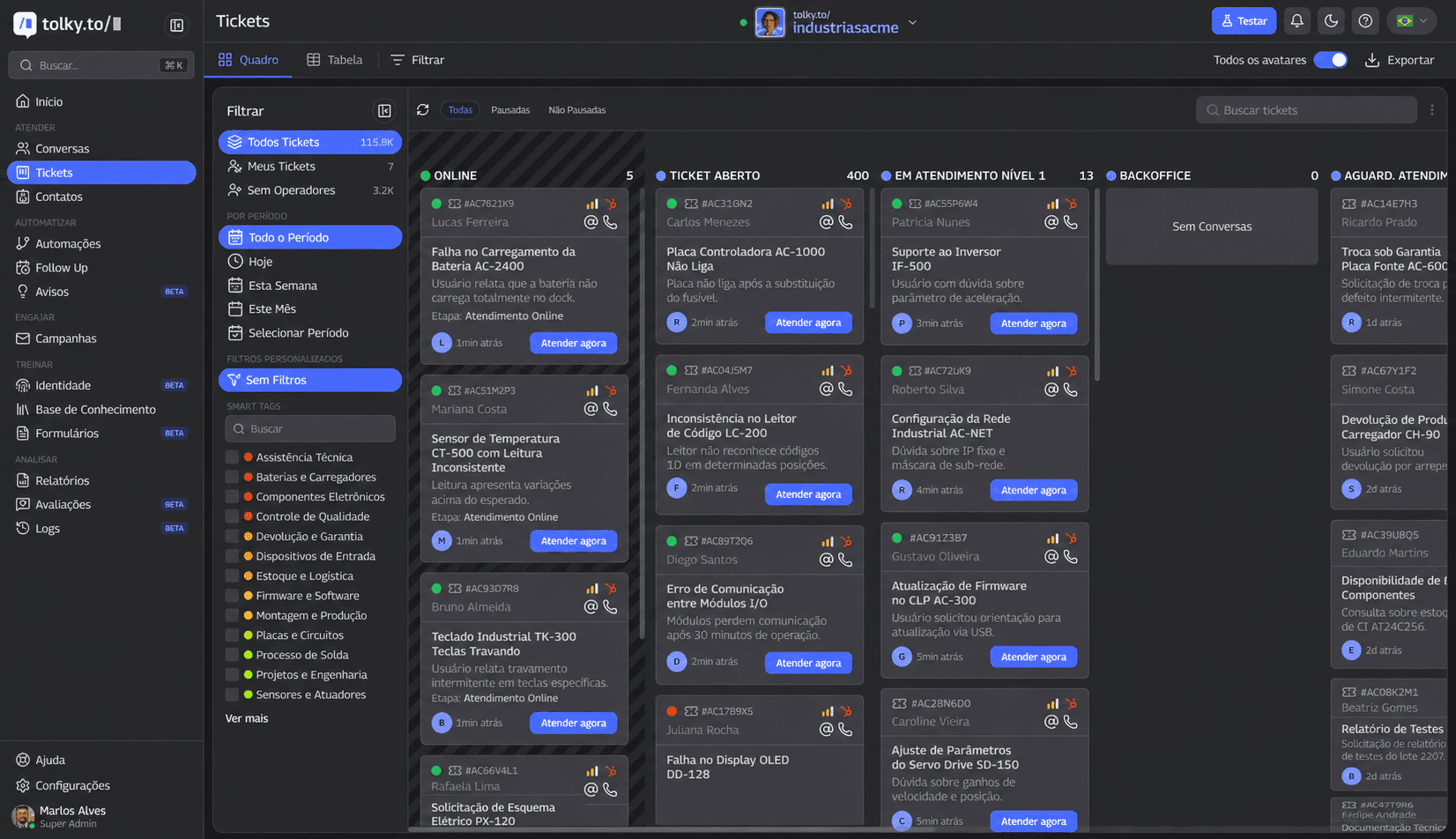
What Tolky does not do: it is not a policy administration or claims adjustment system, it does not calculate premiums and it does not decide coverage. The AI follows the rules the insurer writes, and the decision stays with the team.
Frequently asked questions
Can a chatbot for insurance companies open a claim?
It can record the first notice of loss: it supports the policyholder, collects date, place, description, photos and documents, provides the protocol number and hands the case to the claims team. Coverage analysis, denials and settlement amounts stay with people.
Can AI deny coverage on a claim?
It should not. Under Brazil's Law 15,040/2024, a denial must be express and reasoned, and it is the insurer's decision based on analysis of the case. The chatbot reports progress and hands questions about the decision to a person.
How long does an insurer have to respond to a claim?
In Brazil, Law 15,040/2024 gives the insurer up to 30 days to decide on coverage, counted from the notice with all required elements, and up to 30 days to pay once coverage is recognized. In complex cases, the regulator can set longer deadlines, of up to 120 days.
Can the chatbot provide insurance quotes?
It collects risk and prospect data and explains coverages. The price comes from the broker or from the insurer's rating system, when integrated.
Can insurance brokerages use a chatbot too?
Yes. A brokerage serves the policyholders in its book, organizes quotes and renewals and hands off to the responsible broker when the client wants advice. Insurers also use a separate queue to serve brokers.
How do you protect health data in an insurance chatbot?
Ask only for what is needed, use access-restricted forms for health information and confirm identity before sharing status or amounts. Health data is sensitive personal data under the LGPD.
Conclusion
A chatbot for insurance companies works when it clearly separates information from decisions: duplicate bills, status and document lists stay with AI; coverage, denials and settlements stay with the team, within the deadlines of Law 15,040/2024. Start with the first notice of loss, using the document list from the policy terms, and measure the time to a complete notice.
See the insurance segment, explore WhatsApp customer service, see the plans or talk to the team →. Let's talk?
Share
Tags
- chatbot for insurance companies
- insurance chatbot
- insurance broker chatbot
- whatsapp for insurance
- first notice of loss on whatsapp
- policyholder service
- insurance renewal
- #conversational CRM
About the author

Co-founder of Tolky
Marlos Carmo is an AI entrepreneur and founder of Tolky, the conversational-era infrastructure and AI CRM that unifies intelligent service, multi-channel support (such as WhatsApp and voice), live CRM, and operational intelligence in a single ecosystem. He is a finalist for the SXSW Innovation Awards and a member of Francesco's Economy, a global network of young entrepreneurs focused on innovation and social impact. He works connecting Artificial Intelligence and digital transformation in projects for large organizations.
Next step
Want to bring this to your operation?
Tati, Tolky's AI assistant, understands your scenario in a few questions, suggests the best path and connects you with someone from the team, with full context.
Share