Lead generation chatbot: capture, qualification and CRM handoff
How to use a lead generation chatbot on your website, on WhatsApp and in click-to-WhatsApp ads: qualifying questions, lead scoring, handoff to sales, CRM and follow-up.
TL;DR
A lead generation chatbot is an agent that talks to people who arrive from your website, WhatsApp or an ad, collects contact details and needs, asks the qualifying questions and hands a sales-ready lead to your team, already recorded in the CRM. It works when it replies right away, asks little, scores the lead with rules the sales team wrote and passes the conversation to a person at the right moment, with a summary.
Share
The website form asks for a name, an email and a phone number, and the lead disappears into a spreadsheet someone checks at the end of the day. On WhatsApp, "how much is it?" arrives at 21:40 and gets an answer the next morning, after the interest has cooled.
A lead generation chatbot replaces the idle form with a conversation: it replies right away, understands what the person wants, asks the two or three questions that matter to sales and puts the lead in the pipeline with context. This guide covers where to capture leads, how to qualify without an interrogation, how to score, when to hand off to a sales rep and what to do with people who stop replying.
Updated November 2026.
What is a lead generation chatbot?
A lead generation chatbot is a conversational agent, rule-based or AI-powered, that answers visitors and contacts on channels such as your website and WhatsApp, collects contact and interest data, qualifies the opportunity and records the lead in the CRM for the sales team. It handles the first contact; a person still negotiates and closes.
The difference from a form is the back-and-forth. A form receives data; a chatbot asks, clears up doubts and adapts the next question to the last answer. Someone who asks "do you serve Chicago?" gets the answer and, in the same thread, a question about timing.
If you are still choosing between a menu bot and an AI agent, the guide on what a chatbot is explains the types. This post applies to businesses of any size. For B2B sales with long cycles, ICP criteria and SDRs, go deeper with AI for B2B lead qualification.


Where does a chatbot capture leads: website, WhatsApp and ads?
The three most common capture points are website chat, WhatsApp and click-to-WhatsApp ads, and each needs a different opening. A frequent mistake is using the same message on all three.
Website: web chat instead of a form
On your website, the visitor is researching. The chat opens with a question tied to the page (on the pricing page, "want help choosing a plan?"), answers questions from the knowledge base and asks for contact details when there is a reason to, not in the first message. Landing pages, forms and pop-ups are still useful for people who prefer not to chat.
WhatsApp: button, link and QR code
People who arrive on WhatsApp have already decided to talk to you. The chatbot greets them, asks what they are looking for and keeps the conversation going without a ten-option menu. A WhatsApp link with a prefilled message on your website, Instagram or packaging already tells the agent where the lead came from.
Click-to-WhatsApp ads
A click-to-WhatsApp ad opens the conversation with a starter message defined in the ad itself. This is the channel where speed matters most: the person clicked now and expects an answer now. The agent reads the starter message, replies in the context of the offer and records the source campaign. The technical term is in the glossary under click-to-WhatsApp.
How does a chatbot qualify a lead without turning into an interrogation?
A chatbot qualifies well when it asks few questions, in the order the conversation calls for, and only the ones that change the next sales step. Three to five criteria are usually enough; the sales rep uncovers the rest in their own conversation.
Before writing the script, answer this with your sales team: what makes a lead worth a call today? The answer usually falls into four groups.
- Need. What the person wants to solve, in their own words.
- Fit. Service area, company size, type of customer, product availability.
- Timing. When they need it.
- Decision and budget. Who decides and whether there is budget, when that matters in your business.
With AI, these questions do not need a fixed sequence. If the lead writes "I need 40 uniforms by March for the factory team," the agent already has the need, the volume and the deadline, and only asks what is missing. The glossary entry on lead qualification summarizes common frameworks such as BANT.
A practical rule: if a question does not change where the lead goes next, cut it.
How do you build lead scoring into the conversation?
Lead scoring is the set of points the sales team assigns to each sign of interest and fit, to decide who goes to a rep now, who enters nurturing and who is not a customer. In a chatbot, the score comes from the answers in the conversation plus the lead source. The full definition is in the glossary under lead scoring.
The table below is an illustrative example for a services company. The weights are yours; what matters is that they are written down and your reps agree with them.
| Signal collected in the conversation | Points (illustrative) | Why it matters |
|---|---|---|
| Clear need, naming a product or service | +20 | Shows intent, not curiosity |
| Within the service area or target profile | +20 | No fit, no sale |
| Needs it within 30 days | +25 | Real urgency calls for same-day contact |
| Talking to the decision maker or has budget | +15 | Shortens the cycle |
| Came from an ad for a specific offer | +10 | Knows what they want to buy |
| Asked only for the price and left without replying | -10 | Interest is still weak |
With thresholds defined, the routing rule is simple: above 60 points, a rep the same day; 30 to 60, nurturing with content and a new conversation later; below 30, a polite reply and a record, no sequence. Review the weights after a few weeks by comparing them with who actually bought.
The MQL and SQL labels help separate the lead marketing approved from the one sales accepted.
When should the chatbot hand the lead to sales?
The chatbot should pass the lead to a person as soon as it reaches the agreed score, asks to talk to someone or asks a question the agent cannot answer safely. The handoff matters as much as the capture: a hot lead waiting in a queue cools off just the same.
Three things make the handoff work:
- A summary goes along. The rep gets who the lead is, what they asked, their answers and the score, so nobody repeats questions. The guide on AI-to-human handoff has ready-made rules.
- A response deadline. Define how fast the rep takes over and what happens after hours (the agent says when someone will get back). The post on lead response SLAs shows how to measure it.
- A clear owner. Every accepted lead has one person responsible. Without an owner, it goes back to the same drawer as the form.
Speed of the first reply, known as speed to lead, is where a chatbot helps most, because it answers at 21:40 on a Sunday. The second reply, the rep's, needs a process.
How does the lead reach the CRM without manual data entry?
In a conversational CRM, the conversation itself fills in the record: the agent extracts name, company, need, timing and source and writes them to the contact and opportunity fields for the team to review. Without that, someone copies data from WhatsApp into a spreadsheet, and that is where leads get lost.
What to record for every lead:
- Contact details and source channel (website, WhatsApp, ad and which campaign).
- The need in the lead's own words and the qualifying answers.
- The score and why.
- Pipeline stage and owner.
- Next activity with a date, including when the lead says "message me next week."
If you already use another CRM, the integration defines the path. The guide on integrating AI with your CRM explains the options, and how to choose a sales CRM helps if you don't have one yet.
What should you do with leads who stop replying?
A lead who stopped replying gets a short follow-up with context from the earlier conversation, a single question and a clear way out, and leaves the sequence at the first sign of disinterest. On WhatsApp, this comes with rules.


Within the 24-hour window after the lead's last message, the business can write freely. Outside it, only with a template approved by Meta and to people who gave opt-in. The WhatsApp Business Messaging Policy also requires honoring every request to stop receiving messages (checked November 23, 2026).
The sequence, message templates by stage and the cost of each template are in the guide to following up with leads on WhatsApp. For leads who never replied after the first contact, see when a lead doesn't reply on WhatsApp.
Which mistakes sink a lead capture chatbot?
The mistakes that most often sink lead generation by chatbot are asking for data too early, asking too many questions and having nobody to take over the qualified lead. All of them are easy to fix.
- Asking for an email in the first message. Answer first, ask for contact details when there is a reason.
- A ten-option menu. People who type a sentence want to be understood, not to pick a number.
- Promising what sales won't confirm. Final prices, deadlines and discounts stay with written rules or with a person.
- No owner for hot leads. Qualification loses its value if the lead waits two days.
- Measuring messages answered. What matters is how many leads became opportunities and sales.
- Pushing too hard on WhatsApp. Blocks and reports lower your number quality and the reach of your entire operation.
The full diagnosis of where leads leak is in lead loss on WhatsApp.
How do you measure a lead generation chatbot?
Measure the chatbot by how many qualified leads became opportunities and sales, and by the time until the first human reply, not by the number of conversations. Compare against a few weeks before the agent went live.
| Metric | How to calculate | What to watch |
|---|---|---|
| First response time | Average time between first message and reply | Should drop to seconds with the agent on |
| Capture rate | Conversations with contact and need recorded ÷ conversations | A drop points to a long script or an early ask |
| Qualified leads | Leads above the score cutoff ÷ leads captured | Adjust weights if reps reject many |
| Sales acceptance | Leads accepted by reps ÷ leads sent | Shows whether the scoring rule is right |
| Time to rep takeover | Average time between handoff and first human message | The bottleneck is usually here |
| Conversion by source | Sales ÷ leads, by channel and campaign | Tells you where to invest in ads |
Conversion rate by source is the metric that speaks to your marketing team.
Where does Tolky fit in lead generation?
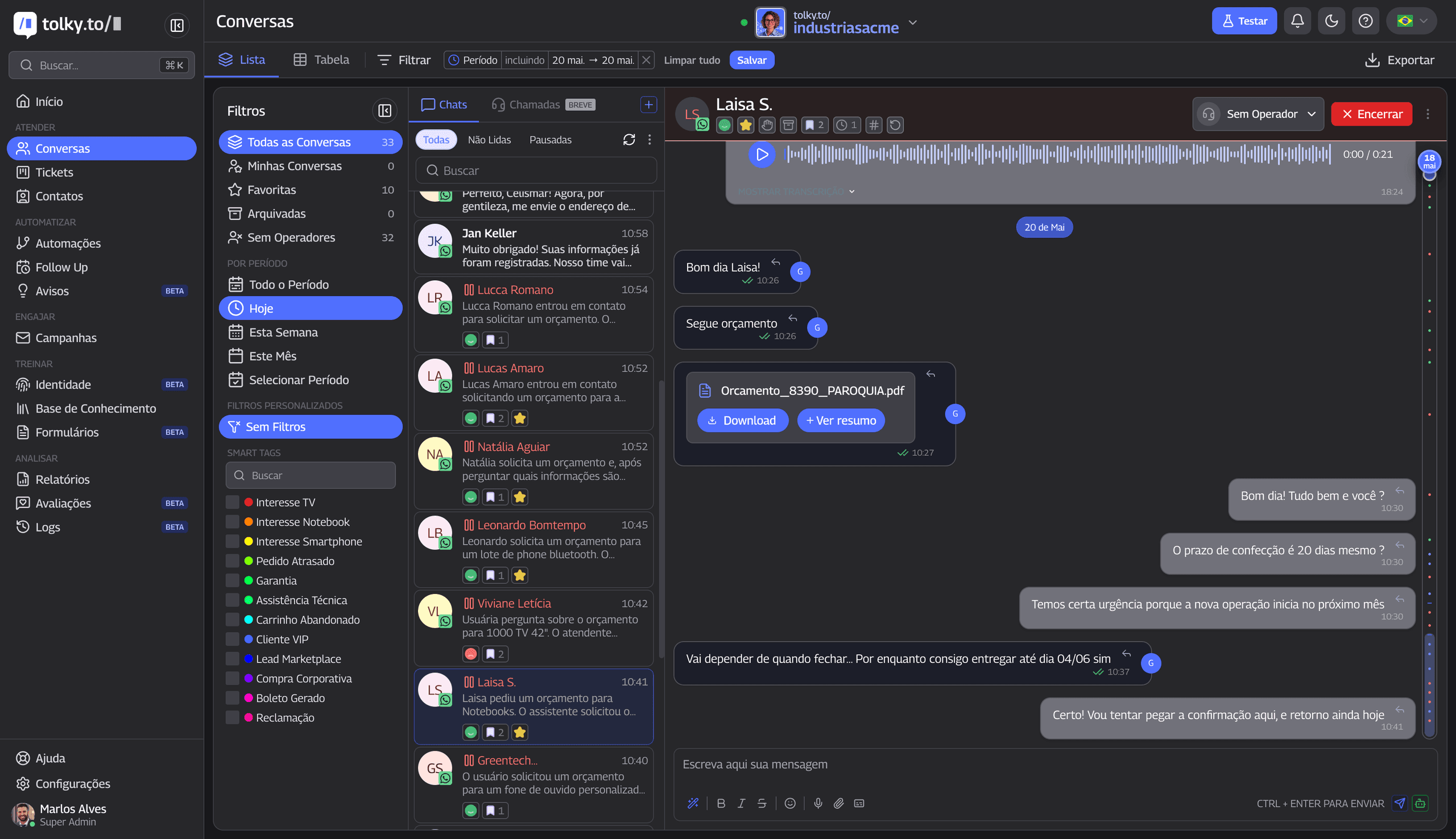
Tolky is an AI-powered conversational CRM: the AI agent works on WhatsApp, website chat, voice, email and Microsoft Teams, qualifies leads with your team's questions and records them in the CRM on the same platform. Instagram and SMS are coming soon.


- Capture. An agent on the official WhatsApp customer service channel and on website chat, plus landing pages, forms and capture pop-ups.
- Qualification. The agent follows the sales mission you write, with your questions and handoff rules. Smart tags classify every conversation, and the collected data fills in the record, with review by your team.
- CRM. In the Tolky CRM, the conversation becomes an opportunity with a stage, an owner and a dated activity. The native integration is with HubSpot; other systems connect through the API, webhooks or Flows.
- Follow Up. When the lead stops replying, the AI waits the time you set and picks the conversation back up from what was said, respecting quiet hours.
- People. Handoff with full history, queues per team and agreed callbacks.
To get started, the Individual plan is free. The sales CRM is included from the Starter plan, and automatic Follow Up and campaigns from the Professional plan; details are on plans and pricing.
What Tolky does not do: it does not buy contact lists or send messages to people who did not opt in. Lead generation starts with people who came to you.
Frequently asked questions
Does a lead generation chatbot work on WhatsApp?
Yes. The agent answers people who arrive from the website button, a link or a click-to-WhatsApp ad, asks the qualifying questions and records the lead. Messages outside the 24-hour window require an approved template and opt-in.
How many questions should a chatbot ask to qualify a lead?
Three to five are usually enough: need, fit, timing and, when it matters, decision and budget. With AI, the agent skips what the lead already said and asks only what is missing.
What is the difference between a lead chatbot and a form?
A form only receives data. A chatbot answers questions, adapts what it asks and delivers the lead with context and a score, while the person is still interested.
What is lead scoring in a chatbot?
It is the points each answer in the conversation adds to the lead, based on weights your sales team defines. The score decides who goes to a rep the same day, who enters nurturing and who leaves the pipeline.
When should a lead go to a sales rep?
When it reaches the agreed score, asks to talk to a person or asks something the agent cannot answer safely, such as a discount outside the rules. The handoff carries the conversation summary.
Does a chatbot replace the sales team?
No. It handles the first reply, qualification and record keeping. Negotiation, objections and closing stay with people, who now receive leads with context.
Conclusion
A lead generation chatbot is worth what happens after the capture: questions that change the next step, scoring written with your sales team, a fast handoff to a person and the lead recorded in the CRM. Start with one channel, ideally the one that brings in the most leads today, measure sales acceptance and adjust the weights.
Explore the Tolky CRM, see WhatsApp customer service, see the plans or talk to the team →. Let's talk?
Share
Tags
- lead generation chatbot
- lead capture chatbot
- chatbot for lead generation
- lead qualification chatbot
- lead scoring
- whatsapp sales chatbot
- click-to-whatsapp ads
- #conversational CRM
Cited in
- Chatbot for insurance companies: quotes, claims and renewals
- How to sell on WhatsApp: catalog, sales script, follow-up and AI
- Chatbot examples: 12 use cases by function and industry, in dialogue
- Conversational marketing: what it is, tactics and how to qualify leads
- What is a chatbot? Types, NLP, examples, cost and how to choose
- Lead Loss on WhatsApp: Why Companies Let Sales Slip in Conversations
- AI Lead Qualification for B2B: How AI Agents Score Leads
About the author

Co-founder of Tolky
Marlos Carmo is an AI entrepreneur and founder of Tolky, the conversational-era infrastructure and AI CRM that unifies intelligent service, multi-channel support (such as WhatsApp and voice), live CRM, and operational intelligence in a single ecosystem. He is a finalist for the SXSW Innovation Awards and a member of Francesco's Economy, a global network of young entrepreneurs focused on innovation and social impact. He works connecting Artificial Intelligence and digital transformation in projects for large organizations.
Next step
Want to bring this to your operation?
Tati, Tolky's AI assistant, understands your scenario in a few questions, suggests the best path and connects you with someone from the team, with full context.
Share