Conversational marketing: what it is, tactics and how to qualify leads
What conversational marketing is, how it differs from traditional marketing and conversational commerce, tactics with website chat, WhatsApp and click ads, and how to qualify and measure.
TL;DR
Conversational marketing means attracting and qualifying prospects through real-time conversations, in website chat, on WhatsApp and in ads that open a conversation, instead of forms and emails that take days. It works when the reply is immediate, the AI asks the qualification questions and the ready lead reaches the salesperson with the full history, inside a conversational CRM.
Share
The website form asks for name, email, company and job title. The lead fills it in, gets an automatic email and waits. When the salesperson finally calls, two days later, the person has already talked to another vendor or no longer remembers what they asked for.
Conversational marketing replaces that wait with a conversation. This guide explains what it is, how it differs from traditional marketing and from conversational commerce, which tactics work (website chat, WhatsApp and click ads), how to qualify a lead without interrogating them and how to measure the results.
Updated November 2026.
What is conversational marketing?
Conversational marketing is the strategy of attracting, engaging and qualifying prospects through real-time conversations, in channels such as website chat, WhatsApp and ads that open a conversation, with AI and people replying at the moment interest appears.
The term conversational marketing became popular in US B2B marketing through companies that sell chat for websites, and it got a book with that name, by David Cancel and Dave Gerhardt, published by Wiley in 2019 (the book's page on O'Reilly, checked on November 23, 2026). The idea was to swap the form for the conversation.
In Brazil, the channel for that conversation is mostly WhatsApp. The short definition is in the glossary, under conversational marketing.
What is the difference between conversational marketing and traditional marketing?
The difference lies in timing and direction: traditional marketing talks to an audience and waits days for a reply, while conversational marketing responds in the minute a person shows interest and leads a dialogue from there.
| Criterion | Traditional marketing | Conversational marketing |
|---|---|---|
| Entry point | Form, landing page, email | Chat, WhatsApp, click ad |
| Response time | Hours or days | Seconds or minutes |
| Direction | One-way message | Two-way dialogue |
| Qualification | Form fields and scoring | Questions asked in the conversation |
| Handoff to sales | Exported lead list | Conversation transferred with history |
| Data generated | Contact record | Contact record, intent and conversation context |
Traditional marketing does not go away. Content, ads and email keep bringing people in. What changes is what happens when someone raises their hand and says they want to know more.
And how does it differ from conversational commerce?
Conversational marketing takes care of the top and middle of the funnel: attracting, understanding and qualifying. Conversational commerce takes care of the sale and the after-sale inside the conversation. In simple sales operations, both happen in the same dialogue; in complex sales, conversational marketing delivers the qualified lead and the salesperson takes it from there.
Why does conversational marketing work?
Conversational marketing works because it replies while interest is still warm and because it uncovers, in the conversation, what the form never asks. The person explains the problem in their own words, and that is worth more than a "job title" field.
Three effects show up in practice:
- Speed. Whoever replies first has a better chance of starting a real conversation. The concept of speed to lead measures exactly this.
- Context. The conversation reveals urgency, budget and objections, and all of it stays on record.
- Less friction. Sending a message is easier than filling in six fields.
The post on losing leads on WhatsApp shows what happens when the reply takes too long.
What are the conversational marketing tactics?
The most common tactics are website chat, WhatsApp with a link and a QR code, click-to-WhatsApp ads, consent-based campaigns and voice callbacks. Each one has a different entry point and brings in a different kind of lead.


Website chat
The webchat shows up on the pages with the highest intent, such as pricing and demo, and opens with a useful question instead of "Can I help you?". An illustrative example on the pricing page: "Want help choosing a plan? Tell me how many people handle customer conversations today." The AI answers questions and offers to continue on WhatsApp.
WhatsApp with a link and a QR code
A link on the website, in the email signature, on the packaging and on printed material, with a ready-made message. The free WhatsApp link generator and WhatsApp QR code generator tools help you create a link for each source and track where every conversation comes from.
Click-to-WhatsApp ads
Ads on Facebook and Instagram that open a conversation instead of a web page. The lead arrives with the ad already identified, and the reply needs to be immediate. See the guide to click-to-WhatsApp ads and the glossary term click-to-WhatsApp.
Consent-based campaigns
Outbound messages to people who have authorized contact, using an approved template and a relevant offer. The post on WhatsApp marketing covers the rules and good practices.
Voice callbacks
For higher-value leads, a phone call right after sign-up brings the conversation closer. The post on the AI SDR that makes phone calls shows how this works.
How do you qualify leads with conversational marketing?
Qualifying in conversational marketing means asking, over the course of the conversation, the few questions that separate people who are ready to talk to sales from people who are still researching, without turning the dialogue into an interrogation. The AI asks one thing at a time and records each answer on the contact.


| Criterion | Natural question (illustrative) | Sign of a ready lead |
|---|---|---|
| Need | "What are you trying to solve today?" | A clear problem tied to what you sell |
| Size | "How many people handle customer conversations today?" | Company size within your audience |
| Timeline | "When do you need this up and running?" | A set deadline in the coming months |
| Decision | "Who else is part of the decision?" | Decision maker in the conversation or involved |
| Budget | "Do you already have an investment range in mind?" | A range that fits your price |
Three habits keep the conversation light:
- Ask only what changes the next action. If company size changes nothing, do not ask about it.
- Answer before you ask. Someone who asked a question expects an answer, not a questionnaire.
- Offer a person at any moment, especially when the lead asks for one.
To go deeper, see AI lead qualification in B2B, the glossary term lead qualification and the guide to the chatbot for lead generation.
How do you hand the qualified lead to sales?
The qualified lead should reach the salesperson with the whole conversation and a summary of what was learned, within a deadline agreed between marketing and sales. A lead transferred without context forces the customer to repeat everything from the start.
A good agreement between the two teams defines:
- What a ready lead is. The criteria from the table above, written down.
- Contact deadline. How quickly the salesperson replies, with an alert when that time runs out. The post on lead response SLAs includes templates.
- Where it goes. The right team's queue, by region, product or company size.
- What happens if it does not close. A lead that is not ready yet goes back to nurturing, with lead follow-up on WhatsApp.
How do you measure conversational marketing?
Measure conversational marketing by how many conversations turn into qualified opportunities and how fast that happens, not by the number of chats opened.
| Metric | How to calculate | What to watch |
|---|---|---|
| First response time | Time between the first message and the first reply | Compare business hours and after hours |
| Engagement rate | Conversations with at least two replies from the lead ÷ conversations started | A weak opening drags this number down |
| Qualification rate | Qualified leads ÷ conversations | Too high may signal loose criteria |
| Opportunities generated | Opportunities created from conversations | Break it down by channel and by campaign |
| Cost per qualified lead | Spend on media and tools ÷ qualified leads | Compare with the cost of the form |
| Sales conversion | Sales ÷ qualified leads | Shows whether the qualification is right |
Listen to the conversations that did not turn into opportunities: they show the question that pushed the lead away or the doubt the AI could not answer.
Where Tolky fits into conversational marketing
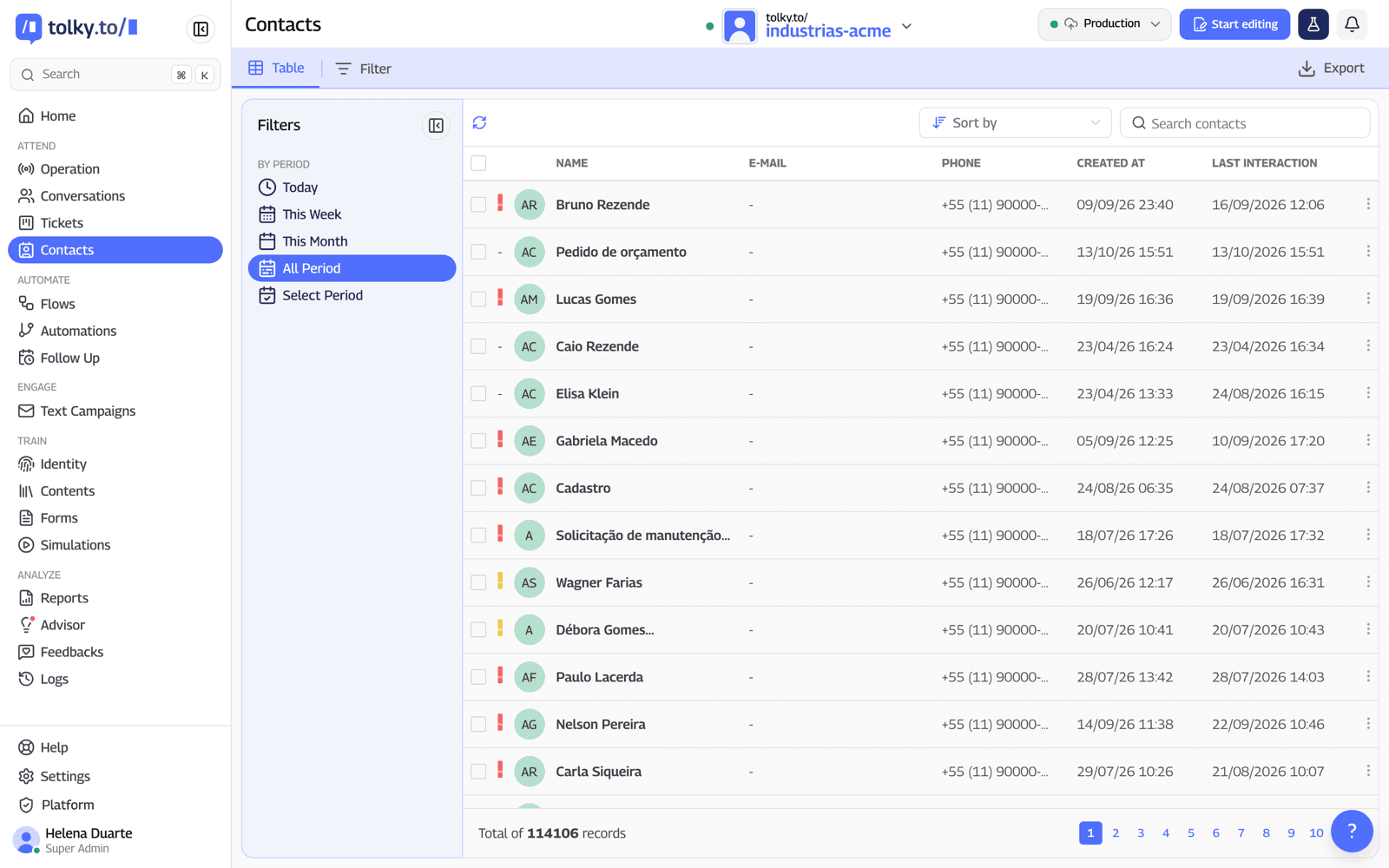
Tolky is a conversational AI CRM that replies to leads on WhatsApp and on the website with AI agents, asks the qualification questions and records everything in the CRM, with handoff to the salesperson and the full history. It is the link between the media that brings the lead in and the team that sells.
- Entry channels. WhatsApp through the official API, webchat and minichat on the website, voice and email. Instagram and SMS are coming soon.
- AI agents by mission. You set up a sales and relationship agent with the qualification questions, the limits and when to call in a person.
- CRM and pipeline. The Tolky CRM creates the opportunity from the conversation and shows which stage each lead is at.
- Campaigns and Follow Up. Text Campaigns with approved templates, and Follow Up for people who are not ready yet.
- Integrations. Native HubSpot integration, REST API, webhooks and more than 1,000 apps through the Integration node in Flows.
What Tolky does not do: it does not buy media or create ads. The campaign stays in the Meta or Google ads manager; Tolky handles the conversation that starts after the click. If all you need is a form with an automatic email, an email automation tool will do the job.
Frequently asked questions
What is conversational marketing in a few words?
It is attracting and qualifying prospects through conversation, at the moment they show interest. Instead of a form and a wait, the person sends a message and gets a reply right away, from an AI or from someone on the team.
What is the difference between conversational marketing and a chatbot?
A chatbot is a tool; conversational marketing is the strategy. A menu chatbot can be part of it, but the strategy includes channels, qualification questions, the handoff to sales and metrics.
Does conversational marketing work in B2B?
It does, and the term became popular precisely in B2B. The conversation helps you understand company size, timeline and who decides before bringing in the salesperson, and the lead arrives with context.
Which channels should you use for conversational marketing?
In Brazil, start with WhatsApp and website chat, where customers are already used to talking to companies. Click-to-WhatsApp ads bring volume, and a callback helps with higher-value leads.
Does AI replace the pre-sales team?
No. The AI replies right away, asks the first questions and organizes the history. The team takes over the negotiation, the complex cases and the higher-value leads, with more time to spend on them.
How do you keep qualification from feeling like an interrogation?
Answer the lead's question before asking yours, ask one question at a time and ask only what changes the next action. Offer to connect them with a person whenever the lead asks.
Conclusion
Conversational marketing is replying while interest is warm and finding out, in the conversation, who is ready to buy. Start with the highest-intent entry points, write a few qualification questions, agree with sales on the deadline and the handoff criteria, and measure opportunities, not chats.
Explore the Tolky CRM, see Text Campaigns, see the plans or talk to the team →. Let's talk?
Share
Tags
- conversational marketing
- marketing conversacional
- lead qualification
- click-to-whatsapp ads
- website chat
- lead generation
- #conversational CRM
Cited in
- WhatsApp Channels: what they are, how to create one, business uses
- Conversational commerce: what it is and how to sell on WhatsApp
- WhatsApp marketing: strategy, opt-in, templates and costs in 2026
- Conversational AI Is Not a Chatbot: Why Go Beyond Automated Replies
- Conversational CRM: What It Is, How It Works and How to Choose
- Conversational AI: what it is, how it works and customer service
About the author

Co-founder of Tolky
Marlos Carmo is an AI entrepreneur and founder of Tolky, the conversational-era infrastructure and AI CRM that unifies intelligent service, multi-channel support (such as WhatsApp and voice), live CRM, and operational intelligence in a single ecosystem. He is a finalist for the SXSW Innovation Awards and a member of Francesco's Economy, a global network of young entrepreneurs focused on innovation and social impact. He works connecting Artificial Intelligence and digital transformation in projects for large organizations.
Next step
Want to bring this to your operation?
Tati, Tolky's AI assistant, understands your scenario in a few questions, suggests the best path and connects you with someone from the team, with full context.
Share