Chatbot for clothing stores: sizing, exchanges and WhatsApp sales
How to use a chatbot for clothing stores on WhatsApp: size charts, stock and catalog, exchanges within consumer law, selling in the conversation, seasonal peaks and when to bring in a sales associate.

TL;DR
A chatbot for clothing stores is an agent on WhatsApp and your website that answers questions about sizing, stock, exchanges, delivery and payment at any hour, helps shoppers pick the right piece using the store's size chart and hands off to a sales associate when the customer wants advice or a deal. It only reports real stock and order status when it is integrated with the store's system, and it follows the written exchange policy, within consumer protection law.
Share
"Do you have it in a medium?", "Does this dress run small?", "Can I exchange it if it doesn't fit?". In a clothing store, the same questions arrive dozens of times a day on WhatsApp, many of them after closing time. Whoever answers fast makes the sale; whoever answers the next day watches the customer buy somewhere else.
A chatbot for clothing stores handles that queue without losing the feel of a good sales associate: it checks the size chart, confirms whether the piece is available in that size, explains the exchange policy and sends the payment link. This guide covers what it solves, what depends on integration, what the law says about exchanges and how to get ready for Mother's Day, Black Friday and the holidays.
Updated November 2026.
What is a chatbot for clothing stores?
A chatbot for clothing stores is a customer service agent, ideally AI-powered, that talks with shoppers on WhatsApp and your website about items, sizes, stock, exchanges, delivery and payment, helps close the sale and hands off to a store employee when the case calls for it. It works with the catalog, measurements and policies the store provides.
It applies to the neighborhood shop that sells from a phone and to the brand with an online store and several locations. What changes is the depth: a small shop starts with answers about sizing and exchanges; a chain integrates stock and orders. If you are just starting out, the guide to WhatsApp chatbots for small businesses helps with the first step.


What does a chatbot solve in a clothing store?
A chatbot handles the questions that repeat (size, stock, exchanges, delivery, payment and address) and frees your sales associates for shoppers who want help choosing. In most stores, those questions take up a large share of WhatsApp traffic.
| Customer question | What the chatbot does | When to bring in a person |
|---|---|---|
| "Do you have it in M?" | Checks stock if integrated, or explains how it will be confirmed | One-of-a-kind piece or a hold outside the rules |
| "Does it run small?" | Answers with the size chart and the fit notes for that piece | Questions that need a stylist's eye, such as alterations |
| "Can I exchange it?" | Explains the written exchange policy, deadline and conditions | Defective item or a case outside the policy |
| "When will it arrive?" | Gives the delivery time and, if integrated, the order status | Delays or lost packages |
| "Do you take cards? Installments?" | Explains payment options and sends the store's link | Discount requests or special terms |
| "Where is the store?" | Sends the address, hours and directions | Rarely |
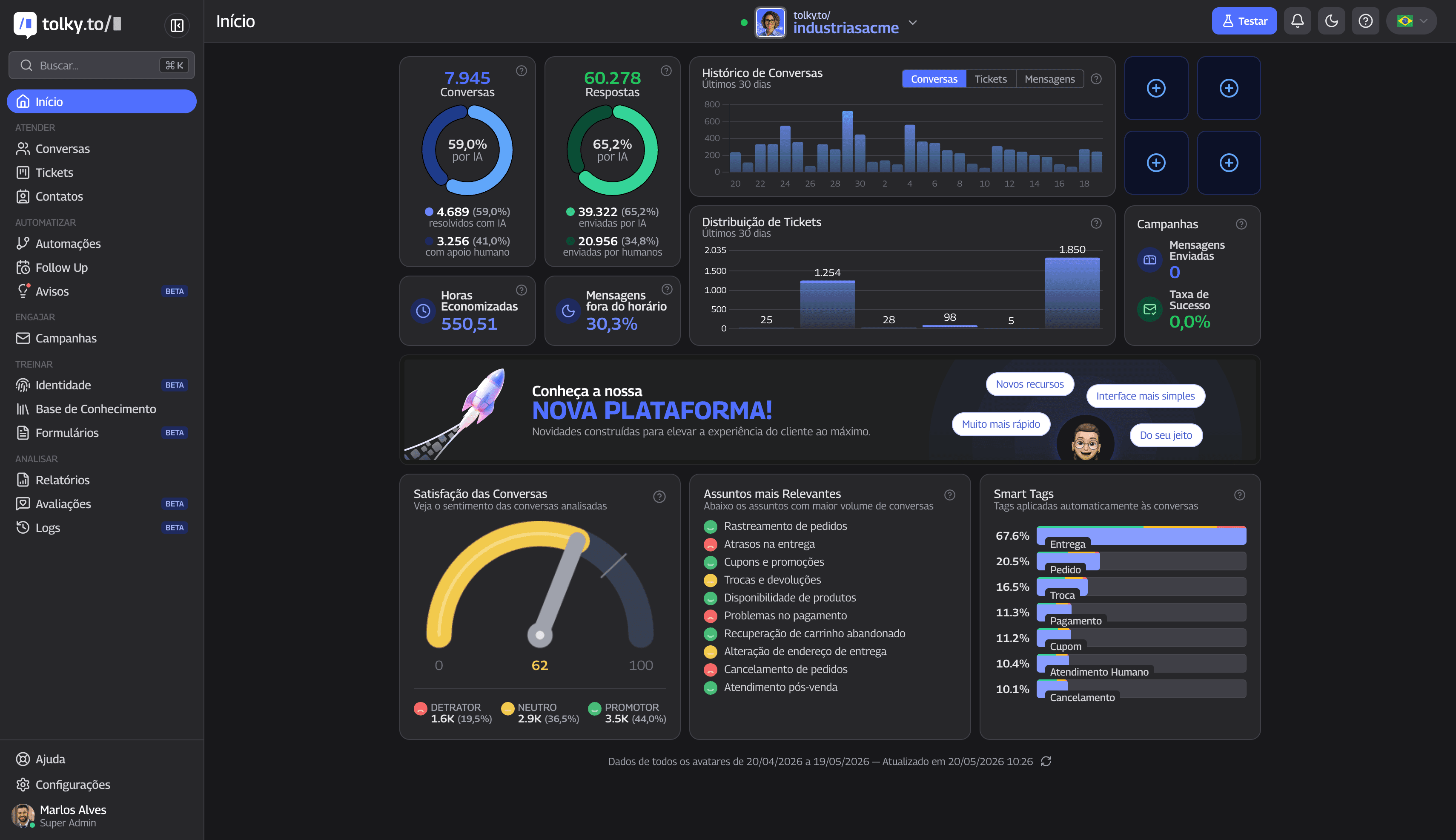
The dashboard below shows how topics appear when the AI classifies conversations: order tracking, exchanges and returns, product availability and coupons usually lead in retail.
How does the chatbot answer questions about size and fit?
The chatbot answers sizing questions with the store's own size chart, piece by piece, not with a generic small, medium and large rule. Every brand fits differently, and shoppers know it.
For good answers, add these to the knowledge base:
- A size chart for each product line, in centimeters or inches (bust, waist, hips, length).
- Fit notes for each piece: "relaxed fit," "non-stretch fabric," "customers between two sizes usually take the larger one."
- How to measure at home, in three steps, for people who don't know their measurements.
The conversation then goes like this (illustrative example): the customer says "I wear a size 10 in pants and my hips are 39 inches," the agent compares that with the chart for the jeans she asked about and suggests the 10, noting that the fabric doesn't stretch. If the question is about fit ("does it look good on petite women?"), the agent can offer photos of people wearing the piece, if the store has them, or hand off to an associate.
The chatbot can't try clothes on for anyone. It reduces doubt and, together with a clear exchange policy, reduces the fear of buying without trying on. The step-by-step for building that base is in training an AI agent with a knowledge base.
Stock and catalog: what depends on integration?
Without integration, the chatbot does not know real-time stock: it only knows what was added to the knowledge base. To answer "do you have it in M" reliably, it needs to query the store's system.
There are three possible levels:
- No integration. The agent answers from the catalog you uploaded and says it will confirm availability with the team. This works for small shops and short collections.
- Integrated catalog. E-commerce platforms such as Shopify, VTEX and WooCommerce have connectors that let the agent look up the product, variant and price during the conversation.
- Integrated orders. Beyond products, the agent checks order status and answers "where is my order" with data from the system.
The guide to chatbots for e-commerce covers orders and carts in detail. In a physical store without a stock system, agree on a simple rule with the team: the agent records the interest and an associate confirms within an hour.
What does the law say about clothing exchanges?
Under Brazil's Consumer Protection Code (CDC), exchanging non-defective clothing bought in a physical store is not mandatory: it is store policy, but whatever the store advertises becomes binding. For purchases made outside the store, such as over WhatsApp or online, the customer can cancel within 7 days. We use Brazil as the reference market here; rules vary by country, so check your local law.
- Remote purchases. Article 49 of the CDC guarantees the right to cancel "within 7 days of signing or of receiving the product" when the purchase happens outside the store, with immediate refund of amounts paid (Law No. 8,078/1990, checked November 23, 2026). A sale closed on WhatsApp and delivered to the customer's home falls here.
- Defective items. Article 26 gives 30 days to report an apparent defect in non-durable goods and 90 days for durable goods, and article 18 gives the supplier up to 30 days to fix the defect (same source).
- Exchanges for size, color or taste in a physical store. There is no legal obligation; it "is a policy the store may or may not offer," explains the Rio Grande do Sul state government (published December 25, 2023, checked November 23, 2026). If the store advertises exchanges, the offer is binding under article 30 of the CDC.
In practice, write the exchange policy in a few lines (deadline, tags, receipt, sale items) and upload exactly that text. The chatbot repeats the policy; a person makes exceptions. This summary is not legal advice.
How do you sell clothes on WhatsApp with a chatbot?
Selling on WhatsApp with a chatbot follows four steps: understand what the customer is looking for, suggest pieces with photos and sizes, clear up exchange and delivery questions and send the store's payment link. The agent leads; the associate steps in when the customer wants advice.
A short, illustrative script:
- Discovery. "Is it for you or a gift? Any special occasion?"
- Suggestion. Two or three pieces with photo, price and available sizes.
- Questions. Measurements, exchanges and delivery time, following store policy.
- Closing. The payment link from your online store or card terminal, and order confirmation.
Shoppers who ask and disappear get a follow-up the next day, naming the piece and asking a single question. The principles of selling in conversation are in how to sell on WhatsApp, and the idea behind them in conversational commerce.
How do you prepare the chatbot for seasonal peaks?
Seasonal dates multiply message volume, and the chatbot only handles the peak if it is tested beforehand, with the campaign rules uploaded and staff scheduled for exceptions. Prepare each date a few weeks ahead.


| Date | What changes in customer service | What to upload beforehand |
|---|---|---|
| Mother's Day | Lots of gift buying, sizing questions for someone else | Gift exchange policy, exchange vouchers, gift wrap |
| Valentine's Day | Gifts with tight deadlines | Delivery times by region, in-store pickup |
| Black Friday | Peak in prices and stock questions | Discount rules, items excluded from the sale, exchange deadline |
| Christmas and New Year | Gifts and exchanges in January | Holiday hours, exchanges after the holidays |
| Collection change | Clearance and launches | Clearance items, exchange conditions |
For proactive messages around these dates, use an approved template and only for people who opted in. The WhatsApp message templates library has collections for Mother's Day and Black Friday, and the guide to WhatsApp marketing shows how to plan the campaign.
When should the chatbot bring in a sales associate?
The chatbot should bring in an associate when the customer wants styling advice, wants to negotiate, reports a defect or asks for something outside the policy, or simply says she wants to talk to someone. The handoff includes the conversation and the pieces she has already seen.
Common handoff signals:
- "Can you help me put together an outfit for a wedding?"
- A request for a discount, special terms or a long hold.
- A defective item, late delivery or complaint.
- A returning customer who always talks to the same associate.
Ready-made handoff rules are in the guide to AI-to-human handoff.
How do you measure a clothing store chatbot?
Measure it by the number of sales that went through the conversation, first response time and the share of questions resolved without a queue, not by message volume. Compare similar weeks, outside seasonal peaks.
- First response time, especially outside store hours.
- Conversations that became orders, with a payment link sent.
- Questions resolved by AI about size, exchanges and delivery.
- Exchanges for the wrong size, which should drop with a good size chart.
- Service rating, with a short survey at the end of the conversation. The guide to customer satisfaction surveys on WhatsApp shows how.
Where does Tolky fit in a clothing store?
Tolky is an AI-powered conversational CRM: the AI agent works on official WhatsApp and website chat using the catalog, measurements and policies you provide, and hands off to your team with full history. See how this works in the retail and e-commerce segment.
- Customer service. The same agent on WhatsApp customer service and on your website, with team queues and handoff to associates.
- Integration. In Flows, the Integration node connects more than 1,000 apps, such as Shopify, VTEX and WooCommerce; once integrated, the agent looks up products and orders.
- Campaigns. Text campaigns with approved templates, personalized by AI, with a conversation when the customer replies.
- Re-engagement. Automatic Follow Up for shoppers who stopped replying, respecting quiet hours.
- Customers. Every conversation in the customer's history, with an opportunity and stage in the CRM.
To start at no cost, there is the free Individual plan; campaigns and Follow Up are included from the Professional plan. See the plans.
What Tolky does not do: it is not an e-commerce platform or a stock system, and it does not process payments: the agent sends the link from the payment method the store already uses.
Frequently asked questions
Does a clothing store chatbot work on WhatsApp?
Yes. It is the channel where most shoppers ask about sizing, exchanges and delivery. The agent answers at any hour with the store's information and hands off to an associate when the customer asks.
Does the chatbot know if the piece is available in my size?
Only if it is integrated with the stock system or the e-commerce platform. Without integration, it answers from the uploaded catalog and passes the confirmation to the team.
Does a store have to exchange clothes that don't fit?
In Brazil, for purchases made in a physical store with no defect, no: exchanges for size, color or taste are store policy, but whatever the store advertised is binding. For remote purchases, such as a WhatsApp sale with delivery, the customer can cancel within 7 days under article 49 of the CDC.
How does the chatbot help choose a size?
By comparing the customer's measurements with the size chart for the piece and with the fit notes the store provides. When the question is about fit or style, it brings in an associate.
Can you sell through a chatbot without an online store?
Yes. The agent presents the pieces, answers questions and sends the payment link the store already uses, and the team confirms the order. E-commerce integration only automates stock and order lookups.
How much does a clothing store chatbot cost?
It depends on the platform and conversation volume, plus Meta's fees for messages outside the 24-hour window. With Tolky, you can start on the free Individual plan; prices for the other plans are on plans and pricing.
Conclusion
A chatbot for clothing stores sells more when it answers quickly about sizing, stock and exchanges, using the store's own information, and knows when to bring in an associate. Start by uploading your size chart and exchange policy, test before the next seasonal peak and measure the conversations that became orders.
See the retail and e-commerce segment, explore WhatsApp customer service, see the plans or talk to the team →. Let's talk?
Share
Tags
- chatbot for clothing stores
- fashion retail chatbot
- whatsapp for clothing stores
- clothing store customer service
- sell clothes on whatsapp
- clothing exchanges
- retail chatbot
- #conversational CRM
About the author

Co-founder of Tolky
Marlos Carmo is an AI entrepreneur and founder of Tolky, the conversational-era infrastructure and AI CRM that unifies intelligent service, multi-channel support (such as WhatsApp and voice), live CRM, and operational intelligence in a single ecosystem. He is a finalist for the SXSW Innovation Awards and a member of Francesco's Economy, a global network of young entrepreneurs focused on innovation and social impact. He works connecting Artificial Intelligence and digital transformation in projects for large organizations.
Next step
Want to bring this to your operation?
Tati, Tolky's AI assistant, understands your scenario in a few questions, suggests the best path and connects you with someone from the team, with full context.
Share