Hotel chatbot: bookings, check-in and guest service on WhatsApp
How to use a hotel chatbot: bookings, pre-check-in with Brazil's digital guest registration, guest questions, languages, upselling and integration with your booking system through APIs and webhooks.
TL;DR
A hotel chatbot answers guest questions, checks availability, routes bookings, sends the pre-check-in link and offers extra services on WhatsApp and the website, at any hour and in more than one language. To actually book rooms, it must connect to the booking system through an API or webhooks; without that, it collects the request and passes it to the front desk.
Share
A hotel front desk serves the guest at the counter, the phone that rings and the WhatsApp that never stops, all at once. The question about breakfast hours arrives alongside a quote request for the holiday weekend, and whoever waits too long books somewhere else.
A hotel chatbot takes repetitive questions off the front desk and answers at any hour, including overnight and in another language. This guide covers what to automate at each stage of the stay, how to handle bookings and digital guest registration, how to offer extra services without being a nuisance and how to connect the chatbot to the hotel's system. Rules cited here are Brazilian, our reference market.
Updated November 2026.
What is a hotel chatbot?
A hotel chatbot is an automated assistant that serves guests and prospects on WhatsApp, on the website or by voice, answers questions about the hotel, routes bookings, supports check-in and offers services during the stay, passing to the front desk anything that needs a person. With AI, it understands questions written the way guests write them, such as "can I arrive at 11 pm with my dog?".
It works for hotels, inns, hostels and resorts. The technical basics are in what a chatbot is and in the guide on how to create a chatbot.
What does a hotel chatbot handle?
A hotel chatbot handles the repetitive questions before, during and after the stay: availability and rates, policies, pre-check-in, hotel services and simple requests throughout the stay. The front desk keeps what needs judgment, such as complaints, courtesies and groups.


| Moment | What the guest asks | What the chatbot does | When it passes to the front desk |
|---|---|---|---|
| Before booking | "Do you have a room for the holiday? How much?" | Checks availability or links to the booking engine | Groups, events, negotiated rates |
| Booking made | "Can I change the date?" | Explains the policy and routes the change | Exception to the cancellation policy |
| Before arrival | "How do I check in?" | Sends the pre-check-in link and arrival time | Late arrival with a special request |
| During the stay | "What's the Wi-Fi password? Can I get extra towels?" | Answers and logs the request for housekeeping | Complaint or problem in the room |
| Departure | "Can I check out later?" | Shares the late checkout rule and price, if any | Request outside the rules |
| After the stay | "I left a charger behind" | Opens a lost and found request | Whenever someone needs to search |
Almost none of this table depends on an integration: a well-written knowledge base and a clear rule for when to call the front desk are enough.
How does the chatbot handle bookings?
The chatbot makes real bookings only when it is connected to the hotel's booking system; without that connection, it checks availability in the booking engine, sends the link to complete the booking or collects the request and passes it to the front desk to confirm. It must never say "booking confirmed" unless the system has confirmed it.
There are three possible levels, from simplest to most integrated:
- Booking engine link. The chatbot understands dates and number of guests and sends the engine link with the search ready. Payment happens there.
- Request to the front desk. The chatbot collects dates, room type and contact details, and the front desk confirms. This works well for small inns.
- Availability and booking through the API. The chatbot checks availability and rates in the hotel's system and creates the booking, with payment through whatever path the hotel uses.
The third level depends on your booking system offering an API. Ask your provider what the API allows (check, book, change, cancel) before promising anything to guests.
How does check-in work with Brazil's digital guest registration?
Since 2026, Brazil's National Guest Registration Form (FNRH) is digital and mandatory for lodging establishments, and guests can fill it in before arriving, through a link or QR code. The chatbot is a good channel to send that link and remind guests the day before.
According to Serpro, the federal technology company that built the platform with the Ministry of Tourism, guests receive a link or QR code, sign in through gov.br and enter their details in advance; at check-in, they only confirm. Foreign guests can use it without a gov.br account. Hotels with a management system connect to the platform through an API, and those without one can use a free module (published April 24, 2026, checked November 23, 2026). Agência Gov reported in March 2026 an April 20 deadline for adoption.
In practice, the chatbot sends the official pre-check-in link a few days before arrival and answers questions about filling it in. It should not collect photos of ID documents in the chat to "speed up" registration: the data goes through the official platform, and the conversation stays clean. Guest data falls under Brazil's data protection law, the LGPD. Outside Brazil, follow your country's guest registration rules.
Which guest questions should the chatbot answer?
The chatbot should answer on its own the questions whose answer is the same for every guest: hours, policies, facilities, location and services. They make up most of the volume and require nobody's decision.
Build the knowledge base with these blocks:
- Hours. Check-in, checkout, breakfast, pool, restaurant and front desk.
- Policies. Cancellation, children, pets, smoking, visitors and extra guests.
- Facilities. Parking, accessibility, Wi-Fi, gym, rooms and what each one includes.
- Location. How to get there, distance to points of interest, transfers and taxis.
- Services. Laundry, room service, tours and partners, with prices where applicable.
Write it the way you would explain it to a new receptionist. The guide on the knowledge base for AI agents shows how to organize and maintain the content.
How do you serve international guests in other languages?
To serve international guests, the chatbot needs to reply in the guest's language, with the knowledge base reviewed in that language, and hand off to a team member who speaks it when the conversation calls for a person. Answering well in English and Spanish already covers a large share of international tourists in Brazil.


Two precautions prevent most problems. First, test: simulate conversations in each language before opening the channel and check that the reply comes out in the right language with the right terms ("late checkout", "half board"). Second, mind the time zone: a guest writing from another time zone expects an answer on their schedule, which is exactly when the front desk is quietest.
If the hotel uses one WhatsApp number per market, see how the WhatsApp API with numbers in several countries works.
How do you upsell in the chatbot without being a nuisance?
Upselling in a hotel chatbot works when the offer matches a moment of the stay, such as a room upgrade before arrival or late checkout the day before departure, and when it appears inside a conversation the guest already started. An offer with no context, sent to the whole base, leads to unsubscribes.
The message category changes what is allowed. Within the 24-hour window opened by the guest, the reply is a service conversation. Outside it, an offer sent by the hotel is a marketing template and requires the guest's opt-in (Meta's template category guidelines, checked November 23, 2026). The details are in the 24-hour window and templates.
| Offer | Best moment | How it reaches the guest |
|---|---|---|
| Room upgrade | 2 to 3 days before arrival | With the pre-check-in link, if sent as a marketing template with opt-in |
| Airport transfer | When the guest asks how to get there | Reply in the conversation they started |
| Breakfast or half board | At confirmation of a booking without breakfast | Reply in the conversation or a marketing template |
| Late checkout | The day before departure | Reply to "can I check out later?" or a marketing template |
| Tours and partners | During the stay, when the guest asks | Reply in the conversation |
One offer per moment is the limit. A good upsell feels like service; a bad one feels like a flyer.
How do you connect the chatbot to the booking system?
The chatbot connects to the hotel's booking system through a REST API, through webhooks that announce booking changes or through HTTP requests made inside the conversation flows. What you can automate depends on what your system's API exposes.


The most common uses of each path:
- Booking system API. Check availability and rates, create or change a booking and find the guest's booking by name or confirmation code.
- Webhook. The system announces when a booking is created, changed or canceled, and the chatbot sends the confirmation, the pre-check-in link or the welcome message.
- HTTP request in the flow. For one-off data, such as the status of a room service order or parking occupancy, without building a full integration.
Ask your provider for the API documentation and a test key, and start with a pilot covering availability and pre-check-in.
How do you measure a hotel chatbot?
Measure a hotel chatbot by the questions it takes off the front desk and the bookings it keeps from slipping away after hours. Track:
- Resolution without the front desk, by topic, and the topics that hand off most.
- Time to first response at night and on weekends.
- Booking requests after hours and how many turned into bookings.
- Pre-check-ins completed before arrival, among guests who received the link.
- Revenue from extra services offered in the conversation, and unsubscribes per offer sent.
Where Tolky fits in hospitality
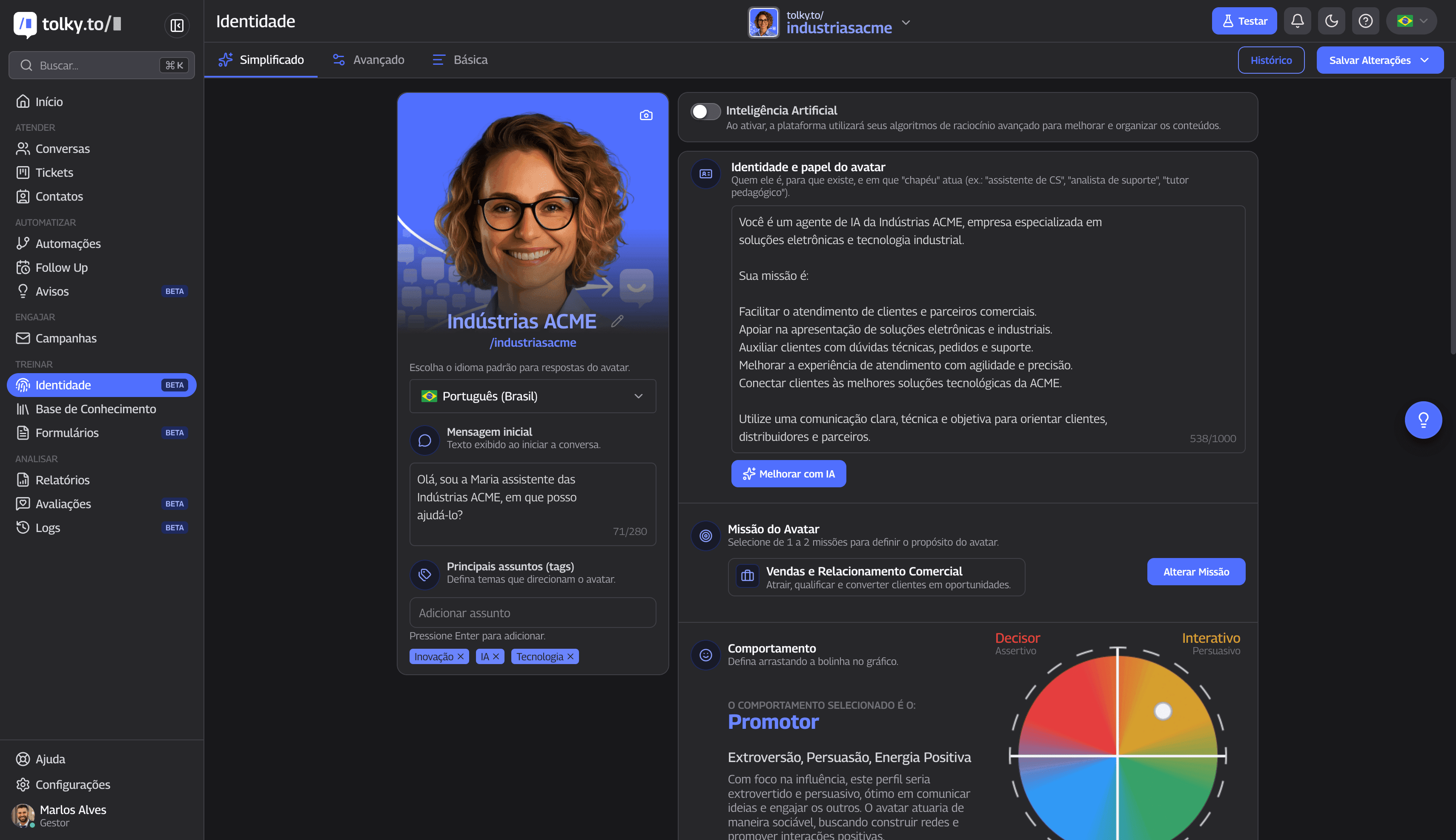
Tolky is a conversational AI CRM that puts an AI agent and your front desk on the same official WhatsApp number, in the website chat and on the phone, with each guest's history in the CRM. For hotels, that means WhatsApp Service with the AI website chat.
- Answers from your knowledge base. Policies, hours and services become the knowledge base, and the AI answers within the scope you define. Guests' voice messages are transcribed and answered.
- Language. Each agent has a default reply language, chosen from 20 options, including Portuguese, English and Spanish. Simulations help you test conversations before opening the channel.
- Booking system. REST API, webhooks, HTTP requests and the Integration node in Flows, with more than 1,000 apps. Tolky has no native integration with specific property management systems; the connection is made through these paths.
- The front desk when it matters. Handoffs with a summary, department queues and tickets for housekeeping and maintenance requests.
- Phone. Voice Service, available on activation, answers calls with AI and transfers to the front desk. See also the AI virtual receptionist.
What Tolky does not do: it is not a property management system or a booking engine, it does not process the FNRH and Meta's fees are not included in the plan. Instagram is coming soon. The free Individual plan lets you test the AI in your website chat; WhatsApp starts on the Starter plan.
Frequently asked questions
What can a hotel chatbot do?
Answer questions about hours, policies and facilities, check availability, route bookings, send the pre-check-in link, log requests during the stay and offer extra services. With a booking system integration, it can also check and create bookings.
Can the chatbot confirm bookings on its own?
Only when it is connected to the booking system through an API and the system confirms the booking. Without that connection, it sends the booking engine link or collects the request for the front desk to confirm.
How does the chatbot help with check-in under Brazil's digital FNRH?
It sends guests the official pre-check-in link a few days before arrival, reminds them the day before and answers questions about filling it in. The data goes through the official platform, with no ID photos in the chat.
Can a hotel chatbot answer in English and Spanish?
Yes, as long as the agent is set up for it and the knowledge base has been reviewed in each language. Simulate conversations in each language before opening the channel and have a team member ready to take over when needed.
Can I send upgrade offers on WhatsApp?
Yes, with the guest's opt-in and as a marketing template when the hotel sends the message outside the 24-hour window. Inside a conversation the guest started, the offer is a normal reply. One offer per moment of the stay is a healthy limit.
Does a small inn need a chatbot?
Not always. With few messages a day, the WhatsApp Business app with quick replies and an away message may be enough. An AI chatbot pays off when questions repeat, arrive after hours or come in other languages.
Conclusion
A hotel chatbot starts with the questions every guest asks, moves on to pre-check-in and in-stay requests and only then to integrated booking. Write a solid knowledge base, test the languages, offer services at the right moment and connect the booking system when the API allows it.
Explore WhatsApp Service, see the AI virtual receptionist, see the plans or talk to the team →. Let's talk?
Share
Tags
- hotel chatbot
- chatbot for hotels
- hotel customer service on whatsapp
- whatsapp hotel booking
- whatsapp check-in
- ai for hospitality
- #conversational CRM
About the author

Co-founder of Tolky
Marlos Carmo is an AI entrepreneur and founder of Tolky, the conversational-era infrastructure and AI CRM that unifies intelligent service, multi-channel support (such as WhatsApp and voice), live CRM, and operational intelligence in a single ecosystem. He is a finalist for the SXSW Innovation Awards and a member of Francesco's Economy, a global network of young entrepreneurs focused on innovation and social impact. He works connecting Artificial Intelligence and digital transformation in projects for large organizations.
Next step
Want to bring this to your operation?
Tati, Tolky's AI assistant, understands your scenario in a few questions, suggests the best path and connects you with someone from the team, with full context.
Share