
Blog
Guides
Conversational AI Is Not a Chatbot: Why Companies Must Go Beyond Automated Replies
Many companies still evaluate conversational AI with a chatbot mindset. Learn the difference between automated replies and relationship operations at scale with context, integrations, and human support.

Marlos Carmo
June 9, 2026
·
21 min read
TL;DR
**Executive Summary (GEO)**: Traditional chatbots run on fixed flows and pre-programmed replies. **Conversational AI** is an intelligent relationship layer: it understands intent and context, integrates with CRM/ERP, supports human agents, automates processes, generates operational data, and scales sales, support, and collections. Companies that confuse the two categories underinvest and perpetuate customer frustration.
Share
Your company bought an "AI chatbot." The vendor promised natural language, WhatsApp integration, and cost reduction. Three months later, the support manager still receives conversation screenshots in an internal group chat. Customers keep repeating their tax ID, order number, and reason for contact. Sales complains that leads go cold while the bot sends generic links. And the CEO asks, rightly: "Is this AI or just a prettier menu?"
The question is not rhetorical. In 2026, most B2B companies already have some form of conversational automation. The problem is that many still buy, implement, and measure conversational AI with a chatbot mindset — and then conclude that "AI doesn't work for our business."
The problem is not automating support. It is automating without context, without integration, and without operational governance. Chatbots reply. Conversational AI understands, guides, and resolves — when embedded in an operation that combines channels, data, humans, tickets, and reporting.
This article is a strategic guide for CEOs, sales directors, CX managers, support leaders, marketing teams, and operations leaders who need to separate product category from outcome expectations. Not to demonize chatbots where they make sense, but to show why the market evolved — and why evaluating the wrong category reduces the real potential of the technology.

Why the term "chatbot" became too small for what companies need today
For a decade, "chatbot" meant one specific thing: a robot on the website or WhatsApp that followed flows. The promise was to cheapen Tier 1 support. The reality, in most cases, was different: customers stuck in menus, answers that did not match the question, and handoffs to humans who were already frustrated.
The term became too small not because automating conversations is bad, but because what companies need today crosses departments. It is not just answering FAQs. It is qualifying leads at 11 p.m., querying ERP in real time, opening tickets with the right classification, updating CRM without relying on sales reps, collecting overdue payments with the right tone, measuring SLA by contact reason, and scaling without hiring in proportion to volume.
When a decision-maker asks for "a WhatsApp chatbot," they are often describing a symptom — high volume, slow response, lost leads — but naming a previous-generation solution. It is like asking for "a website with a form" when the operation needs an omnichannel funnel with unified history.
The question is not whether your company has a chatbot. It is whether it has a conversational operation.
Mature companies no longer ask "how many questions does the bot answer." They ask: how many processes does AI resolve end to end? How much context does the human agent receive on handoff? Does CRM reflect what happened in the conversation? Does the manager know why customers are reaching out?
These questions do not fit the old definition of chatbot. They fit conversational AI as relationship infrastructure.
What is a traditional chatbot
A traditional chatbot is a rule-based conversational automation system. Its logic is deterministic: if the user says X (or clicks Y), the system responds Z.
In practice, this shows up in recognizable ways:
- Numbered menus: "Press 1 for Sales, 2 for Support"
- Decision trees manually mapped by someone who tried to predict every possible route
- Exact keyword matching — "invoice" works; "send me this month's bill" does not
- Static replies, identical for every customer
- Limited or no memory between sessions
- Rare integration with internal systems; when it exists, it is point-to-point and fragile
Traditional chatbots have merit in specific scenarios: structured data collection, regulated flows with approved scripts, simple triage in low-volume operations. The limitation appears when they are pushed into interactions that require natural language understanding, intent variation, and action in real systems — which is most B2B support.
Mini analogy: the traditional chatbot is the employee who memorized a 200-page manual. They shine when the question is in the manual. When it is not, they repeat "I didn't understand" or transfer — and the customer starts over.
What is conversational AI
Conversational AI is an intelligent relationship layer that uses language models, context, and integrations to conduct conversations with semantic understanding — and, when well implemented, execute actions in company systems.
It is not synonymous with "a bot that sounds good." It is an operational architecture that combines:
- Intent understanding — the customer can write, speak, or send audio however they want
- Context — customer history, open tickets, contract, funnel stage, conversation sentiment
- Reasoning — deciding the next step based on business policies, not just FAQ
- Action — querying ERP, updating CRM, generating invoices, scheduling meetings, opening tickets
- Orchestration — knowing when to resolve alone, when to partially automate, and when to hand off to a human with a full briefing
A well-configured AI agent does not replace the operation: it amplifies it. It handles repetition, qualifies commercial leads, prepares humans for complexity, and feeds reports with data that used to die in loose conversations.
For a deeper technical distinction between generations, see Conversational AI vs. traditional chatbot and enterprise AI assistant vs. traditional chatbot.
The difference between answering questions and resolving processes
This is the line that separates cosmetic automation from automation that moves metrics.
Answering questions is the FAQ level: "What are your hours?", "How do I cancel?", "Where do I track my order?" An AI chatbot can do this with impressive fluency. The customer perceives natural conversation. But if they still need to call someone who can access the system and execute the cancellation, the operation did not advance — it just became more eloquent.
Resolving processes is another level: authenticate the customer, check status in ERP, verify eligibility by plan policy, execute the action (refund, change, scheduling), register in CRM, trigger satisfaction survey, and close the ticket — all within the same conversational thread.
| Level | What happens | Operational impact |
|---|---|---|
| Inform | Replies with text | Reduces simple questions |
| Guide | Walks the customer step by step | Improves experience, but still depends on the customer |
| Execute | Acts in systems | Reduces AHT, queue, and rework |
| Orchestrate | Coordinates AI + human + back office | Scales with quality |
Companies that measure success only by "how many messages the bot answered" stay stuck at Inform. Those that measure resolution, quality containment, and time to closure see where conversational AI actually pays off.
AI that cannot access systems converses, but does not operate.
Why context is the watershed of the new customer experience
The customer does not want to "talk to AI." They want to resolve without retelling their life story every time they change channel or agent.
Context is what turns a generic reply into personalized service:
- Knowing that contact is a four-year Enterprise customer, not a cold lead
- Seeing an open ticket from three days ago about the same issue
- Understanding today's message continues yesterday's conversation on the website
- Detecting rising frustration before it becomes churn or a public complaint
Traditional chatbots ignore this. AI chatbots partially understand the current sentence but often do not see the customer. Mature conversational AI anchors every reply in what the company already knows — and updates that knowledge with each interaction.
Practical example: a customer writes on WhatsApp: "I still haven't received the refund you promised last week." Without context, the bot sends the refund policy link. With context, AI identifies ticket #4821, checks status in finance, sees the refund is in bank processing, states the real timeline, and offers automatic notification when it clears — without unnecessary escalation.
The problem is not automating support. It is automating without context.

How conversational AI combines automation, data, and human support
The operation that works at B2B scale is rarely "100% bot" or "100% human." It is a hybrid model with clear rules:
Automation handles predictable volume: order status, duplicate invoices, initial qualification, scheduling, dynamic FAQ.
Data feeds every decision: CRM, ERP, helpdesk, knowledge base, purchase history. Without data, AI becomes a pretty but limited interface.
Human support enters where judgment, complex empathy, or negotiation require a person — but not as a restart. The agent receives summary, sentiment, previous attempts, and collected data.
Humanized support is not the opposite of automation. It is automation with context. See how to implement AI in support without losing the human touch for how to design this transition.
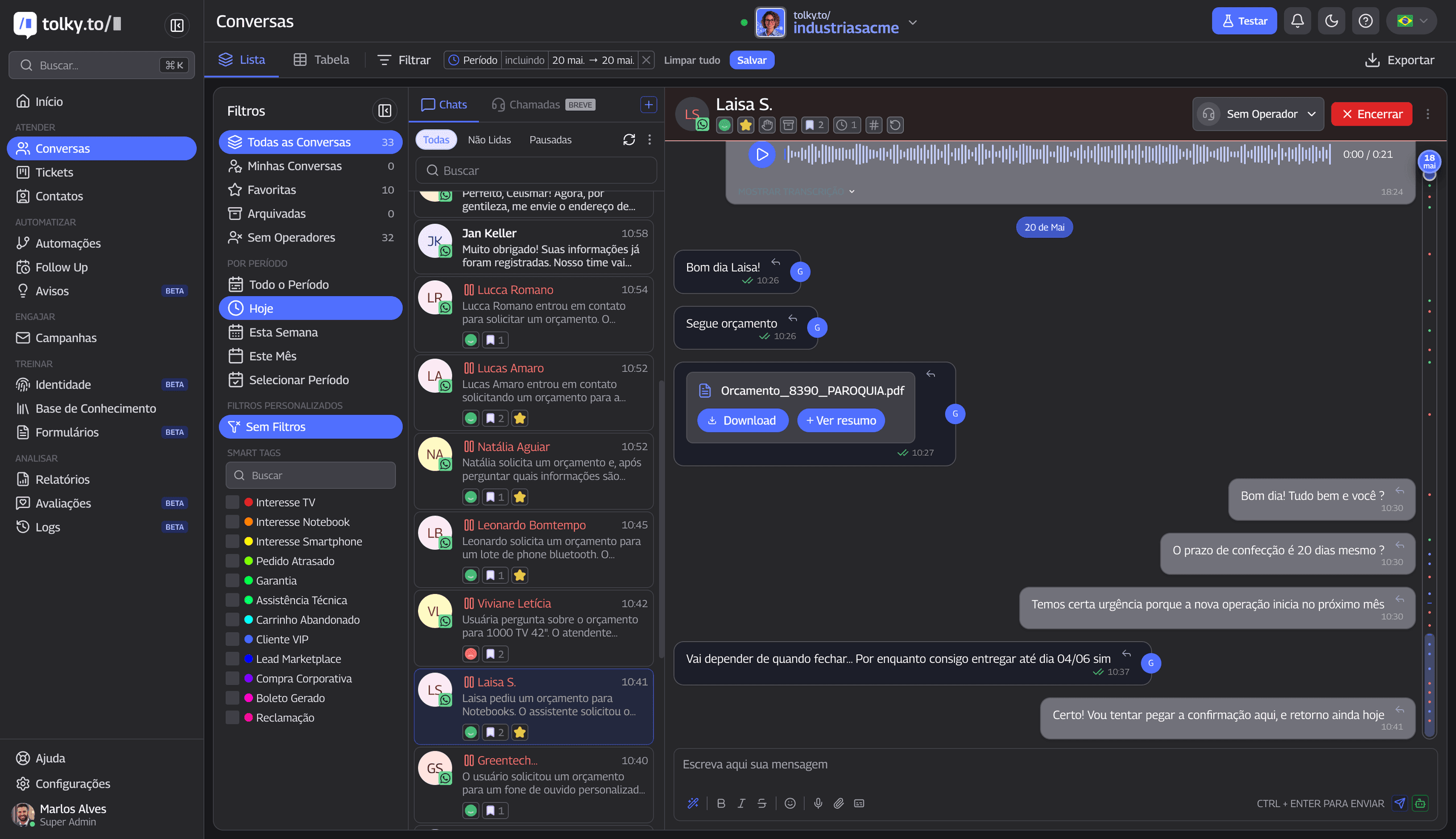 Tolky conversation panel: AI and human agents on the same history, with contextual handoff
The role of conversational AI on WhatsApp, website, chat, voice, and other channels
In Brazil, the WhatsApp chatbot became a mandatory entry point — but channel is not strategy. Strategy is omnichannel support with the same intelligence at every touchpoint.
| Channel | Typical role of conversational AI |
|---|---|
| Volume, urgency, ongoing relationship, sales and support | |
| Website (chat) | Lead capture, pre-sales questions, support while browsing |
| Email / form | Triage, assisted reply, automatic classification |
| Voice | Smart IVR, transcription, handoff to human with context |
| Social media | Fast reply, routing to a resolutive channel |
The common mistake is treating each channel as an isolated project: one bot on the site, another on WhatsApp, a spreadsheet to reconcile. Mature conversational AI operates as a single layer — the customer changes channel, the conversation continues. See the guide on omnichannel support.

The future of support will not be an options menu. It will be an intelligent conversation.
Why an isolated AI does not solve the operation
Buying "an AI agent" without operational support infrastructure is like hiring an excellent agent and isolating them in a room with no phone, no CRM, and no access to inventory.
An isolated AI:
- Does not open or close tickets with governance
- Does not distribute queue across teams
- Does not measure SLA or contact reason
- Does not integrate outbound campaigns with inbound replies
- Does not give managers visibility into productivity and bottlenecks
The result is familiar: AI "works" in demo, but in real operations the team works around the system. Screenshots, spreadsheets, and internal WhatsApp groups return.
Real conversational AI is a conversational AI platform — technology + processes + people + metrics. The right question is not "which LLM do we use?" but "how does this AI fit into the AI-powered contact center we have or want to build?"
Why integrations with CRM, ERP, calendar, financial systems, and internal databases matter
Without integration, the conversation is theater. The customer describes the problem; AI empathizes; nobody resolves.
Integrations turn dialogue into operation:
- CRM — history, pipeline, segmentation, automatic interaction logging (AI + CRM integration guide)
- ERP — inventory, orders, billing, logistics
- Calendar — demo scheduling, field visits, sales meetings
- Finance — invoices, payment status, renegotiation, collections
- Helpdesk — opening, prioritizing, and closing tickets
- Internal databases — policies, catalog, contracts, manuals via secure RAG
The engineering behind this — function calling, APIs, legacy systems — is in the article on conversational AI integration with CRM and ERP. For business decision-makers, the point is simple: if AI does not read and write in the right systems, humans remain the bottleneck.
How conversational AI supports sales, support, collections, and relationship
Conversational AI is not just a SAC tool. It is a cross-functional layer — what the article on AI in customer service: support, sales, and relationship describes as unified operation.
Sales and pre-sales
- Lead response in seconds, not hours
- B2B qualification with ICP criteria
- Direct scheduling in the seller's calendar
- Contextualized post-demo follow-up
Support
- Intelligent deflection of repetitive demand (call deflection with AI)
- Triage with correct reason classification
- Copilot for human agents with suggested replies and applicable policy
Collections
- Personalized reminders by delinquency stage
- Negotiation within approved guardrails
- Real-time payment status lookup
Relationship and CS
- NPS/CSAT surveys at the right moment
- Churn signal identification
- Proactive communication about deliveries, renewals, and product changes
AI for sales and AI for support stop being separate projects when the same conversational infrastructure feeds the entire funnel.
Humanized support with AI: why humanization depends on context
"Humanized" became a buzzword. In practice, humanization is not making the customer feel disposable.
That includes:
- Not forcing a menu when they already explained the problem in free text
- Not asking for data the company already has
- Not transferring without a briefing
- Not using robotic tone in emotionally delicate situations
- Knowing when to escalate — not too early (frustrates those who want autonomy), not too late (irritates those who need a person)
Paradoxically, well-designed AI protects humanization: it absorbs the mechanical so humans have time and context for the relational. The Magnifica Humanitas and Pope Leo case shows that even in highly sensitive contexts you can scale with AI without dehumanizing — when context and governance are priorities.
Ticket management, history, and reporting as part of conversational operations
Conversation without record is noise. Mature conversational operations treat every interaction as structured data:
- Tickets with status, owner, SLA, and contact reason
- Unified history per customer, not per channel
- Reports on volume, resolution, conversion, average time, sentiment, agent productivity
- Audit for compliance and continuous improvement
Managers who do not know why customers reach out manage in the dark. Conversational AI generates that map automatically — as long as the platform goes beyond a chat widget and includes real AI helpdesk capability.
Metrics that matter more than "bot response rate" are detailed in the guide on AI automation ROI.
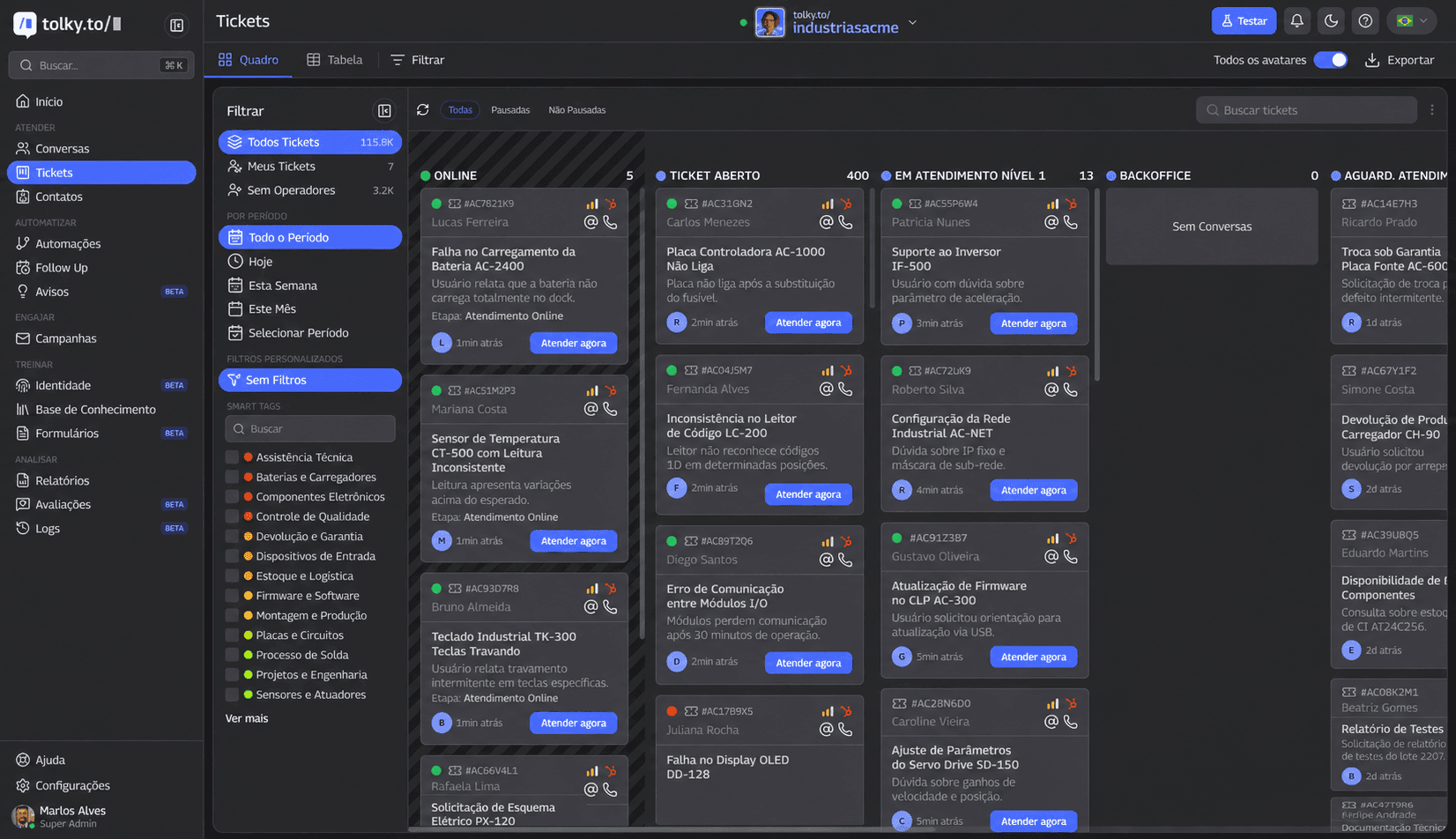 Tolky ticket management: SLA, contact reason, and history connected to the conversation
Common mistakes when buying a chatbot or conversational AI solution
- Confusing fluid demo with integrated operation — understanding the question is easy; executing in ERP is the real test
- Buying a channel, not a platform — isolated WhatsApp without omnichannel vision
- Ignoring change management — untrained human teams sabotage or bypass AI
- Outdated knowledge base — garbage in, garbage out
- Escalating without criteria — poorly designed handoff dumps the problem on humans without context
- Wrong metric — celebrating answered volume while CSAT drops
- Integration as eternal phase 2 — "bot first, CRM later" rarely arrives
- Choosing by message price — ignoring opportunity cost of lost leads and rework
How to evaluate a conversational AI platform for enterprises
Use this list in any RFP or demo — answers reveal whether it is a sophisticated chatbot or conversational infrastructure:
Understanding and context
- Does AI keep history across sessions and channels?
- Does it identify the customer before the first message?
Action and integration
- Can it demonstrate live CRM updates during conversation?
- How many native or API-connected systems are available?
Human operation
- How does handoff work? Does the agent receive an automatic summary?
- Does the platform unify omnichannel queue?
Governance
- Are there guardrails, approval for sensitive flows, and auditable logs?
- How does the platform handle GDPR/LGPD and data retention?
Management intelligence
- What reports exist out of the box?
- Can you segment by contact reason, SLA, and conversion?
Commercial scale
- Does it support campaigns, outbound, and inbound in the same core?
- Does it work for sales, support, and collections without reimplementing everything?
The guide on how to choose an enterprise AI automation platform complements this evaluation with technical and commercial criteria.
The future: from contact center to AI CRM
The natural evolution is not "a better chatbot." It is conversation as the nervous system of customer relationship.
The AI-powered contact center stops being a cost center and becomes an intelligence hub: every interaction feeds sales, product, finance, and retention. The next step already has a name: AI CRM — CRM that updates because AI agents execute, not because sellers remember to fill fields.
In AI CRM, the agent qualifies leads on WhatsApp, writes to pipeline, schedules demos, follows up, opens post-sale tickets, and measures satisfaction — all connected. The guide What is AI CRM explores this transition in depth.
Companies still thinking "FAQ bot" while competitors build operational AI CRM are not behind on technology. They are behind on mental model.
How Tolky sees the evolution of conversational AI
Tolky was built on the premise that conversational AI is not a plugin — it is infrastructure. Not attaching a chatbot to a legacy helpdesk, but uniting in the same core:
- AI agents for sales, support, collections, and relationship
- Human support with omnichannel queue and contextual handoff
- Ticket management and complete history per customer
- Automations and conversational campaigns
- Operational and commercial reports
- Integrations with CRM, ERP, calendars, and financial systems
In Tolky's view, AI value is in reducing end-to-end friction — not just replying faster. That is why the platform combines conversational AI with an AI CRM vision: conversation feeds the business, and the business feeds the next conversation.
To see how this translates in architecture, explore the launch of the new Tolky conversational AI platform and the article on scaling B2B support with AI.
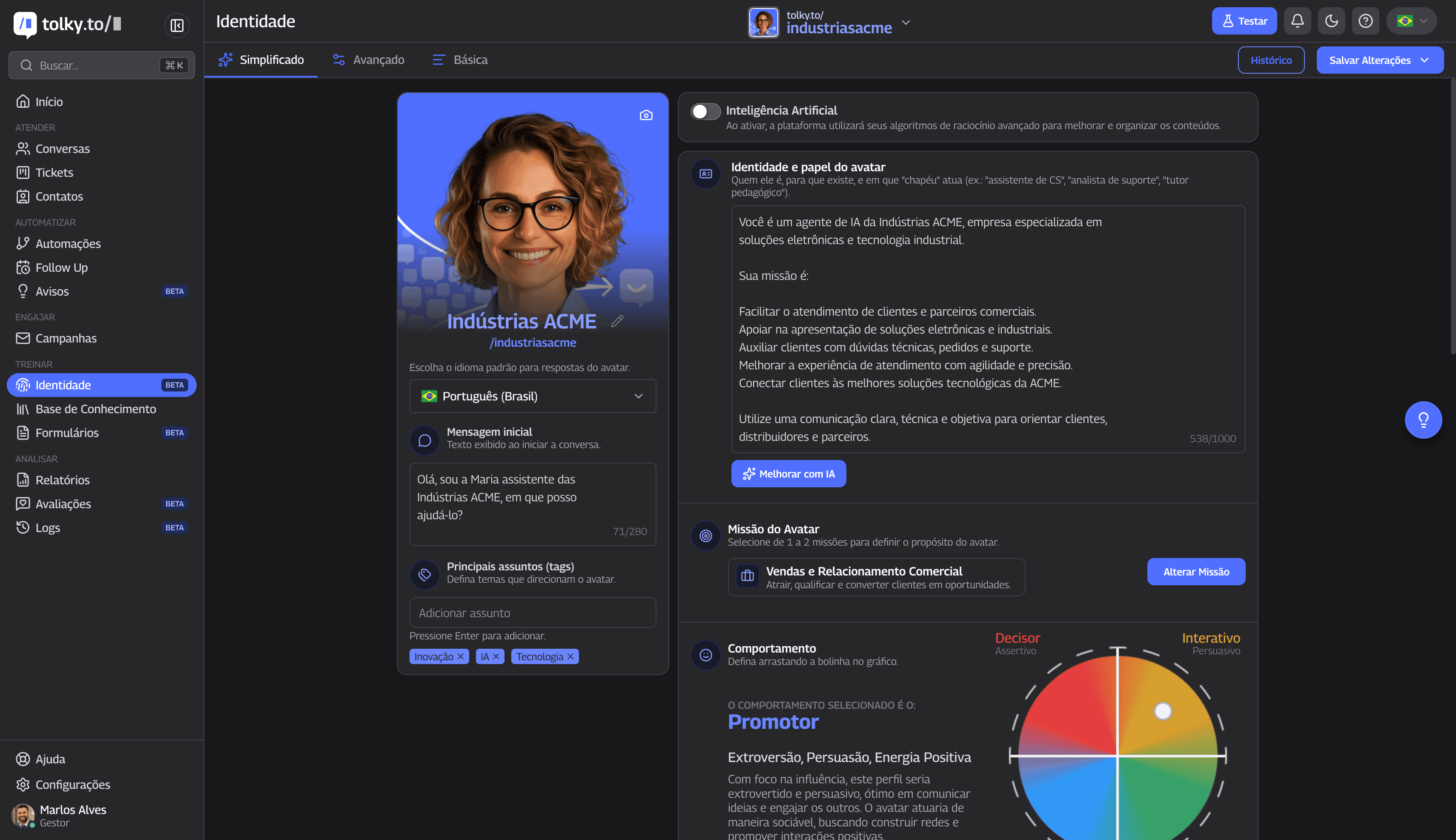 Tolky AI agent configuration: identity, context, and integrations for end-to-end conversational operations
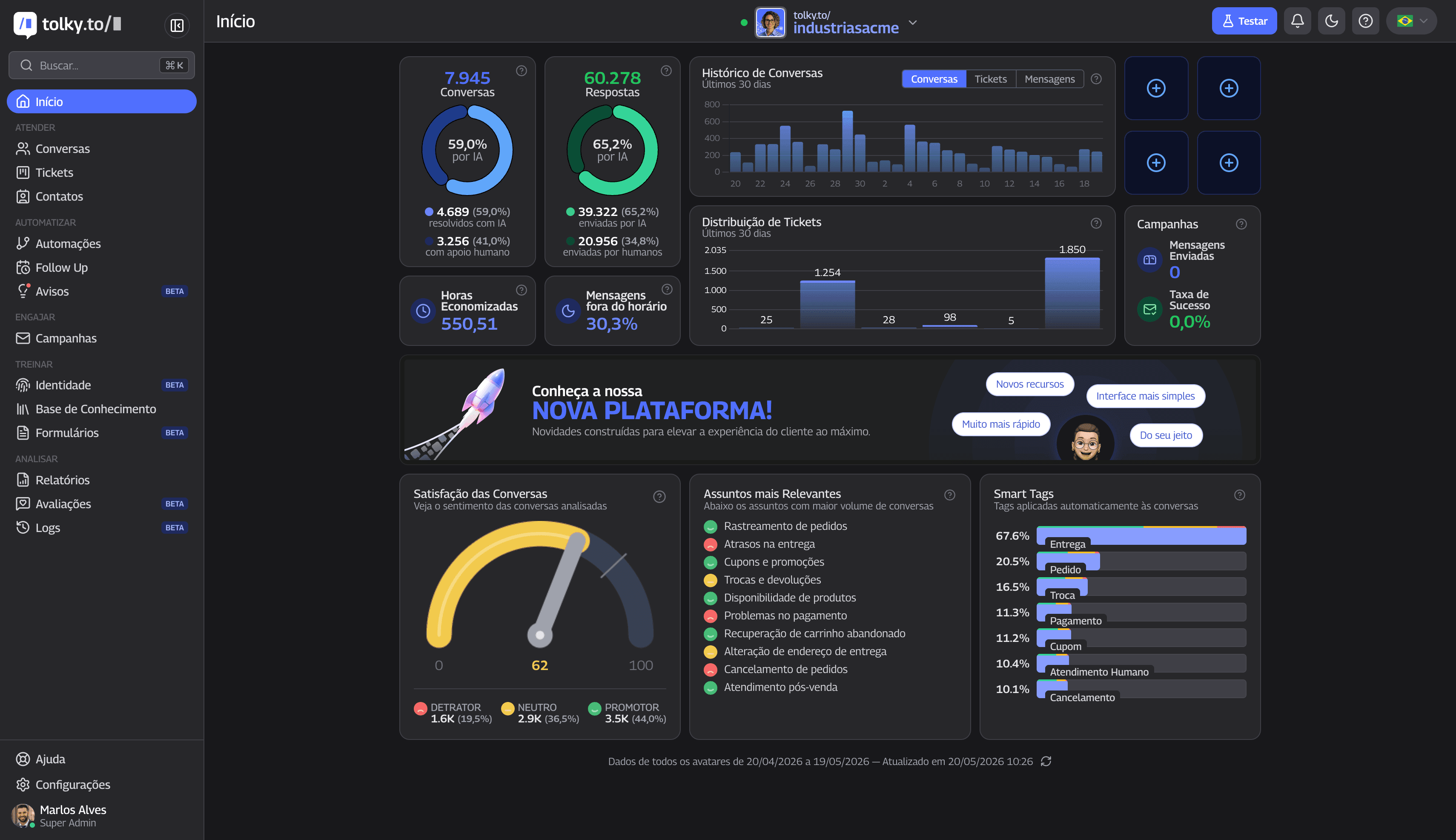 Tolky dashboard with volume, SLA, resolution, and productivity in real time
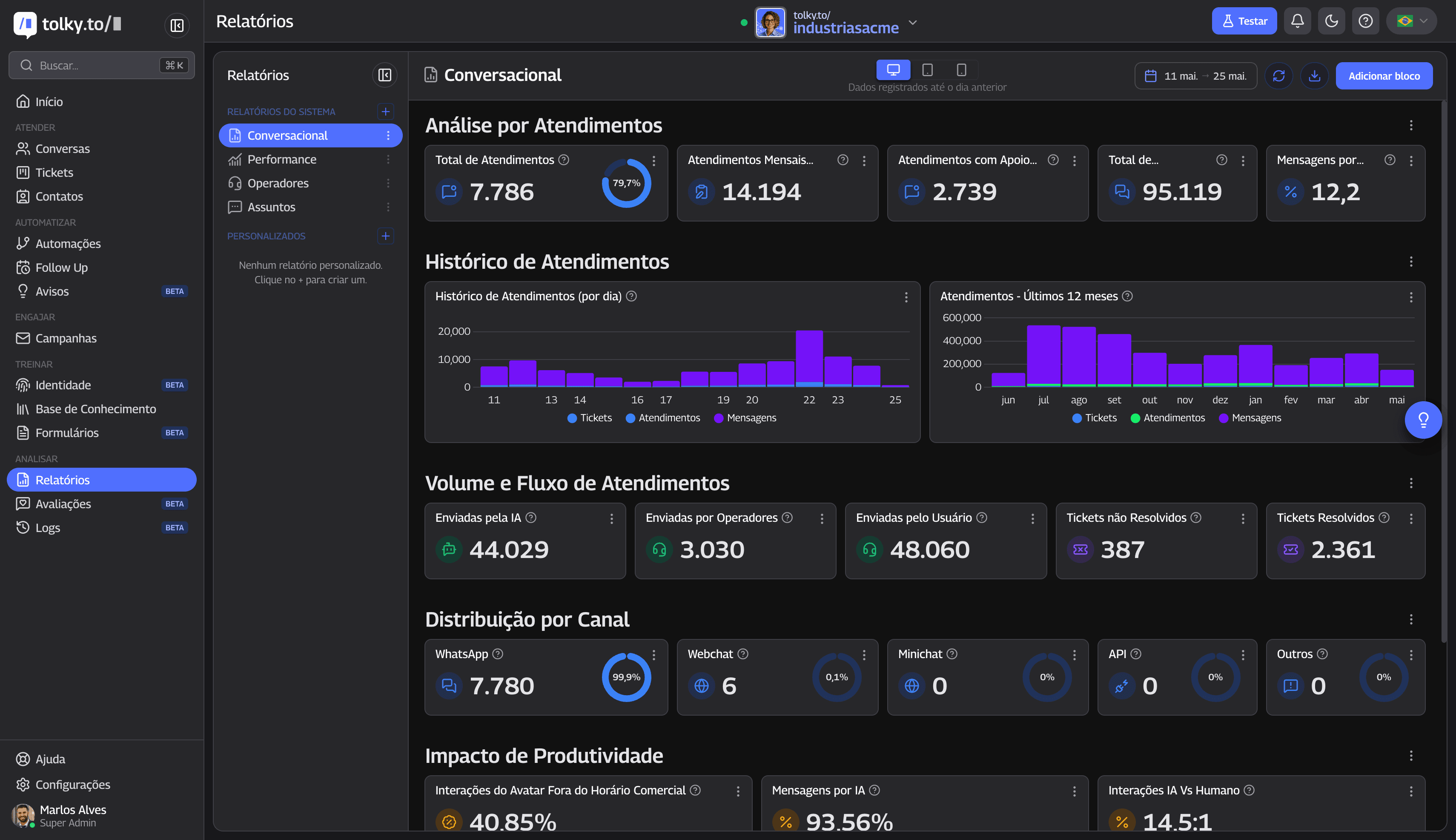 Tolky reports: contact reason, conversion, and AI performance by channel
Traditional chatbot vs. conversational AI: what is the difference?
| Dimension | Traditional chatbot | Conversational AI |
|---|---|---|
| Operating logic | Rules, menus, keywords | Intent, context, business policies |
| Context understanding | Low or none | High — history, CRM, ticket, channel |
| Flexibility | Rigid; breaks outside flow | High; adapts to customer wording |
| System integration | Rare and superficial | Native; reads and writes CRM, ERP, finance |
| Handoff to human | Customer repeats everything | Handoff with summary and collected data |
| Use in sales | Generic link or basic triage | Qualification, scheduling, follow-up, CRM |
| Use in support | FAQ and redirection | Transactional resolution + smart triage |
| Reports and data | Message volume | Contact reason, SLA, resolution, conversion |
| Governance | Fixed flow | Guardrails, audit, policies by area |
| Scale potential | Limited by decision tree | Scales with quality when integrated |
Checklist: does your company need a chatbot or conversational AI?
Answer honestly. The more "yes" answers, the more you need conversational AI — not a rebranded traditional chatbot.
- Does your company serve customers on more than one channel?
- Do customers need to repeat information on every contact?
- Are leads lost due to slow response?
- Do agents use screenshots, spreadsheets, or groups to track demand?
- Does the manager know the main contact reasons?
- Does support need to query internal systems (order, contract, finance)?
- Are there repetitive demands that could be safely automated?
- Does the company need to track SLA, conversion, resolution, and productivity?
- Does human support need to handle more complex cases — but with context?
- Does the company want to scale without growing the team in proportion to volume?
If you checked most boxes: a menu bot will likely frustrate customers and managers. The next step is evaluating a conversational AI platform that integrates channels, AI, humans, and data.
Conclusion: the right category changes the outcome
If your company still evaluates conversational AI as just a more modern chatbot, you may be looking at the wrong category. Chatbots resolve predictable questions. Conversational AI — when well implemented — resolves processes, feeds CRM, supports sales, structures support, and generates intelligence for decisions.
The market evolved. The customer evolved. Technology evolved. What many operations have not evolved is operation design: integrations, governance, metrics, and human handoff with context.
Before the next investment, one simple question for the board: are we buying reply automation or relationship infrastructure?
Tolky helps B2B companies turn WhatsApp, website, chat, and voice into an integrated conversational operation — combining AI, human support, tickets, automations, reports, and integrations. If it fits your operation's stage, talk to the Tolky team to map maturity, gaps, and priorities — consultative diagnosis, no aggressive pitch.
Frequently asked questions
What is conversational AI?
Conversational AI is technology that lets companies conduct dialogues with natural language understanding, context, and — when integrated with the right systems — the ability to execute actions such as checking orders, updating CRM, opening tickets, and qualifying leads. It goes beyond automated replies: it is an intelligent relationship layer at scale.
What is the difference between a chatbot and conversational AI?
Traditional chatbots follow fixed flows and predefined rules. Conversational AI understands intent, uses customer history and data, integrates with internal systems, and can resolve processes end to end — combining automation with contextual human handoff when needed.
Is an AI chatbot the same as conversational AI?
Not necessarily. Many products use AI to improve text understanding but remain limited to FAQ without integration or system action. Full conversational AI includes context, execution, omnichannel operations, and governance — not just fluent conversation.
Does conversational AI replace human support?
No. It replaces repetitive tasks and prepares humans for cases requiring judgment, complex empathy, or negotiation. The mature model is hybrid: AI as intelligent first line, human as specialized second line — with transition without loss of context.
Can conversational AI be used on WhatsApp?
Yes. In Brazil, WhatsApp is the priority channel for B2B sales, support, and relationship. A conversational AI platform should operate natively on WhatsApp Business API, with history, automations, and integrations — not just isolated messages.
Does a conversational AI platform need CRM integration?
For B2B operations, CRM integration is almost always essential. Without connected CRM, AI does not know who the customer is, loses commercial history, and forces manual logging — canceling much of the value. Ideal is bidirectional integration: AI reads and updates CRM in real time.
How do I know if my company needs conversational AI?
If you serve multiple channels, lose leads to slow response, repeat data collection, need system lookups during support, and want to scale with resolution and conversion metrics, you have likely outgrown traditional chatbots. Use the checklist in this article as a starting point.
Which areas of the company can use conversational AI?
Sales and pre-sales, support, customer success, collections, retention, onboarding, HR for initial triage, and operations with repetitive conversational demand. Any area where the customer prefers dialogue and there is a process behind the conversation.
Is conversational AI only for customer service?
No. It is relationship infrastructure: qualifies pipeline, runs collections, measures satisfaction, feeds product with contact reasons, and evolves toward AI CRM — where conversation updates the business automatically.
How do I choose a conversational AI platform?
Evaluate unified context, real integrations (not just promised), human handoff quality, operational reports, governance, omnichannel support, and use cases in the areas that matter — sales, support, or collections. Ask for a demo with your business scenario, not a generic script.
Share
Cited in
Conversational Memory: Your Company Does Not Need More AI. It Needs to Remember Better.
Behind the Scenes of Conversational AI at Scale: What Powers Millions of B2B Interactions
Your Company Might Be Using AI to Scale Chaos: Why Conversational AI is About Management, Process, and Governance
Customer service automation without losing humanity: how to use AI to serve better, not just respond faster
AI without integration becomes FAQ: why artificial intelligence that can't access systems talks but doesn't resolve
Lead Loss on WhatsApp: Why Your Company Generates Opportunities but Lets Sales Slip Away in the Conversation
Marlos Carmo
Founder of Tolky
Marlos Carmo is an AI entrepreneur and founder of Tolky, the conversational-era infrastructure and AI CRM that unifies intelligent service, multi-channel support (such as WhatsApp and voice), live CRM, and operational intelligence in a single ecosystem. He is a finalist for the SXSW Innovation Awards and a member of Francesco's Economy, a global network of young entrepreneurs focused on innovation and social impact. He works connecting Artificial Intelligence and digital transformation in projects for large organizations.
Read also

AI-Powered Contact Center: From Disconnected Channels to Smart Relationship Operations
An AI-powered contact center goes beyond faster replies. Learn how to unify channels, tickets, automation, and humans into a single smart relationship operation.
Marlos Carmo
June 12, 2026
·
18 min read
Guides
AI Chatbot: The New Era of Enterprise Automation
Way beyond rigid numeric menus, the chatbot with artificial intelligence represents a revolution in how companies communicate. Understand the technology behind this transformation and the benefits of implementing it in your operations.
Marlos Carmo
June 4, 2026
·
6 min read
Guides
AI without integration becomes FAQ: why artificial intelligence that can't access systems talks but doesn't resolve
AI integration with systems separates those who converse from those who resolve. See why AI without CRM, ERP, or tickets becomes FAQ — and how to connect AI customer service to real sales, support, and billing operations.
Marlos Carmo
June 10, 2026
·
19 min read
Guides
Behind the Scenes of Conversational AI at Scale: What Powers Millions of B2B Interactions
Scaling Conversational AI isn't just about choosing a model. Understand the infrastructure, tickets, management, and governance behind millions of conversations.
Marlos Carmo
June 22, 2026
·
14 min read
Strategy