
Blog
Guides
What is AI CRM? The Complete Guide for Businesses in 2026
Traditional CRM depends on data that salespeople never enter. AI CRM solves this with autonomous agents that handle customer service, qualify leads, update records, and close cycles on WhatsApp, without manual input. Understand the difference, real use cases, and how to choose the right platform.

Marlos Carmo
June 1, 2026
·
22 min read
TL;DR
**AI CRM** is a platform that replaces the passive traditional CRM with an active ecosystem built on **autonomous AI agents**: they handle customers 24/7, qualify leads on WhatsApp, automatically update records, and execute actions without manual input. Unlike a chatbot (which only responds), an AI CRM acts, decides, and integrates systems. Platforms like **Tolky** process over 4 million messages per month with more than 67% autonomous resolution.
Share
Every company that has ever adopted a CRM knows the same frustration: the tool only works when people enter data, and people never enter enough data.
The result is predictable. Outdated pipelines. Incomplete customer history. Managers making decisions based on information they don't trust. Sales teams opening the CRM only when a manager asks for it.
AI CRM exists to solve this problem at the root, not with more training or more pressure on the team, but by changing the architecture of the system. Instead of a tool that waits for the human to act, the AI CRM acts on its own.
What is AI CRM: Definition
An AI CRM is a customer relationship management platform that replaces manual data entry with autonomous artificial intelligence agents. These agents conduct conversations, qualify leads, update records, execute actions, and resolve service requests on the channels customers already use, such as WhatsApp, without human intervention for each interaction.
The core difference from traditional CRM is not having AI embedded to generate insights. It is having agents that act: the CRM updates itself because the agent made it happen, not because the salesperson remembered to log it.
AI CRM vs Traditional CRM vs Chatbot: The Comparison Table
| Feature | Traditional CRM | Chatbot | AI CRM |
|---|---|---|---|
| Data updates | Manual, depends on the salesperson filling it in | Does not update CRM | Automatic via agents |
| 24/7 service | No (requires a human) | Yes, but limited to scripts | Yes, with real resolution |
| Lead qualification | Manual, by human SDRs | Partial (FAQ, basic triage) | Autonomous with ICP criteria |
| Decision-making | Human | Fixed rule-based | Contextual reasoning |
| System integration | Active (API) but does not execute | Generally none | Reads and writes in external systems |
| Scalability | Linear with headcount | High, but quality drops | High with maintained quality |
| Primary channel in Brazil | Email / phone | Webchat | WhatsApp + omnichannel |
| Consistency | Varies by agent | High (for covered cases) | High for all cases |
The most important distinction is decision-making: a chatbot follows a pre-programmed flow: if the customer says something outside the script, the bot breaks. An AI CRM agent understands natural language, interprets intent, handles variation, and decides how to act based on context, the same way a good salesperson would.
Why Traditional CRM Failed (and Why AI Solves It)
The CRM problem is not technological. It is behavioral and structural.
Salespeople don't enter data into the CRM because it competes with the time they could be selling. This tension is intrinsic: creating value for the management system means taking energy away from the activity the salesperson is paid to do. Decades of training, gamification, and management pressure have not solved this.
The only structural solution is to remove the dependency on manual entry. That is what AI CRM does.
When an AI agent conducts a lead qualification conversation on WhatsApp, the conversation ends with the agent having collected: job title, company size, main pain point, estimated budget, and agreed next step: all automatically written into the lead record in the CRM, without the SDR ever opening the system. The salesperson who accesses the record next finds complete context, not an empty field.
The compounding effect of this over 6 months of operation is a CRM database that reflects reality, not what the team wanted to log.
How an AI CRM Works in Practice
An AI CRM operates across three layers simultaneously:
Layer 1: Conversation (the front)
The AI agent conducts natural language conversations with leads and customers on configured channels. In Brazil, the primary channel is WhatsApp, where 94% of smartphones have the app installed and where B2B companies already receive most of their commercial and support requests. The agent understands text messages, audio (with automatic transcription in Brazilian Portuguese), images, and documents.
Layer 2: Reasoning (the brain)
Behind the conversation, the agent accesses: (1) the complete contact history in the CRM, (2) configured business policies and rules, (3) data from integrated systems (ERP, helpdesk, order system), and (4) the product/service catalog. With this context, it makes decisions: qualify or not, respond directly or escalate, register as an opportunity or ticket, trigger next step or wait.
Layer 3: Execution (the actions)
The agent does not just respond: it acts. This includes: updating CRM fields, opening tickets in the helpdesk, checking order status in the ERP, scheduling meetings in the salesperson's calendar, sending proposals or materials, triggering team notifications, and logging CSAT at the end of the interaction. All without manual intervention.
The Complete Cycle
A typical cycle in an AI CRM works like this:
- Lead comes in through WhatsApp after seeing an ad
- SDR Agent begins qualification: job title, company, context, urgency
- Lead qualified → agent creates opportunity in CRM with pre-filled fields
- Agent schedules demo directly in the responsible salesperson's calendar
- Post-demo: agent sends proposal, runs automatic follow-up on day +3
- Deal closed → agent triggers onboarding, opens CS ticket, and updates pipeline
- During relationship: agent answers questions, measures NPS, alerts team to churn signals
At every step, the CRM is up to date. Not because someone remembered. Because the agent executed.
In practice, the conversation panel of an AI CRM like Tolky shows AI and the human team operating side by side in the same ecosystem, with filters by operator, status, channel, and period, and each conversation showing history, transcribed audio messages, and shared documents inline.
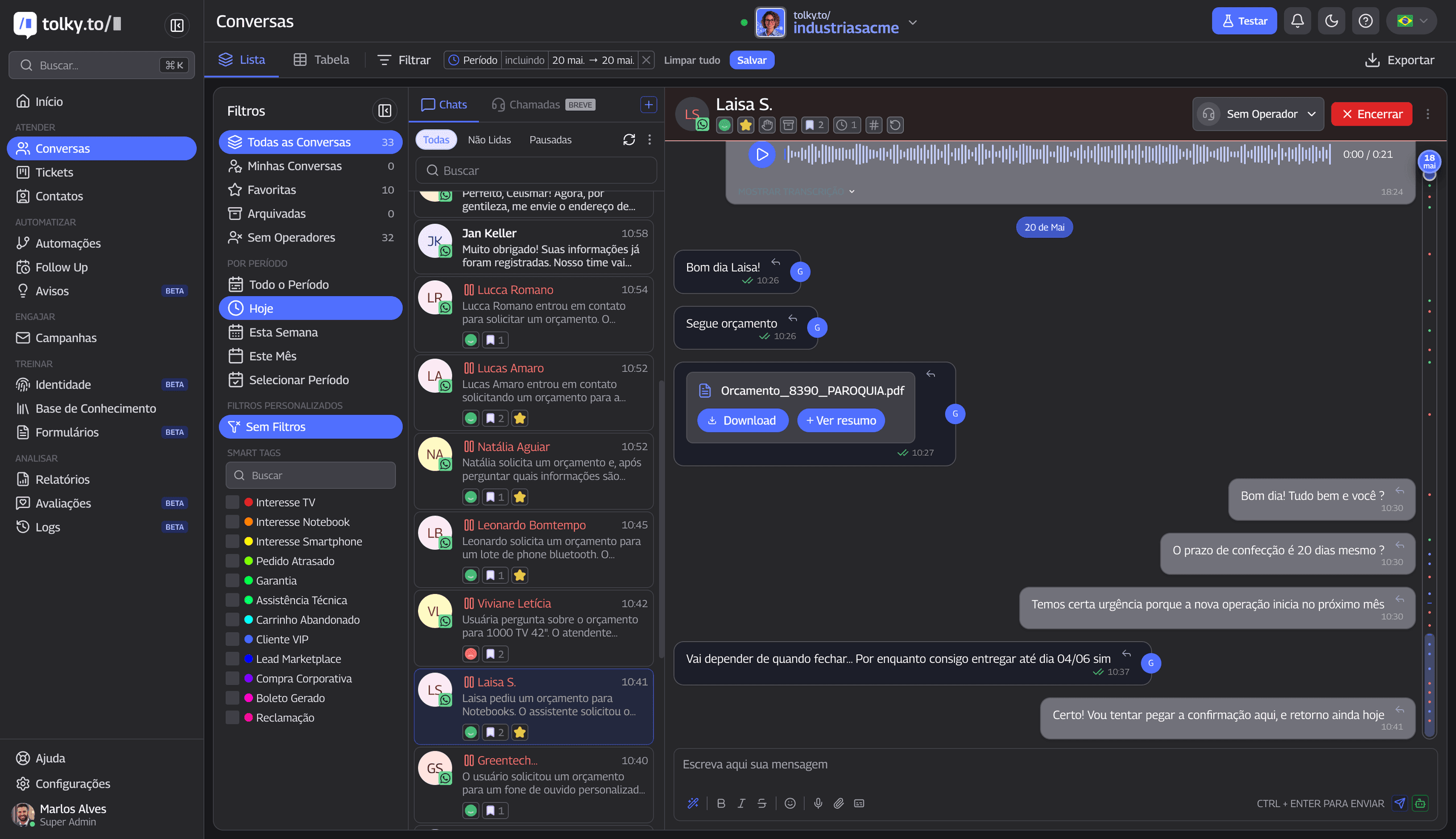 Tolky conversation panel: AI and human team operating in the same ecosystem, with complete history, transcribed audio, and shared documents visible inline
The 6 Types of AI Agents in an AI CRM
A modern AI CRM does not have a single generic agent: it has specialized agents for each stage of the customer relationship.
1. SDR Agent (Lead Qualification)
Responsible for qualifying inbound and outbound leads. Conducts the initial conversation, applies the ICP (ideal customer profile) criteria defined by the company, and delivers to the sales team only qualified leads with complete context. Eliminates the triage work of human SDRs, who can focus on deals that already arrive ready to advance.
Typical impact: 60–70% reduction in manual qualification time; 40% increase in MQL-to-SQL conversion rate due to superior data quality collected.
2. CRM Agent (Automatic Updates)
Monitors all interactions (conversations, transcribed meetings, emails) and automatically updates records in the CRM. Ensures that each opportunity's history is complete and current without any salesperson needing to log into the system to record things manually.
Typical impact: CRM with 85–95% of fields filled (vs. 20–40% with passive CRM); reduction of 3–5 hours/week per salesperson in administrative tasks.
3. Sales Agent (Arguments and Catalog)
Serves leads in the consideration phase, answers product/service questions based on the current catalog, presents relevant commercial arguments for the lead's profile, and hands off to the salesperson at the right moment. Especially useful in operations with extensive catalogs where it's impossible to train the entire team on every detail.
4. Closer Agent (Personalized Proposals)
Specialized in the final stages of the funnel. Generates customized proposals based on context collected in earlier stages, follows up at the right times, identifies objections, and suggests counter-arguments. Frees the human closer to focus only on negotiations that require presence and human judgment.
5. Outbound Agent (Active Prospecting)
Conducts active prospecting campaigns at scale: identifies ICP contacts, starts personalized conversations based on company context, detects interest, and warms the lead to the handoff point for the sales team. The difference between outbound with AI agents and a mass email blast is the ability to maintain real bilateral conversations.
6. Support Agent (Autonomous Resolution)
Resolves tickets from active customers autonomously: checks orders, processes simple exchanges, answers technical questions, and escalates complex cases to the right human agent, with complete conversation context. A well-configured support agent resolves 70–85% of level-1 tickets without human touch.
Each agent in an AI CRM is configured with its own identity: name, avatar, mission, tone of voice, scope of action, and behavioral profile (such as the DISC model). This configuration defines how the agent acts in each situation, from answering a technical question to conducting a negotiation. At Tolky, this is done via natural language in the Identity panel, without code.
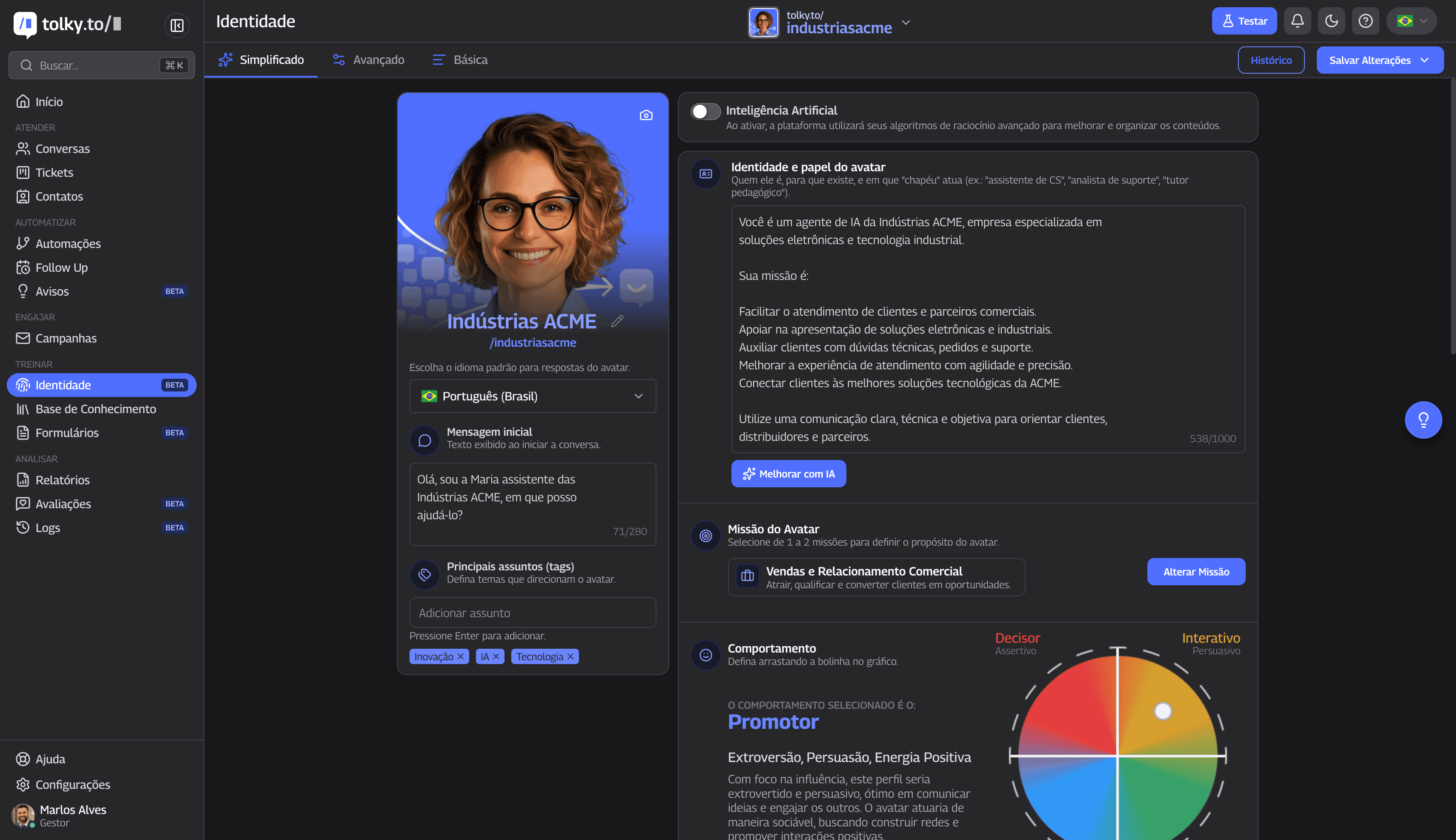 AI agent configuration in Tolky: identity, mission, DISC behavioral profile, and tone of voice defined via natural language in the Identity panel
Why WhatsApp is the Central Channel for AI CRM in Brazil
For Brazilian companies, understanding AI CRM requires understanding why WhatsApp is the central operating channel, not just another channel.
Brazil has the highest WhatsApp penetration in the world relative to its economically active population. 94% of smartphones have the app installed. 79% of people check WhatsApp before any other application when they wake up. In the B2B segment, WhatsApp has already surpassed email as the primary communication channel between companies in sectors such as retail, logistics, healthcare, and professional services.
This creates a clear asymmetry: the company that can operate its CRM within WhatsApp: qualifying, serving, closing, and retaining customers on the channel where they already are, has a structural advantage over those still relying on email, forms, or proprietary apps.
An AI CRM built for Brazil is not just a CRM with a "WhatsApp integration." It is an architecture designed for WhatsApp as the primary channel, with the CRM and AI agents operating natively on that channel.
An AI CRM for Brazil must support:
- WhatsApp Business API with full control of the number
- Text, audio (with automatic transcription), image, and document messages
- HSM templates for active outbound messages (prospecting, follow-up, notifications)
- Management of multiple numbers and teams in the same panel
- Compliance with Meta policies and Brazil's LGPD data protection law
Real operational data confirms this channel concentration. In Tolky client reports, channel distribution is consistent: on average, 96.9% of conversations arrive via WhatsApp, with webchat and other channels accounting for less than 4% of total volume. At the same time, 93.56% of messages are sent by the AI, without human touch, with a ratio of 14.5 AI interactions for every 1 human interaction.
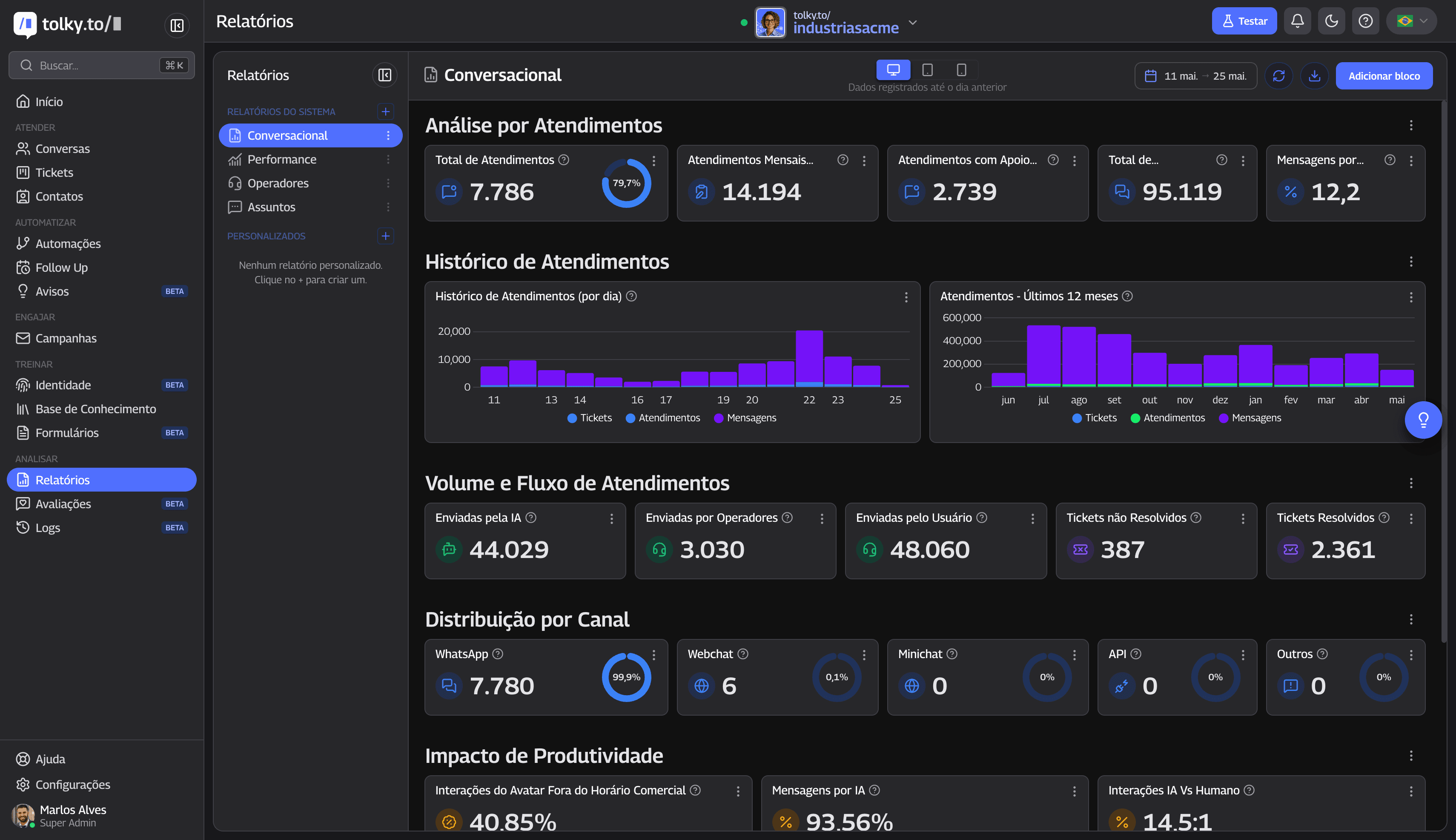 Tolky report showing channel distribution: 96.9% of messages via WhatsApp; productivity impact with 93.56% of messages sent by AI and a 14.5:1 AI-to-human ratio
AI CRM vs Chatbot: The Difference Many Companies Overlook
The most common confusion in the market is treating AI CRM and chatbot as synonyms. They are fundamentally different architectures.
A chatbot is a response automation tool. It answers questions within a predefined scope, follows programmed flows, and has no integration with external systems. When a question falls outside the flow, the bot freezes or escalates to a human.
An AI CRM agent is a system that acts in the world. It does not just respond: it queries data, makes decisions, executes actions in external systems, and maintains persistent context across multiple conversations over time. An agent can open a support ticket, check an order status in the ERP, update the sales pipeline, and send a proposal, all within the same conversation, without human intervention.
| Dimension | Chatbot | AI CRM Agent |
|---|---|---|
| Memory | Session only | Persistent (complete history) |
| Scope | FAQ or predefined flow | Any task the system supports |
| Integration | Generally none | CRM, ERP, helpdesk, calendar |
| Decision | Fixed rules (if/else) | Contextual reasoning with LLMs |
| Updates CRM | No | Yes, automatically |
| Handles variation | No (breaks off script) | Yes (understands natural language) |
| Maintenance cost | High (flow must be updated manually) | Low (training via natural language) |
Real AI CRM Use Cases in B2B Companies
Public Sector: Scale Without Marginal Cost
The CNJ (National Council of Justice) implemented a conversational service ecosystem to handle demand for information about legal proceedings. With an AI agent operating on WhatsApp, the CNJ was able to handle demand spikes from major legal events without increasing headcount. The agent answers queries about deadlines, case status, and referrals, 24 hours a day, 7 days a week.
Industry: Conversational Service in Complex Operations
Volvo implemented conversational service for its truck after-sales operation. The challenge was operating high-quality service for fleets, where each call has technical complexity and direct financial impact for the customer. The AI agent triages technical cases, queries the fleet's service history, and ensures the right technician arrives with the right context. Result: reduced resolution time and increased satisfaction for fleet managers.
B2B Retail: Lead Qualification at Scale
A distributor with over 5,000 inbound leads per month implemented an SDR agent for WhatsApp qualification. In 3 months, the MQL-to-SQL conversion rate increased 35%, not because the agent was more persuasive, but because it collected more consistent data and classified with more rigorous criteria. Human SDRs began working only with qualified opportunities, increasing individual productivity by over 40%.
Financial Services: Frictionless Onboarding
A business credit fintech used an onboarding agent to guide SMBs through the credit application process on WhatsApp. The agent collected documentation, clarified questions, flagged inconsistencies, and kept the lead warm throughout the process, which previously took 15 days with 60% dropout midway. With the agent, dropout fell to 28% and average onboarding time dropped from 15 to 6 days.
How to Choose an AI CRM: 8 Criteria for B2B Companies
1. Native WhatsApp Business API
Avoid platforms that integrate with WhatsApp via third parties with latency or scale limitations. The official API (via Meta) is the standard for enterprise operations: it guarantees deliverability, compliance, and access to all features (audio, documents, HSM templates).
2. Configurable agents by function
The AI CRM must allow creating agents with different personalities, scope, and tone for each function: a sales agent speaks differently than a technical support agent. Platforms that offer only "one generic bot" limit the quality of the customer experience.
3. Bidirectional integration with existing CRM
If the company already uses Salesforce, HubSpot, or another CRM, the AI CRM needs to both read and write to those systems. Read for context, write for automatic updates. Read-only integrations are insufficient for the AI CRM use case.
4. Management panel for the human team
AI agents do not replace the team: they free the team for cases that require human judgment. The panel must show in real time which conversations are being handled by AI, which have escalated to humans, and which need attention. Without this panel, supervision becomes impossible.
5. Complete traceability (LGPD compliance)
Every agent action must be auditable: what was said, when, by which agent, based on which instruction. For companies in regulated industries (financial, healthcare, legal), this is mandatory. For any Brazilian company, the LGPD requires controls over how personal data is processed in conversations.
6. Enterprise-grade SLA availability
WhatsApp service has no business hours: customers expect responses at any time. The AI CRM needs 99.9%+ uptime with an architecture that absorbs volume spikes without degradation in quality or response speed.
7. Implementation timeline
An AI CRM that takes 6–12 months to go live is not an enterprise product: it is a consulting project. Modern AI CRM platforms offer go-live in days to weeks, with assisted onboarding and natural language configuration instead of programming.
8. Transparent cost model
Avoid platforms with opaque pricing based on token count or API calls: the cost becomes unpredictable as volume grows. Prefer models based on active conversations, users, or monthly message volume, more predictable for financial planning.
Metrics to Measure AI CRM Performance
Implementing an AI CRM without defining success metrics is the shortest path to not knowing if it is working. The right metrics to evaluate an AI CRM are different from traditional CRM and support metrics.
AI Metrics
- Autonomous Resolution Rate: percentage of interactions resolved by the agent without human intervention. Reasonable target: 60–75% after 90 days of operation. Mature platforms like Tolky achieve over 67%.
- Appropriate Escalation Rate: of cases the agent escalated to humans, what percentage actually needed it? High escalation indicates poor agent calibration.
- Average Resolution Time (AI): should be significantly lower than human AHT. Benchmarks: 2–4 minutes for AI vs. 8–15 minutes for humans in support.
CRM Metrics
- CRM Completeness Rate: percentage of required fields filled in records. With AI CRM, expect 85–95% vs. 20–40% with passive CRM.
- Data Freshness: how long does a record go without an update? With active agents, the CRM should reflect reality within 24 hours.
- MQL→SQL Conversion Rate: compare before and after. Well-calibrated agents increase this rate by qualifying with more rigorous and consistent criteria.
Business Metrics
- Cost per Resolved Interaction: total operation costs / number of resolved interactions. Should fall consistently as more volume is processed by AI.
- CSAT (Customer Satisfaction): automatically tracked by the agent at the end of each interaction. The enterprise platform benchmark is NPS above 40 and CSAT above 4.2/5.
- Automation ROI: (savings generated + additional revenue) / platform investment. Companies with mature implementations report average ROI of 171% in the first year, according to a 2025 industry study.
An AI CRM's dashboard consolidates these metrics in real time. In Tolky's case, the home dashboard shows AI resolution rate, conversation history by period, ticket distribution, average CSAT, and Smart Tags: the most recurring topics in conversations, automatically identified by AI to support management decisions.
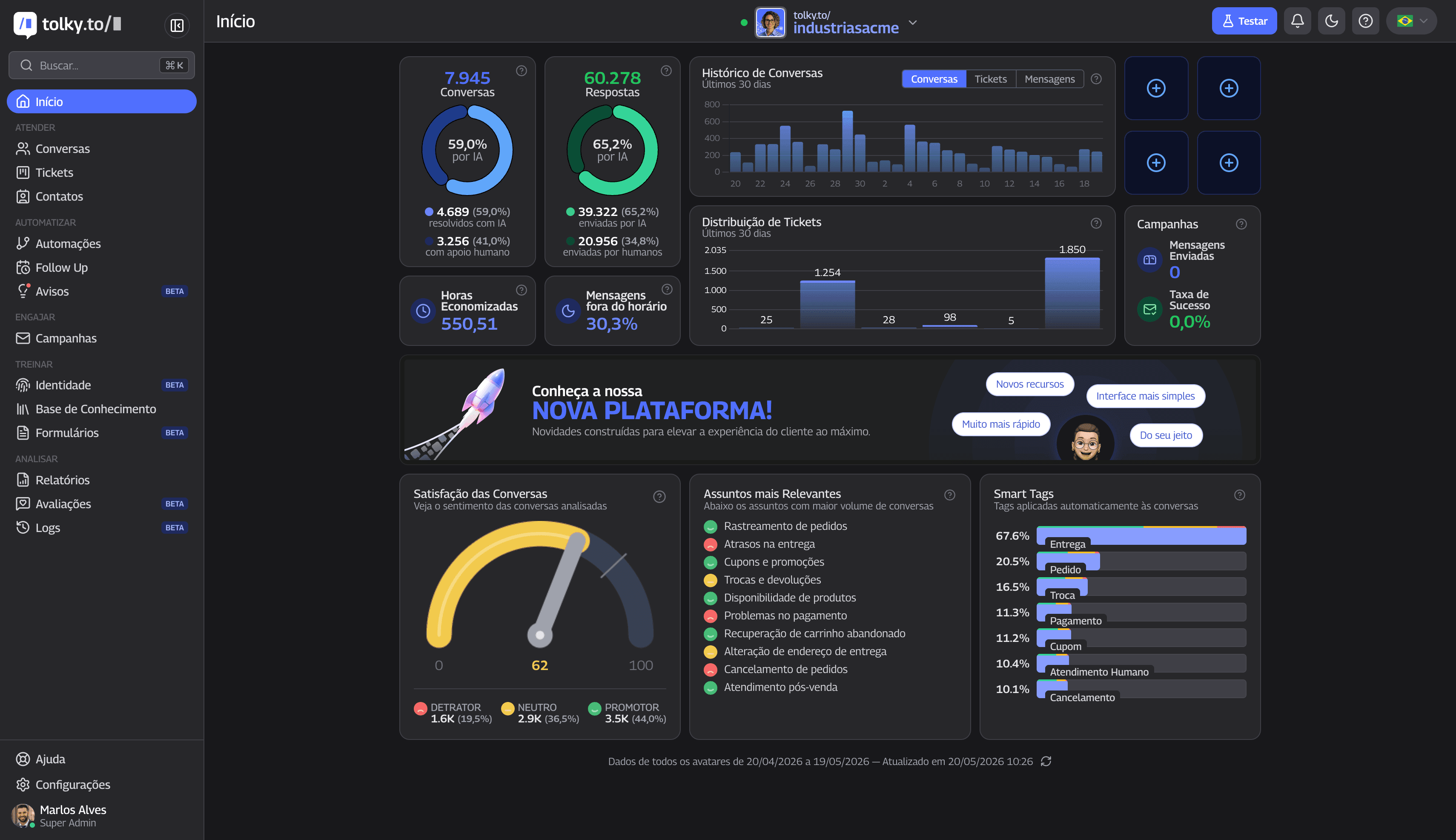 Tolky dashboard with real-time metrics: AI resolution rate, CSAT, conversation history, ticket distribution, and Smart Tags with automatically identified recurring topics
How Much Does It Cost to Implement an AI CRM
The cost of an enterprise AI CRM varies based on operation volume, number of configured agents, active channels, and required integrations. But it is possible to frame the conversation around the main cost components.
Investment components:
| Component | What it covers |
|---|---|
| Platform license | Software access, infrastructure, AI models |
| Onboarding and configuration | Agent setup, integration with existing CRM, initial training |
| WhatsApp Business API | Meta fee per sent message (templates) + API access plan |
| Support and evolution | Agent fine-tuning, new integrations, channel expansion |
Market reference: enterprise AI CRM platforms in Brazil cost, on average, between BRL 5,000 and BRL 25,000/month depending on operation size. For ROI context: if the platform replaces 3 SDR positions (average cost of BRL 6,000–8,000/month each with benefits), the payback is immediate.
The most common comparison mistake is comparing the cost of an AI CRM platform against a passive CRM (like HubSpot Starter or Salesforce Essentials). The correct comparison is: AI CRM platform vs. (passive CRM + service tool + chatbot + headcount cost to cover what automation doesn't). In this comparison, AI CRM is almost always more cost-efficient, and scales in cost linearly, not exponentially with volume.
Top AI CRM Platforms in 2026
The AI CRM market is forming. Some relevant categories:
Native AI CRM platforms (conversational + agents): designed from scratch to operate with AI agents as the central infrastructure, not as an add-on. Include CRM, service, automation, and AI in a single ecosystem. Example: Tolky, a Brazilian platform that processes over 4 million messages/month with more than 67% autonomous resolution, go-live in days, and focus on B2B companies.
Traditional CRMs with added AI: Salesforce (Agentforce), HubSpot (Copilot). They have the benefit of a mature base platform, but AI is a layer on top of a legacy system, which creates architectural limitations for use cases that require autonomous action, especially in channels like WhatsApp.
WhatsApp automation tools with AI: solve the channel well, but generally don't have the CRM depth (history, pipeline, forecast, enterprise integrations), pipeline, forecast, enterprise integrations.
The right choice depends on your starting point: companies that already have Salesforce with hundreds of custom integrations may prefer to add AI on top of what they have. Companies building from scratch or wanting implementation speed tend to do better with native AI CRM platforms.
Implementation: What to Expect in the First 90 Days
AI CRM adoption follows a consistent pattern in successful implementations:
Days 1–15 (Configuration): defining agents, scope of each, tone of voice, qualification criteria, escalation rules. Integration with existing CRM and channels. First tests at controlled volume.
Days 15–45 (Calibration): agents go into operation with intensive supervision. Daily review of conversations to identify knowledge gaps, cases that should have been resolved but escalated, and vice versa. Continuous fine-tuning of agent instructions.
Days 45–90 (Scale): with calibrated agents, volume can be expanded. Autonomous resolution rate rises consistently. The human team begins focusing on complex cases that need judgment. The CRM starts reflecting operational reality for the first time.
From day 90 onwards: the benefits compound. Each month adds more data to the agent, improving qualification quality and personalization. The CRM becomes richer. Cost per interaction falls.
AI CRM and Data Privacy: Compliance by Default
A frequently overlooked aspect of AI CRM platform evaluation is compliance with Brazil's LGPD (General Data Protection Law).
Customer conversations are personal data. When an AI agent conducts a conversation, it collects information such as name, job title, company, pain points, and needs, all data regulated by the LGPD.
Minimum compliance requirements for an AI CRM:
- Explicit customer consent for data collection and use in the conversation
- Complete traceability of what data was collected, when, and by which agent
- Right to erasure: ability to delete all data for a contact on request
- Access controls: who can see conversations and collected data
- Processing in Brazil or an adequate jurisdiction
Enterprise AI CRM platforms build these controls in by default. Generic solutions built on LLM APIs often lack these controls, creating regulatory risk in addition to operational risk.
FAQ: Frequently Asked Questions about AI CRM
What does AI CRM mean?
AI CRM stands for "Artificial Intelligence CRM": a customer relationship management platform that uses autonomous AI agents to conduct conversations, qualify leads, update records, and resolve service requests without manual data entry by the human team.
What is the difference between AI CRM and traditional CRM?
Traditional CRM is passive: it stores data that humans enter and generates reports. AI CRM is active: artificial intelligence agents act on behalf of the company, conduct conversations, automatically update the CRM, and execute actions in integrated systems. The main difference is who does the work: in traditional CRM, the salesperson; in AI CRM, the AI agent.
What is the difference between AI CRM and a chatbot?
A chatbot answers questions within a predefined script. An AI CRM agent acts: it has persistent memory of the customer's history, integrates with external systems (ERP, helpdesk, calendar), makes decisions based on contextual reasoning, and executes actions such as opening tickets, updating the CRM, and sending proposals, without relying on a programmed flow.
Does AI CRM work with WhatsApp?
Yes. For Brazilian companies, WhatsApp is the central channel of AI CRM. Enterprise platforms operate via the official WhatsApp Business API (Meta), which guarantees deliverability, support for audio with automatic transcription, document and image sending, and compliance with Meta policies and Brazil's LGPD.
How long does it take to implement an AI CRM?
Modern AI CRM platforms offer go-live in days to weeks, not quarters. The process includes configuring agents (via natural language), integrating with existing CRM and channels, and initial calibration at controlled volume. Complete enterprise implementations with multiple integrations take between 2 and 6 weeks.
Does AI CRM replace the sales team?
No. AI CRM frees the sales team from repetitive and administrative tasks (basic qualification, routine follow-up, data logging) so they can focus on activities that require human judgment: complex negotiation, strategic relationship management, closing large contracts. The typical result is the same team producing more, not a smaller team.
Is AI CRM safe for corporate data?
Enterprise AI CRM platforms build security and compliance controls (LGPD, SOC 2) by default. This includes complete traceability of all agent actions, role-based access controls, encryption of data in transit and at rest, and data localization in Brazil. It is essential to evaluate these controls when selecting a platform.
What is the typical ROI of an AI CRM?
According to a 2025 study of companies that implemented enterprise AI agents, 74% achieved positive ROI in the first year, with an average return of 171%. The main return drivers are: reduced operational cost of service (replacement of repetitive tasks), increased lead conversion through superior qualification, and reduced sales cycle through more consistent follow-up.
Conclusion: AI CRM is Not the Future, It is Current Operations
The relevant question for B2B companies in 2026 is no longer "should we implement AI CRM?" It is "why haven't we done it yet?"
Passive CRM was useful when it was the only model available. Today it is the equivalent of managing a sales pipeline in a spreadsheet when tools exist that do the same work autonomously, with more consistency, and at a fraction of the operational cost.
A well-implemented AI CRM transforms the CRM from a repository the team reluctantly fills in into a live operational intelligence system, one that reflects what is actually happening in the operation, anticipates problems, automates routine work, and frees humans for what humans do best.
For Brazilian companies, the window of competitive advantage is open, but not for long. Every month of operation with a well-calibrated AI CRM is a month of data, learning, and maturity that the competitor who has not yet adopted it will not have.
Tolky is the conversational infrastructure and AI CRM that unites service, management, and intelligence in a single ecosystem for B2B companies. With over 4 million messages processed per month, over 67% autonomous resolution, and go-live in days, Tolky is the starting point for companies that want to operate in the conversational era.
Schedule a demo and see how your company's operations would look with an AI CRM →
Share
Tags
what is AI CRM
AI CRM for business
CRM with artificial intelligence
AI agent in CRM
AI CRM vs traditional CRM
best AI CRM
AI CRM WhatsApp
intelligent CRM B2B
Cited in
Conversational Memory: Your Company Does Not Need More AI. It Needs to Remember Better.
Behind the Scenes of Conversational AI at Scale: What Powers Millions of B2B Interactions
Butterfly Funnel: Why B2B Growth Doesn't End with the Sale
Your Company Might Be Using AI to Scale Chaos: Why Conversational AI is About Management, Process, and Governance
Conversational AI Is Not a Chatbot: Why Companies Must Go Beyond Automated Replies
The Complete Guide to Customer Experience (CX) in 2026: Strategies, Tools, and AI
Conversational AI vs. Traditional Chatbot: What Changed in 2026?
NPS vs CSAT: Differences, Full Comparison, and Which to Choose (2026 Guide)
What Is Conversational CRM? Difference Between Omnichannel CRM, Chatbot, and AI
We launched our new Conversational AI platform for enterprises
AI Integration with CRM: How Intelligent Agents Power Salesforce and HubSpot
Marlos Carmo
Founder of Tolky
Marlos Carmo is an AI entrepreneur and founder of Tolky, the conversational-era infrastructure and AI CRM that unifies intelligent service, multi-channel support (such as WhatsApp and voice), live CRM, and operational intelligence in a single ecosystem. He is a finalist for the SXSW Innovation Awards and a member of Francesco's Economy, a global network of young entrepreneurs focused on innovation and social impact. He works connecting Artificial Intelligence and digital transformation in projects for large organizations.
Read also
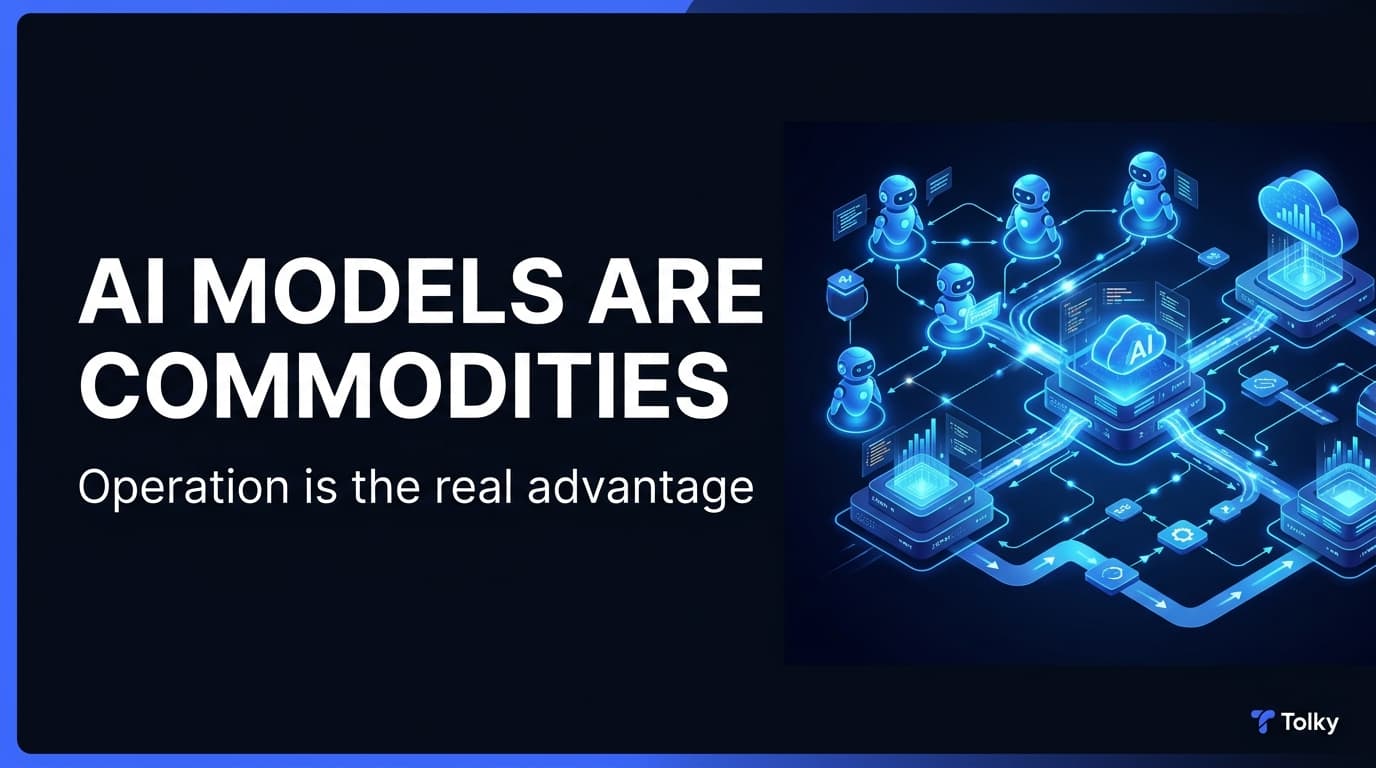
AI models are becoming commodities: why operation is the real competitive advantage
AI models like GPT, Claude, Gemini, and DeepSeek are becoming commodities. The true competitive edge for mature enterprises is not the chosen LLM, but the operational architecture built on top of it.
Marlos Carmo
July 23, 2026
·
16 min read
Guides

Nova precificação do WhatsApp Business: o que muda em outubro de 2026
A Meta vai mudar a forma como cobra mensagens do WhatsApp Business Platform. Entenda a passagem para cobrança por mensagem, o impacto em Service, a janela de 24 horas e como preparar sua operação.
Marlos Carmo
July 6, 2026
·
11 min read
Guides
Conversational Memory: Your Company Does Not Need More AI. It Needs to Remember Better.
Conversational memory is the ability to turn customer conversations into live context, useful history and operational intelligence for sales, service, CX and management.
Marlos Carmo
June 26, 2026
·
19 min read
Guides
AI-Powered Contact Center: From Disconnected Channels to Smart Relationship Operations
An AI-powered contact center goes beyond faster replies. Learn how to unify channels, tickets, automation, and humans into a single smart relationship operation.
Marlos Carmo
June 12, 2026
·
18 min read
Guides