What is Meta Muse? Models, API pricing and use in business
Muse is Meta's family of AI models that replaced Llama at the center of the company's strategy. See the Spark, Wonder and Glimmer models, what the API costs and what changes for businesses.
TL;DR
Muse is Meta's family of AI models, built by Meta Superintelligence Labs and launched on April 8, 2026 with Muse Spark. It powers Meta AI on WhatsApp, Instagram and Facebook, has open versions (Glimmer and Spark Open) and a paid API, from US$ 0.10 to US$ 20 per million tokens. For customer service, the model is only one piece: the operation still needs an official channel, rules, integrations and people.
Share
Meta changed AI models in 2026, and almost no one outside tech noticed. The AI that answers on WhatsApp, Instagram and Facebook is no longer Llama; it is now Muse, a new family built by a new lab.
For anyone making technology decisions at a business, the practical question is different: does Muse change anything in customer service, in sales or in the cost of AI? This guide explains what Muse is, which models exist, how much the API costs and where it fits (and where it does not) in a customer service operation.
Updated in November 2026, with Meta's official pages checked on November 19, 2026.
What is Meta Muse?
Muse is Meta's family of language and media models, developed by Meta Superintelligence Labs (MSL) and launched on April 8, 2026 with Muse Spark. Meta introduced Spark as "the first model in the new Muse series" and its most powerful model to date (Meta announcement, April 8, 2026).
The name covers three different things, and that is where the confusion starts:
- The models: Spark, Wonder, Glimmer, Ember, Image and Video, each with its own role.
- Meta AI: the assistant inside WhatsApp, Instagram and Facebook, which now runs on Muse Spark.
- The Muse agent: a personal agent app, launched in September 2026, that carries out tasks for the user. It has its own guide in Meta's Muse agent.
An LLM, the type of model that generates text, is the engine. Meta AI and the Muse agent are products built on top of that engine.
Which models are part of the Muse family?
The Muse family has closed models (Spark, Wonder and Ember, accessed through the API) and open-weight models (Glimmer and Spark Open, which can be downloaded), plus image and video models. The table sums up what Meta had published as of November 19, 2026.


| Model | Launch | What it is | Access |
|---|---|---|---|
| Muse Spark | April 8, 2026 | Flagship model; versions 1.1 (July), 1.2 (August) and 1.3 (September) | Closed, through the API and in Meta's apps |
| Muse Image and Muse Video | July 7, 2026 | Image and video generation; video launched as a preview | Meta's apps and API (image) |
| Muse Glimmer | August 10, 2026 | Small 30 billion parameter model, distilled from Spark | Open weights, Apache 2.0 license |
| Muse Wonder | October 12, 2026 | Most capable line, aimed at long agent tasks | Closed, in preview on the API |
| Muse Spark Open | October 15, 2026 | 816 billion total parameters, 42 billion active | Open weights, its own license |
| Muse Ember | Date not published | Lowest-cost model | Closed, through the API |
Sources: Meta's announcements of Spark 1.1 (July 9), Spark 1.2 and Muse Code (August 5), Spark 1.3 (September 2), Muse Image and Muse Video (July 7), Glimmer (August 10), Wonder (October 12) and Spark Open (October 15); Ember appears in the API documentation.
What changes between Spark versions
Spark 1.1 brought multimodal reasoning and a 1 million token context window. Version 1.2 focused on coding and arrived alongside Muse Code, a coding agent for the terminal. According to Meta, 1.3 uses about 20% fewer tool calls and 25% fewer tokens than 1.2 on the same tasks.
The context window is how much text the model reads at once. One million tokens fits an entire product manual, but that does not replace an organized knowledge base.
Did Muse replace Llama?
In practice, yes: Muse now holds the place Llama used to hold as Meta's main model family, although Meta does not use the word "successor". In Spark's technical announcement, Meta says it matches the performance of Llama 4 Maverick using more than ten times less compute (Meta AI blog, April 8, 2026).
Two differences matter for businesses:
- Llama was born open; Muse was born closed. Spark debuted API only, in preview for partners. The open models came later, in August (Glimmer) and October (Spark Open).
- The license changed. Glimmer uses Apache 2.0, a permissive license. Spark Open uses the Muse Model License, with limited commercial terms that, according to Meta, allow free use for many developers. Read the license before going to production.
If you already run Llama, there is no need to rush a migration. The right question is whether switching improves the answers your customers get, and that is measured with testing, not with announcements.
Which Muse model runs Meta AI on WhatsApp?
Meta AI on WhatsApp, Instagram, Facebook, Messenger and Threads has run on Muse Spark since May 2026, according to the update Meta made to the Spark announcement on May 12. In April, Spark was already answering in the Meta AI app and on meta.ai (Meta announcement).
Meta does not say which Spark version answers inside WhatsApp today. It also does not say which model powers Meta Business Agent, the AI that serves customers on WhatsApp Business; we cover that product in is the WhatsApp Business AI agent free?.
The full guide to the assistant, with what it does and what it sees of your chats, is in Meta AI on WhatsApp.
How much does it cost to use Muse through the API?
On the Meta Model API, Muse costs from US$ 0.10 to US$ 4.00 per million input tokens and from US$ 0.20 to US$ 20.00 per million output tokens, depending on the model and the tier. The prices below come from the API pricing page, checked on November 19, 2026.


| Model | Input (US$ per million tokens) | Output (US$ per million tokens) | Cached input |
|---|---|---|---|
| Muse Wonder 1.0 | 4.00 | 20.00 | 0.20 |
| Muse Spark 1.1 to 1.3, Standard tier | 1.25 | 4.25 | 0.15 |
| Muse Spark 1.2 and 1.3, Contributor tier | 0.10 | 0.20 | 0.002 |
| Muse Ember, up to 200 thousand input tokens | 0.10 | 0.50 | 0.004 |
Image generation with Muse Image costs US$ 0.01 per image on the same page. The Contributor tier is much cheaper because, according to press reports, Meta may retain the data to improve its products. For conversations with customer data, that weighs on LGPD, Brazil's data protection law, and on your contract with the end customer.
The API uses the endpoint https://api.meta.ai/v1 and, according to the documentation, is compatible with OpenAI's and Anthropic's SDKs. That makes switching providers simpler, but the real cost of an agent goes beyond tokens: see how much a WhatsApp AI agent costs.
What are Muse Glimmer and Muse Spark Open?
Glimmer and Spark Open are the open-weight versions of Muse: a business downloads the model and runs it on its own infrastructure, without sending data to Meta's API. It is the same principle as Llama, with very different sizes.
- Muse Glimmer has 30 billion parameters and, according to Meta, runs on a Mac or on a PC with a single consumer graphics card, taking up less than 20 GB with 4-bit quantization.
- Muse Spark Open has 816 billion total parameters and 42 billion active per response, with a 1 million token window. The weights are on Amazon SageMaker AI, Google Cloud Model Garden and Microsoft Foundry, and providers such as Groq, Fireworks, Together and OpenRouter offer the model hosted.
On October 15, 2026, Meta and Apple showed Spark Open running locally on two to four Mac Studios with the MLX framework (CNBC). It is a technical partnership: the report mentions no financial terms and no link to Siri.
Running an open model gives you control over the data, but it shifts the cost of servers, updates and security to your business. For most customer service operations, that only pays off with high volume and a dedicated technical team.
Is Muse good for customer service on WhatsApp?
Muse can be the model behind a customer service agent, but the model alone serves no one: it still needs the official channel, the knowledge base, the integrations, the handoff rules and the CRM record. The same conclusion applies to GPT, Claude or Gemini, as we discuss in AI models have become a commodity.
In a customer service AI agent, the model is one layer among several. The others are:
- Channel: the official WhatsApp Business API, with a verified number and approved templates.
- Knowledge: up-to-date documents, policies and catalog, to avoid hallucination.
- Tools: order, invoice and calendar lookups through an API or MCP.
- Rules: when the conversation goes to a person, with its history. See the handoff rules.
- Record: every conversation becomes data in a CRM, for sales and management.
There is also a Meta rule to follow. Since January 15, 2026, WhatsApp's terms ban from the API AI providers whose main product is a general-purpose assistant; a business's own customer service agents are still allowed. In Brazil, CADE, the country's competition authority, suspended that ban, and Meta started charging those providers per message. We explain what applies in WhatsApp bans general-purpose AI chatbots.
How do you evaluate Muse before adopting it?
Evaluate Muse with your own conversations: pick 50 to 100 real questions, run them on your current model and on Muse with the same prompt and the same knowledge base, and compare accuracy, tone, cost and response time. Public benchmarks measure the model on generic tests, not on your catalog.
- Build the test set with easy questions, hard ones and the ones that should go to a person.
- Hold everything else fixed: same prompt, same knowledge base, same tools.
- Measure what matters: correct answers, handoff at the right time, cost per conversation and latency.
- Check the data policy of the tier you sign up for (Standard or Contributor).
- Have a fallback model for when the main one gets slow or goes down.
This method is detailed in how to measure your AI resolution rate.
Where does Tolky fit?
Tolky is a conversational AI CRM: it does not sell access to a specific model and treats the LLM as infrastructure, with agents that serve customers on WhatsApp through the official API, hand off to people with the history and record everything in the CRM. The value is in the operation around the model.
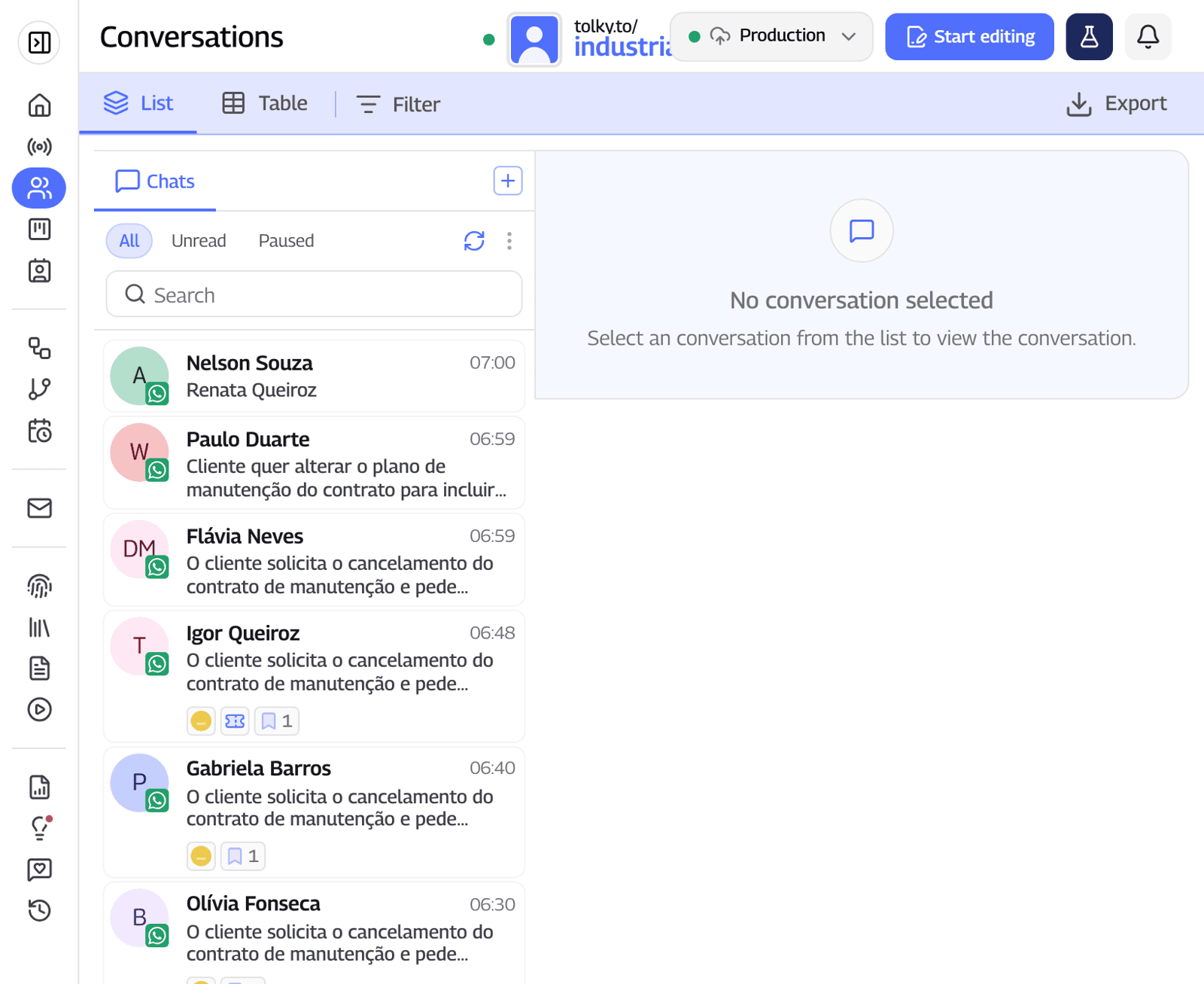
- Agents by mission: support, sales and customer relationship, with limits you write. See the AI chatbot for WhatsApp.
- Team and CRM in one place: queues, handoff with context and customer records. See customer service on WhatsApp.
- Integrations: REST API, webhooks, HTTP requests and MCP tools to query your systems.
What Tolky does not do: it does not offer a choice of Muse model in the dashboard, and it does not run open-weight models on your server. If your project is to host Spark Open, the path is a cloud or inference provider.
Frequently asked questions
What is Meta Muse?
Muse is Meta's family of AI models, built by Meta Superintelligence Labs. The first one, Muse Spark, was announced on April 8, 2026 and now answers in Meta AI on WhatsApp, Instagram and Facebook.
Is Muse free?
It depends on how you use it. Meta AI in the apps is free for everyday use; the API is paid per token, from US$ 0.10 to US$ 20.00 per million; and the open models Glimmer and Spark Open can be downloaded, under different licenses.
Is Muse open source?
Partly. Spark, Wonder and Ember are closed and accessed through the API. Glimmer has open weights under the Apache 2.0 license, and Spark Open has open weights under the Muse Model License, which comes with limited commercial terms.
What is the difference between Muse Spark and Muse Wonder?
Spark is the flagship model, used in Meta AI and cheaper on the API. Wonder, launched on October 12, 2026, is the most capable line for long agent tasks, in areas such as law, finance and coding, and it costs more.
Does Muse speak Portuguese?
Meta AI, which runs on Spark, chats in Portuguese on WhatsApp, a language Meta announced in July 2024; for voice, Portuguese is not on the list yet. Meta does not publish a list of API languages on the pages we checked, so test with real conversations before adopting it.
Can you use Muse in a WhatsApp chatbot?
Yes, as the model of your business's customer service agent, connected to the official WhatsApp API. What Meta's terms have banned since January 2026 is using the API to offer a general-purpose AI assistant; in Brazil, that rule is suspended by CADE.
Conclusion
Muse is Meta's new AI foundation: it runs Meta AI, has a paid API with competitive pricing and open versions for those who want to host it. For customer service, it is one more engine option; the result still depends on an official channel, knowledge, integrations, rules and people.
See the plans, understand Meta AI on WhatsApp, meet the Muse agent or talk to the team →. Let's talk?
Share
Tags
- what is meta muse
- muse spark
- muse wonder
- meta muse api pricing
- muse spark open
- meta superintelligence labs
- meta ai model
- #conversational CRM
Cited in
- Is the WhatsApp Business AI agent free? What it means for businesses
- Meta's Muse agent: what it is and what it means for businesses
- Meta AI for business: Meta AI, Meta Business Agent or Muse?
- Meta AI on WhatsApp: what it does, what it reads, what it changes
- WhatsApp bans general-purpose AI chatbots? What applies in 2026
About the author

Co-founder of Tolky
Marlos Carmo is an AI entrepreneur and founder of Tolky, the conversational-era infrastructure and AI CRM that unifies intelligent service, multi-channel support (such as WhatsApp and voice), live CRM, and operational intelligence in a single ecosystem. He is a finalist for the SXSW Innovation Awards and a member of Francesco's Economy, a global network of young entrepreneurs focused on innovation and social impact. He works connecting Artificial Intelligence and digital transformation in projects for large organizations.
Next step
Want to bring this to your operation?
Tati, Tolky's AI assistant, understands your scenario in a few questions, suggests the best path and connects you with someone from the team, with full context.
Share