WhatsApp sales with AI: from lead to signed contract in one chat
How to run the full sale on WhatsApp with AI agents: qualification, eligibility, documents, proposal, e-signature and CRM, in lending, insurance and school enrollment.
TL;DR
WhatsApp sales with AI take the customer from first contact to signed contract in the same chat: AI agents qualify, check eligibility and pricing in the company's systems, receive documents, present the proposal and send the contract for e-signature, with the CRM updated at every stage. It works best for sales with clear rules, such as lending, insurance and school enrollment, and leaves the out-of-policy negotiation to the salesperson.
Share
The lead arrives at 9:40 p.m., right after seeing an ad. They want to know if they qualify for the loan, how much the monthly payment is and what they need to send. At most companies, they get a "a consultant will be with you shortly" and, by the next morning, they have already talked to two competitors.
Selling on WhatsApp is not new. What changed is that the chat can go beyond the first reply: AI agents can query the company's systems, read documents, build the proposal and take the customer all the way to signature. This guide shows how to design that full sale, where AI helps, where a person needs to step in and what Brazilian law, our reference market, says about contracts closed at a distance.
Updated November 2026.
What is a full WhatsApp sale with AI?
A full WhatsApp sale with AI is a journey in which AI agents guide the customer from first contact to signed contract in the same chat, querying the company's systems and recording every stage in the CRM. The sales team steps in when the negotiation needs a person, not to type data.
It differs from two similar things. A customer service chatbot answers questions and passes the lead on. A salesperson on WhatsApp uses the app as a channel but does everything by hand. The full sale combines both: AI does the repetitive work of qualifying, checking and building the proposal, and the salesperson handles what needs judgment. For the basics of catalog, script and follow-up, see how to sell on WhatsApp; for the broader concept, conversational commerce.
Which sales fit entirely in the chat?
A sale fits entirely in the chat when it has a clear eligibility rule, standard documents and a single contract template, as in lending, insurance and school enrollment. The more the decision depends on case-by-case negotiation, the earlier the salesperson needs to step in.


| Criterion | Fits in the AI chat | Needs a salesperson earlier |
|---|---|---|
| Eligibility | Objective rule, checkable in a system | Subjective analysis or committee |
| Price | Rate table or calculation from customer data | Discount negotiated on every sale |
| Documents | Fixed list: ID, proof of address, history | Documents vary case by case |
| Contract | Standard template with filled fields | Clauses drafted for each customer |
| Deal size | Low or medium, quick decision | High, with several decision makers |
Most operations have both columns. A school can close an elementary school enrollment entirely in the chat and pass a scholarship request to the coordinators. An insurance broker can issue an auto insurance quote right away and bring in the broker when the customer wants to compare coverage.
What are the stages, from lead to contract?
There are six stages: qualification, eligibility check, document collection, proposal, signature and CRM record, with a person stepping in where the rule ends. Every stage has a defined owner, even when it is the AI.
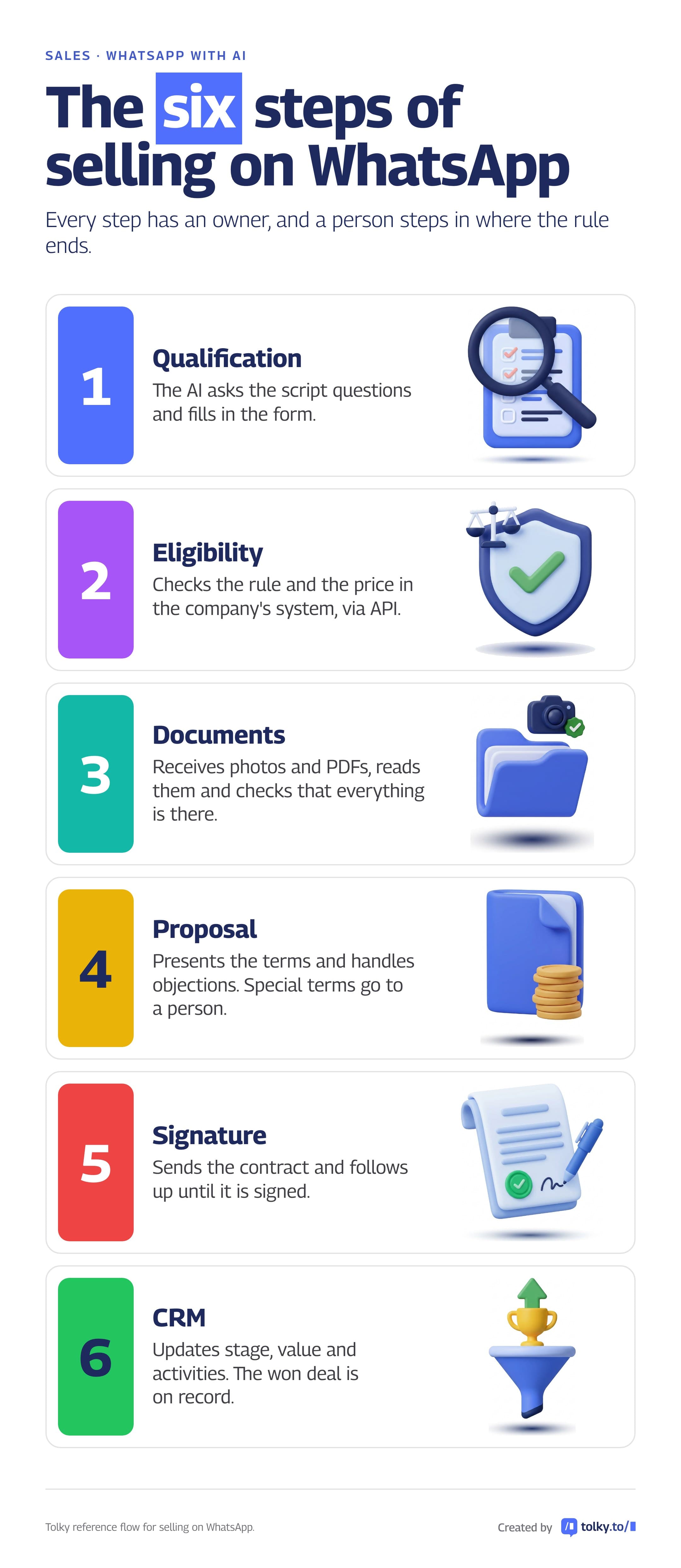 The six steps of selling on WhatsApp, with the AI leading and a person stepping in where the rule ends.
| Stage | What the AI does | Where the data comes from | Where a person steps in |
|---|---|---|---|
| Qualification | Asks the script questions and fills in the form | The chat | Off-profile lead with potential |
| Eligibility | Checks the rule and shares the result | Company system, via API | Borderline case or dispute |
| Documents | Receives, reads and checks everything is there | Photos and PDFs sent | Unreadable or mismatched document |
| Proposal | Presents terms and handles objections | Rate table, knowledge base | Request for special terms |
| Signature | Sends the contract and follows up | E-signature tool | Legal question |
| CRM | Updates stage, value and activities | Chat and integrations | Pipeline review |
Agents can be configured by mission: one to qualify, another to make the offer and handle objections. Each follows its own instructions, limits and knowledge base. We explain the design in single-agent or multi-agent architecture.
How does the AI know what it can offer?
The AI knows what to offer by querying the company's systems during the chat, not by guessing from generic text. Eligibility, price and availability of seats or policies come from the same source the salesperson would use.
In practice, the check is an API call or HTTP request made mid-conversation: the AI sends the customer's tax ID and stated income, and the system returns whether the person is eligible and on what terms. When the company has no API, the rule can live in the knowledge base, such as a price table by bracket, with a clear limit: the AI only states what is written there. Without integration, the AI becomes an FAQ; the reason is in AI without integration becomes an FAQ.
Three safeguards prevent wrong promises:
- Fixed answers for what is policy. Rates, terms, waiting periods and cancellation conditions come from approved text, not a generated sentence.
- Agent scope. The sales agent does not answer about other products or give financial advice. Out-of-scope messages are deflected.
- A record of every answer. For each AI message, the company must be able to see where the information came from: instruction, knowledge base excerpt or system call.
How do you receive and check documents in the chat?
The customer sends a photo or PDF of the document in the chat, the AI reads the content, checks that it is the requested document and that the data matches what was stated, and flags what is missing. The salesperson gets the complete file or the exact reason it is pending.


Ask only for what the sale requires. In Brazil, the LGPD, the national data protection law, sets necessity as a principle, limiting processing to the minimum needed for the purpose (art. 6, III, of Law No. 13,709/2018). An enrollment does not need the parent's bank statement; a loan might. Write the list per product and let the AI ask for exactly that.
When fraud risk is high, a document and a photo are not enough. Identity verification with a document, selfie and liveness check confirms that the person on the other side is the person in the document. We explain the precautions in the post on liveness checks with selfie and document.

Is a contract closed on WhatsApp legally valid?
In Brazil, a contract between private parties signed electronically is valid, and the signature method can be any one the parties accept as valid, as long as it proves authorship and integrity. That is what art. 10, § 2, of Provisional Measure No. 2,200-2/2001 says; it is in force and was checked on November 24, 2026.
Three points complete the picture:
- Signature types. Brazil's Law No. 14,063/2020 classifies electronic signatures as simple, advanced and qualified (art. 4), but the chapter on the subject applies to interactions with public bodies and does not apply to contracts between individuals or private companies (art. 2, sole paragraph). For private sales, choosing the type is a risk decision: the higher the value, the stronger the proof of authorship.
- Signature tool. In practice, the contract goes out as a link from an e-signature tool, which records who signed, when and from where. The WhatsApp chat keeps the history of the negotiation.
- Right of withdrawal. Under art. 49 of Brazil's Consumer Defense Code, consumers can withdraw within 7 days when the contract is made outside the business premises, such as by phone or at home. For e-commerce, Decree No. 7,962/2013 requires the supplier to state clearly and prominently how to exercise that right (art. 5). State the deadline and the way to withdraw in the contract and in the chat.
Regulated sectors such as lending and insurance have their own rules from Brazil's Central Bank (Banco Central) and insurance regulator (Susep) on offers, disclosure and contracting. This summary does not replace review by your legal and compliance teams.
Lending, insurance and enrollment: what changes in each
The process is the same in all three, but the data that drives the offer, the critical document and the point where a person steps in change.
Lending and financial services
The decision comes from the institution's eligibility rule, checked via API. The critical document is the ID, and strong verification makes sense before releasing the contract. The analyst steps in on borderline cases and disputes. For customer service in the sector, see chatbot for banks.
Insurance and vehicle protection
The quote depends on data about the insured item, collected in the chat, and on photos of the vehicle or property. The broker steps in when the customer wants to compare coverage or asks for terms outside the table. The guide on chatbots for insurers covers quotes, claims and renewals.
Education and enrollment
The offer depends on program, class, available seats and payment terms. The documents belong to the student and the parent, and the contract goes to the financially responsible party. The school office steps in for scholarships, transfers and exceptions. See conversational AI for education.
How do you measure WhatsApp sales with AI?
Measure conversion by stage, time from first contact to contract and the reason for each drop-off, not just total sales. The total hides where the journey stalls.
- Conversion by stage: how many qualified leads become eligible, how many eligible leads send documents, how many proposals become contracts.
- Time to contract: from first contact to signature, split by the time the lead arrived.
- Drop-off by reason: pending document, price, change of mind, no reply.
- Sales outside business hours: contracts closed at night and on weekends.
- Handoffs to the salesperson: by reason, to tune the agents' rules.
Why does the CRM need to track every stage?
The CRM needs to track every stage because it shows where the sale stops, and without that data the company cannot tell whether the problem is the offer, the document or the signature. With AI, the record comes from the chat, without the salesperson typing.
Each stage change becomes a move of the deal in the pipeline: qualified, eligible, documents complete, proposal sent, contract signed. Anyone who stopped midway gets an automatic follow-up or joins a win-back campaign. See the term conversational CRM and the guide on integrating AI with your CRM.
Where Tolky fits in WhatsApp sales
Tolky is a conversational AI CRM in which AI agents run the sale on the official WhatsApp, query the company's systems and update the CRM at every stage. The full design is on the WhatsApp Sales solution page.


- Agents by mission. Qualify, make the offer and handle objections, each agent with instructions, limits, fixed answers and protection against out-of-scope messages.
- System lookups. More than 1,000 apps in the integrations catalog, REST API, webhooks, HTTP requests and MCP tools.
- Documents read in the chat. The AI reads images, audio and documents the customer sends, and forms collect the script data.
- Signature by integration. The contract goes out through a catalog app, such as PandaDoc, or through the API of the e-signature tool you already use.
- Liveness Check. Document, selfie and liveness check in one link, no app needed. It is in early access.
- CRM without typing. Deal, stage and activities updated in the Tolky CRM or in the CRM you already use (native integration with HubSpot, Salesforce and Pipedrive (RD Station CRM and Pipefy through the API)), with follow-up for anyone who stopped midway.
- A record of every answer. The instructions, knowledge base excerpts and external calls behind each AI message.
Tolky handles the conversation and the CRM; credit decisions and insurance underwriting stay with the company's system and rules, queried through the integration. E-signature tools such as DocuSign or Clicksign connect through the API, webhooks, MCP tools and the Integration node in Flows.
Frequently asked questions
Can AI close a sale on WhatsApp on its own?
Yes, when the sale fits the rules the company defined: eligibility checked in the system, table pricing, standard documents and a single contract template. The company decides at which stage the salesperson steps in: in the negotiation, at closing or only for exceptions.
Is a contract signed through WhatsApp legally valid?
In Brazil, a contract between private parties signed electronically is valid when the method proves authorship and integrity and is accepted by the parties, under art. 10, § 2, of Provisional Measure No. 2,200-2/2001. In practice, the contract goes out as a link from an e-signature tool, and the chat keeps the history.
How does the AI check whether the customer qualifies for credit?
By checking the institution's eligibility rule during the chat, via API or HTTP request. The AI sends the data the customer provided and receives the system's result. It does not make the credit decision: it only reports what the system returned.
Can customers send documents over WhatsApp?
Yes. The customer sends a photo or PDF in the chat, and the AI reads it and checks that it is the requested document. Ask only for what the sale requires, as the LGPD necessity principle demands, and use selfie and liveness verification when fraud risk is high.
Can the customer cancel a contract closed on WhatsApp?
Yes. In Brazil, art. 49 of the Consumer Defense Code gives 7 days to withdraw from a contract made outside the business premises, counted from signing or from receiving the product or service. State this deadline in the contract and in the chat.
What is the difference between selling on WhatsApp and running the full sale with AI?
Selling on WhatsApp means using the channel to serve and negotiate, often by hand. The full sale with AI takes the customer to the contract in the same chat, with system lookups, documents, signature and an updated CRM, and leaves the salesperson for the exceptions.
Conclusion
A full WhatsApp sale with AI works when the rules are written down: who is eligible, which documents to ask for, which proposal to present and where the salesperson steps in. Connect the AI to the systems that drive the offer, use a signature tool that proves authorship, record every stage in the CRM and measure where the journey stalls.
Explore WhatsApp Sales, see the plans or talk to the team →. Let's talk?
Share
Tags
- whatsapp sales with ai
- close a contract on whatsapp
- sign a contract on whatsapp
- ai agents for sales
- consultative selling on whatsapp
- credit eligibility on whatsapp
- enrollment on whatsapp
- #conversational CRM
About the author

Co-founder of Tolky
Marlos Carmo is an AI entrepreneur and founder of Tolky, the conversational-era infrastructure and AI CRM that unifies intelligent service, multi-channel support (such as WhatsApp and voice), live CRM, and operational intelligence in a single ecosystem. He is a finalist for the SXSW Innovation Awards and a member of Francesco's Economy, a global network of young entrepreneurs focused on innovation and social impact. He works connecting Artificial Intelligence and digital transformation in projects for large organizations.
Next step
Want to bring this to your operation?
Tati, Tolky's AI assistant, understands your scenario in a few questions, suggests the best path and connects you with someone from the team, with full context.
Share